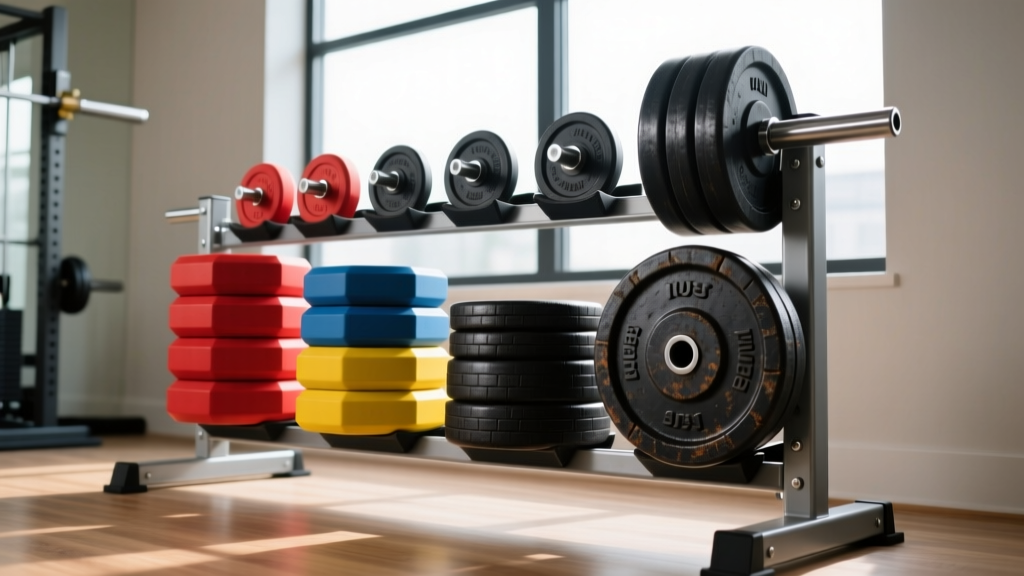
Bumper vs Iron Plates: The Golden Dumbbell Tarkov of Gym Layouts
Master your home gym layout. We compare bumper vs iron plates for space optimization, using Tarkov inventory logic to maximize your training footprint.

In the cult-classic extraction shooter Escape from Tarkov, securing a high-value, compact loot item like the legendary golden dumbbell requires meticulous inventory grid management. You are constantly weighing physical volume against functional value. When designing a high-density home gym in a constrained space—like a spare bedroom, narrow galley, or shared garage—you face the exact same spatial puzzle. Finding the real-life equivalent of that golden dumbbell tarkov loot drop means maximizing your gym's weight density without sacrificing usable floor plan.
For home gym architects in 2026, the most critical spatial decision you will make is choosing between bumper plates and cast iron plates. While both serve the fundamental purpose of loading a barbell, their volumetric footprints, storage requirements, and layout implications are drastically different. Let us break down the physics, geometry, and spatial optimization strategies for your free weight layout.
The Inventory Grid: Understanding Plate Density
Space optimization begins with understanding volumetric density. Cast iron is significantly denser than vulcanized rubber. This means that for any given weight increment, iron plates consume vastly less physical space on the barbell sleeve, the storage tree, and the floor. According to equipment analysts at BarBend, a standard 45lb cast iron plate is roughly 1.35 inches thick, whereas a standard 45lb bumper plate is uniformly 17.7 inches in diameter but can range from 2.15 to 3.25 inches thick depending on the manufacturing grade.
If your layout requires tucking equipment into tight alcoves or maximizing the loadable capacity of a standard Olympic barbell, iron is the undisputed king of spatial efficiency.
Dimensional Data: Bumper vs. Cast Iron Matrix
To visualize the spatial tax of rubber bumpers versus machined iron, review the dimensional matrix below based on standard 2026 commercial and home gym specifications (e.g., Rogue Echo vs. Rogue Machined Iron).
| Feature | 45lb Cast Iron (Machined) | 45lb Bumper (Standard Virgin Rubber) |
|---|---|---|
| Diameter | 17.7 inches (varies slightly by brand) | 17.7 inches (450mm IWF Standard) |
| Thickness (Width) | ~1.35 inches | ~3.25 inches |
| Volume per Pair | ~130 cubic inches | ~315 cubic inches |
| Max Pairs on 16.3" Sleeve | 6+ Pairs (540+ lbs) | 2-3 Pairs (Max 270-405 lbs) |
| Avg. Cost per Pound (2026) | $1.50 - $2.20 | $2.80 - $3.50 |
A standard Olympic barbell sleeve offers exactly 16.3 inches of loadable space. Loading three 45lb bumper plates per side eats up 9.75 inches, leaving room for collars. However, attempting to load heavy sets (e.g., 405 lbs) with bumpers causes dangerous sleeve overhang, altering the bar's whip and balance point. Iron plates allow you to load 500+ lbs safely within the sleeve boundary, a critical factor for advanced powerlifters in compact spaces.
Spatial Layout Scenarios: Which Plate Fits Your Room?
Your room's geometry and your training style dictate which plate type offers the best spatial ROI. As weightlifting educators at Catalyst Athletics note, bumpers are non-negotiable for Olympic weightlifting due to the dynamic dropping of the bar. But for pure spatial optimization, the choice is nuanced.
Scenario A: The Narrow Galley Gym (Iron Dominance)
If you are building a gym in a narrow basement corridor, a spare bedroom closet, or a low-ceiling attic, cast iron plates are your best tool for space optimization. Iron plates can be stored on ultra-compact wall-mounted plate holders that protrude only 6 to 8 inches from the wall. Furthermore, because iron plates are thinner, you can store a complete set (10s through 45s) on a single vertical weight tree tucked tightly into a corner, requiring a swing radius of less than 20 inches.
Scenario B: The Multi-Purpose Garage Drop-Zone (Bumper Necessity)
If your gym shares space with vehicles or features finished flooring that cannot withstand the kinetic shock of dropped iron, bumper plates are mandatory. While they consume more square footage on a weight tree, you can optimize this layout by utilizing A-frame horizontal storage racks rather than vertical trees. A-frames keep the bumpers low to the ground, preserving vertical clearance for overhead presses and keeping the visual weight of the room balanced.
Storage Footprint: Trees, Racks, and Wall Mounts
The true test of the golden dumbbell tarkov inventory philosophy is how the plates live when they aren't on the bar. The thickness of your plates dictates the hardware you must buy, which in turn dictates your floor plan.
- Vertical Weight Trees: Standard trees feature 10-inch or 12-inch pegs. A 12-inch peg holds roughly three 45lb bumpers or eight 45lb iron plates. If you buy bumpers, you must ensure your tree pegs are long enough to prevent the plates from sliding off the edge and damaging your floor.
- Wall-Mounted Plate Holders: Ideal for saving floor space. Iron plates can be stored on heavy-duty 8-inch wall pegs. Bumpers require 14-inch to 16-inch wall pegs, which protrude further into the room and create a larger "dead zone" where you cannot walk or place other equipment.
- Under-Bench Storage: Many modern power racks (like the Rogue SML-2C) feature integrated horn storage. Iron plates sit flush and compact against the uprights, whereas bumpers may extend past the rack's footprint, creating a tripping hazard in tight layouts.
The Decision Framework: Calculating Your Volumetric Limit
Before purchasing plates, run your space through this 3-step optimization framework:
- Map the Drop Zone: Measure the area where the barbell will be dropped. If you are within 2 feet of a shared wall, drywall, or a vehicle, you must use bumpers and invest in 3/4-inch horse stall mats to dampen acoustic and kinetic transfer.
- Calculate Sleeve & Peg Capacity: Tally your target max lift. Divide by 90 (two 45lb plates). If the resulting number of pairs exceeds 3, and you are using bumpers, you will need longer barbell sleeves (rare) or you must accept the spatial tax of iron plates for heavy loading.
- Audit the Storage Perimeter: Measure the wall space dedicated to storage. If you only have 24 inches of horizontal wall space, a vertical tree is required. If your ceiling height is under 7 feet, a horizontal A-frame is required. Match the plate thickness to the hardware that fits that specific geometric constraint.
Edge Cases and Failure Modes in Compact Spaces
Space optimization is useless if the equipment degrades due to poor spatial planning. Be aware of these real-world failure modes:
"Rubber has a memory. If you store bumper plates vertically on their edge in a hot, uninsulated garage for six months, the bottom edge will compress and 'taco' or warp, rendering them unstable when stacked horizontally later."
Iron Rust & Coatings: In humid, unclimate-controlled spaces (like coastal garages), bare cast iron will oxidize rapidly, staining your floors and ruining the knurling on your bars. To maintain spatial efficiency without sacrificing longevity, opt for urethane-coated iron plates. Urethane adds a mere 0.1 inches of thickness compared to rubber but offers near-total moisture resistance and zero odor, making it the ultimate hybrid for tight, multi-use rooms.
Bumper Edge Degradation: Cheap, recycled rubber bumpers will chunk and flake when dropped on concrete without proper matting. In a tight layout where the bar might strike a wall or rack upright during a missed lift, premium virgin rubber (like Rogue Echo Bumpers) is required to prevent black scuff marks and structural degradation.
Final Verdict: Securing the Loot
Optimizing a home gym layout is an exercise in spatial geometry and material science. Cast iron plates offer unmatched volumetric density, allowing for massive weight loads on standard sleeves and ultra-compact, low-profile wall storage. They are the ultimate space-savers for powerlifters and bodybuilders operating in tight, low-clearance rooms. Bumper plates, while spatially demanding, are non-negotiable for Olympic lifters, CrossFit athletes, and anyone training in multi-purpose living spaces where noise and floor preservation are paramount.
By treating your floor plan like a high-stakes inventory grid, you can select the exact plate composition that delivers maximum training value without compromising your living space. Choose your materials wisely, measure your pegs twice, and secure your layout.
More gear to consider
All reviews
2026 Dumbbell Racks for the Best Hamstring Exercise with Dumbbells
Bumper Plate vs Iron Plate Comparison: Progressing Beyond the Dumbbell Pilates Workout

Best Dumbbell Lower Back Exercises: Adjustable Dumbbell Mistakes
Heels Elevated Dumbbell Squat Trends & Kettlebell Buying Guide 2026

EZ Curl Bar vs Straight Bar vs Neutral Grip Dumbbell Press
