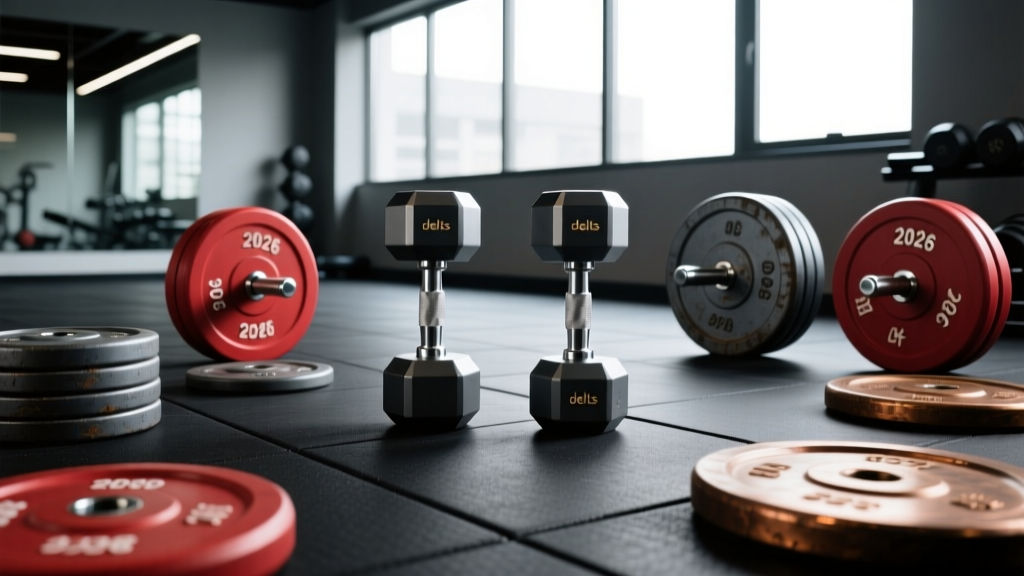
Bumper vs Iron Plates: 2026 Trends & Delts Dumbbell Workout Pairings
Analyze 2026 bumper vs iron plate market trends, pricing, and failure modes, plus how to pair your setup with a highly effective delts dumbbell workout.

The 2026 Free Weight Market: Bumper vs. Iron Plate Shifts
As we navigate the fitness equipment market in 2026, the debate between bumper plates and traditional cast iron plates has evolved from a simple preference of material to a complex calculation of biomechanics, home gym flooring preservation, and supply chain economics. During the pandemic-era boom, consumers bought whatever was in stock. Today, strategic home gym builders and commercial facility managers are making data-driven purchasing decisions based on durometer ratings, drop-cycle tolerances, and price-per-pound metrics.
According to recent industry manufacturing reports, the global shift toward polyurethane and high-density virgin rubber has stabilized, but pricing tiers have distinctly separated. Entry-level crumb rubber bumpers have largely been phased out of premium home gyms due to off-gassing complaints, replaced by mid-tier virgin rubber and high-end urethane options. Conversely, machined cast iron plates have seen a resurgence among powerlifters and Olympic weightlifters who prioritize rack space and thin plate profiles over noise reduction.
2026 Market Insight: The average cost of premium urethane bumper plates has settled at approximately $3.10 to $3.50 per pound, while standard enameled cast iron plates hover between $1.60 and $2.10 per pound. This 40-50% price gap forces buyers to adopt a hybrid allocation strategy, investing heavily in iron for heavy compound lifts while reserving budget for specialized isolation tools.Bumper Plate vs Iron Plate Comparison: Core Metrics
To understand where your capital is best deployed, we must examine the physical and economic differences between these two plate categories. The following matrix breaks down the critical specifications you need to evaluate before purchasing.
| Metric | Premium Bumper Plates (Urethane/Virgin Rubber) | Machined Cast Iron Plates |
|---|---|---|
| Shore A Durometer | 85-90 (Competition/Dead Bounce) | N/A (Rigid Metal) |
| Drop Rating | 10,000 to 30,000+ drops from 8ft | Low (Prone to floor/bar damage) |
| Avg Cost per Pound (2026) | $2.75 - $3.50 | $1.60 - $2.10 |
| Thickness (45lb/20kg Plate) | 3.0 to 3.5 inches | 1.2 to 1.5 inches |
| Hub Material | Stainless Steel or Chrome Insert | Cast Iron (sometimes machined steel) |
For Olympic weightlifting movements like the snatch and clean & jerk, bumper plates are non-negotiable. The International Weightlifting Federation (IWF) mandates specific dimensional tolerances and bounce characteristics that only calibrated rubber or urethane plates can provide. However, for powerlifting, bodybuilding, and general strength training, the thickness of bumper plates becomes a limiting factor. Loading a barbell with 400 lbs of bumper plates often maxes out the sleeve space, whereas thin machined iron plates allow for significantly heavier loads on standard Olympic bars.
Failure Modes & Edge Cases: When Plates Degrade
Understanding how equipment fails is the hallmark of an informed buyer. Both plate types have distinct failure modes that manifest over a 3-to-5-year lifecycle in a rigorous home or garage gym environment.
Bumper Plate Degradation
- Hub Separation: The most common failure point in lower-tier bumpers is the metal hub tearing away from the rubber matrix. This occurs due to repeated high-impact drops where the kinetic energy transfers directly to the steel insert. Premium 2026 models mitigate this with hooked steel inserts and multi-layer vulcanization.
- Edge Whitening and Cracking: Virgin rubber plates exposed to UV light and ozone (common in garage gyms) will oxidize, leading to edge whitening and eventual micro-cracking. Urethane plates resist this UV degradation far better, justifying their higher price point.
- Dead Bounce vs. Live Bounce: Cheaper crumb rubber plates exhibit a 'live bounce,' which can dangerously deflect a barbell back into the lifter's shins during a missed clean. Always verify the Shore A durometer rating; anything below 80 is considered high-bounce and unsafe for heavy Olympic drops.
Iron Plate Vulnerabilities
- Enamel Chipping and Oxidation: Standard painted or enameled cast iron plates will chip when clashed together, exposing the raw iron to humidity. In non-climate-controlled garages, surface rust can develop within weeks, degrading the plate's aesthetic and transferring rust dust to your hands and barbell sleeves.
- Calibration Drift: While the plates themselves do not lose mass, cheaper cast iron plates often have a weight variance of +/- 3%. For competitive lifters, this necessitates buying NSF Certified calibrated steel plates, which guarantee a +/- 10-gram tolerance but cost upwards of $5.00 per pound.
The Accessory Gap: Why Plates Aren't Enough for Hypertrophy
While a robust collection of iron or bumper plates forms the foundation of any strength program, barbell training inherently lacks the biomechanical freedom required for optimal joint isolation and unilateral hypertrophy. This is particularly true for the shoulder complex. The barbell overhead press is an excellent mass builder for the anterior deltoids and triceps, but it heavily restricts the scapular plane movement necessary to safely and effectively target the medial and rear deltoids.
This limitation is exactly why strategic home gym builders in 2026 are adopting a hybrid equipment model: investing in cost-effective iron plates for heavy squats, deadlifts, and presses, while reallocating the saved capital toward high-quality adjustable dumbbells. A targeted delts dumbbell workout is not merely an accessory afterthought; it is a biomechanical necessity for complete shoulder development and injury prevention.
"The medial deltoid functions primarily as an abductor of the humerus. A barbell cannot accommodate the natural arc of lateral abduction without placing excessive shear force on the acromioclavicular joint. Dumbbells allow the lifter to manipulate the moment arm and align the resistance curve with the muscle's natural strength profile." — Biomechanics Analysis, American Council on Exercise (ACE)
Integrating a Delts Dumbbell Workout into a Plate-Centric Gym
If you have opted for a budget-friendly iron plate setup to fund your dumbbell arsenal, the following 2026 hypertrophy protocol is designed to maximize all three heads of the deltoid. This routine leverages the unique resistance profiles that only free-weight dumbbells can provide.
1. Seated Dumbbell Overhead Press (Anterior & Medial Focus)
By performing this movement seated with a slight backward incline (75 degrees rather than a strict 90 degrees), you reduce the involvement of the upper pectorals and isolate the anterior deltoid while protecting the rotator cuff.
- Sets/Reps: 4 sets of 8-10 reps.
- Execution: Keep the elbows slightly tucked forward (in the scapular plane, roughly 30 degrees from the frontal plane). Do not flare the elbows directly out to the sides.
- Tempo: 2-0-1-1 (2 seconds eccentric, 1 second concentric, 1 second pause at the top).
2. Lean-Away Lateral Raises (Medial Deltoid Isolation)
The standard lateral raise suffers from a poor resistance curve; the tension on the medial delt is near zero at the bottom of the movement and maximal at the top. By leaning away from a rack or bench, you shift the gravity vector, introducing tension much earlier in the range of motion.
- Sets/Reps: 3 sets of 12-15 reps per arm.
- Execution: Hold a sturdy rack with your non-working hand and lean your torso away until your working arm is fully extended toward the floor. Raise the dumbbell until the arm is parallel to the floor, leading with the elbow.
- Edge Case: Avoid using momentum. If you must swing the weight, the load is too heavy, and the upper traps will hijack the movement.
3. Chest-Supported Incline Y-Raises (Rear Delt & Lower Trap)
Rear delts are notoriously underdeveloped in lifters who rely solely on barbell bench pressing and overhead pressing. The Y-raise targets the rear delts and the lower trapezius, crucial for scapular stability during heavy barbell lifts.
- Sets/Reps: 3 sets of 15-20 reps.
- Execution: Set an adjustable bench to a 30-degree incline. Lie face down with a light pair of dumbbells (10-15 lbs is often sufficient). Raise the weights up and outward at a 45-degree angle, forming a 'Y' shape with your body.
Budget Allocation Framework: Plates vs. Dumbbells
How should you divide a $2,000 equipment budget in 2026 to accommodate both heavy barbell work and a comprehensive delts dumbbell workout? Here is a proven allocation model for the modern home gym:
The Hybrid $2,000 Blueprint
- Olympic Barbell ($300): A 20kg dual-knurl stainless steel bar with 190k PSI tensile strength.
- Cast Iron Plate Set ($650): 300 lbs of machined, urethane-coated cast iron plates (approx. $2.15/lb). Coated iron prevents rust while keeping the profile thin.
- Adjustable Dumbbell Set ($800): A premium 5-50 lb or 5-80 lb adjustable dumbbell system (e.g., Nuobell or PowerBlock). This replaces 15+ pairs of fixed dumbbells, providing the exact increments needed for precise delts dumbbell workout progressions.
- Collars & Maintenance ($50): High-quality locking collars and 3-in-1 oil for barbell sleeve maintenance.
Final Market Verdict
The 2026 fitness equipment market clearly rewards the informed consumer. While bumper plates remain essential for Olympic weightlifting and high-impact functional fitness, machined iron plates offer superior space efficiency and cost-effectiveness for traditional strength and hypertrophy training. However, no plate collection can replace the biomechanical necessity of free-weight isolation. By strategically saving capital on your plate purchases, you can fund the adjustable dumbbells required to execute a flawless delts dumbbell workout, ensuring balanced muscular development, joint longevity, and a truly complete home gym ecosystem.
More gear to consider
All reviews
Overhead Shoulder Press Dumbbell vs Kettlebell: Cast vs Competition
Barbell Collar Types Compared & Rogue Rubber Hex Dumbbell Setups

Olympic vs Standard Plates: Serve the Platter Dumbbell Setup Guide
Complete Home Gym Setup: Racking Your 17.5 Dumbbells

Chest and Bicep Dumbbell Workout Upgrade: Barbell Knurling Mistakes
