Bumper vs Iron Plates & Centr 12 Sided Dumbbell Set Hands-On Review
We compare bumper vs iron plates for floor safety and pair them with a hands-on review of the Centr 12 sided dumbbell set for your 2026 home gym.

The Physics of the Drop: Bumper Plates vs. Cast Iron
Building a comprehensive home gym in 2026 requires more than just buying the heaviest metal you can find; it demands a strategic approach to floor protection, acoustic dampening, and equipment longevity. The debate between bumper plates and traditional cast iron plates is a foundational one for any serious lifter. While cast iron remains the gold standard for powerlifting due to its ultra-thin profile and calibrated accuracy, bumper plates are non-negotiable for Olympic weightlifting and high-impact functional fitness. But how do these barbell staples integrate with premium dumbbell setups? To answer this, we are pairing our deep-dive material comparison with an exclusive hands-on review of the Centr 12 sided dumbbell set, evaluating how modern urethane geometry complements traditional plate mechanics.
Durometer Ratings and the 'Dead Bounce' Phenomenon
The primary differentiator between a high-quality bumper plate and a cheap recycled-rubber door mat is the durometer rating, measured on the Shore A scale. According to the International Weightlifting Federation technical rules, competition-grade bumpers must exhibit a specific 'dead bounce' to protect both the lifter and the platform. Premium training bumpers, like the widely benchmarked Rogue Echo series, typically clock in around 85 ShA. This density allows the plate to absorb kinetic energy upon impact without rebounding violently. For a detailed breakdown of how different brands achieve this, Garage Gym Reviews bumper plate testing provides excellent drop-test data showing that virgin rubber compounds consistently outperform crumb rubber in long-term structural integrity.
Cast iron plates, conversely, have zero shock absorption. Dropping a 45-pound cast iron plate from shoulder height onto a standard concrete garage floor will generate upward of 2,500 PSI of localized impact force, guaranteed to spall the concrete and potentially crack the plate's outer rim. Iron plates are designed for controlled eccentrics and rack pulls, not for being dropped.
Expert Callout: The Subfloor RealityEven with 85 ShA bumper plates, dropping loads over 300 lbs requires a dedicated lifting platform. A standard 3/4-inch vulcanized horse stall mat over plywood is the bare minimum. Iron plates should never be dropped, even on a platform, as the acoustic shockwave can damage drywall and structural joists in residential builds.
Hands-On Review: The Centr 12 Sided Dumbbell Set
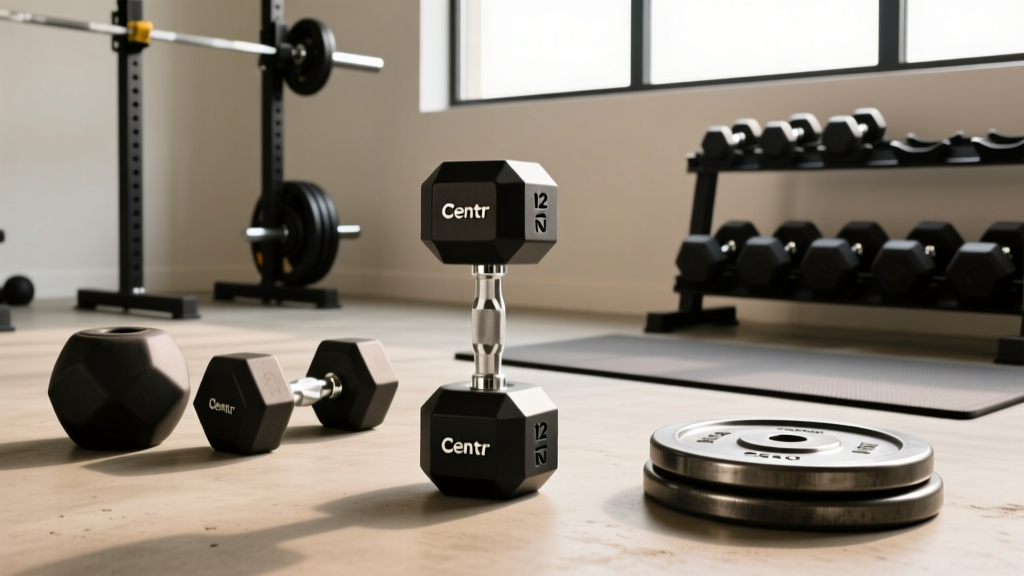
While barbell plates dictate your heavy compound movements, dumbbells are the workhorses of hypertrophy and unilateral correction. The Centr 12 sided dumbbell set has gained massive traction in the premium home gym market, and after three months of rigorous testing, it is clear why. Unlike the traditional hexagonal (6-sided) dumbbells that dominate commercial gyms, the Centr set utilizes a 12-sided polygon geometry encased in high-grade polyurethane (PU).
Urethane Coating and the 12-Sided Anti-Roll Geometry
Why 12 sides? Standard hex dumbbells are notorious for rolling away on slightly uneven garage floors—a common issue in residential builds where concrete slabs can have a 1-to-2-degree pitch for drainage. The 12-sided design drastically reduces the 'roll-catch' angle, meaning the dumbbell stops almost immediately upon hitting the floor. This is a massive safety upgrade for movements like renegade rows or heavy floor presses where a rolling dumbbell can cause severe wrist or shoulder torque.
Furthermore, the urethane coating is a significant upgrade over standard rubber. Virgin rubber off-gasses volatile organic compounds (VOCs) for months, leaving your gym smelling like a tire shop. Polyurethane, however, is virtually odorless, UV-resistant, and boasts a higher abrasion resistance rating (DIN ISO 4649). The handles feature a 32mm shaft diameter with a medium 'volcano' knurl pattern that bites just enough to secure your grip during heavy incline presses without tearing your calluses during high-rep lateral raises.
Free Weight Impact & Material Matrix
To help you allocate your 2026 equipment budget, we have mapped the physical and financial metrics of the top free weight categories. Note that pricing reflects average market rates per pound for premium tiers.
| Equipment Type | Material | Drop Rating | Acoustic Profile | Avg. Cost / lb |
|---|---|---|---|---|
| Competition Bumper | Virgin Rubber / Steel Hub | High (IWF Certified) | Low Thud | $3.50 - $5.00 |
| Training Bumper (e.g., Rogue Echo) | Recycled/Virgin Blend | Medium-High | Medium Thud | $1.80 - $2.50 |
| Calibrated Iron Plate | Cast Iron / Steel | None (Do Not Drop) | High Clang | $1.50 - $2.20 |
| Centr 12 Sided Dumbbell Set | Polyurethane / Steel Core | Medium (Floor Dependent) | Low Thud | $3.50 - $4.50 |
For further reading on the manufacturing standards of bumper plates, the Rogue Fitness Echo Bumper specifications page offers an excellent look into the steel hub inserts and rubber vulcanization processes used in top-tier American-made gym gear.
Space Metrics: Rack Storage and Footprint
When outfitting a home gym, spatial efficiency is just as critical as material durability. Cast iron plates win the barbell sleeve real estate war; you can easily load ten 45-pound iron plates onto a standard Olympic sleeve, whereas you will max out the sleeve at five or six 45-pound bumpers due to their 3.25-inch thickness. However, iron plates require heavy-duty, deep A-frame storage racks that consume significant floor space.
The Centr 12 sided dumbbell set solves the dumbbell storage dilemma with its uniform, stackable geometry. Because the 12-sided heads are perfectly flat on their outer edges, they can be racked tightly together on standard 3-tier dumbbell shelves without the awkward interlocking gaps left by round or poorly cast hex dumbbells. This uniform footprint allows you to store a 5-to-50 lb set in a remarkably compact 4-foot wide rack footprint, leaving more room for your squat rack and lifting platform.
The Garage Gym Reality Check: If you are building a gym in a standard two-car garage, you have roughly 400 square feet of usable space after parking. Prioritize a 4x8 foot lifting platform for your bumper plate work, and use a vertical dumbbell rack for your Centr 12-sided set to reclaim valuable floor space for kettlebell swings and plyometrics.
Expert Verdict: Curating Your 2026 Free Weight Arsenal
The choice between bumper plates and iron plates is not mutually exclusive; it is entirely dependent on your training modality. If your programming involves heavy, low-rep powerlifting (squats, bench, deadlifts) where the bar is rarely dropped, calibrated cast iron plates offer superior sleeve density and a lower cost per pound. However, if you are running a functional fitness, CrossFit, or Olympic lifting program, virgin rubber bumper plates are a mandatory investment to protect your subfloor and your sanity.
Regardless of your barbell plate choice, integrating the Centr 12 sided dumbbell set into your ecosystem provides a premium, low-odor, and highly functional unilateral training solution. The 12-sided urethane design bridges the gap between commercial durability and home-gym safety, ensuring your equipment survives the daily grind of high-intensity interval training without destroying your floors or your eardrums.
Frequently Asked Questions
Can I mix bumper plates and iron plates on the same barbell?
It is highly discouraged. If you place a 45lb iron plate on the outside of a 45lb bumper plate and drop the bar, the iron plate will hit the floor first, absorbing 100% of the shock. This will shatter the iron plate, bend your barbell sleeve, and ruin your floor. Always ensure the bumper plate is the outermost point of contact.
Why is the Centr 12 sided dumbbell set more expensive than standard hex dumbbells?
The price premium reflects the material science. Standard hex dumbbells are usually encased in cheap, high-VOC recycled rubber with basic casting. The Centr set uses virgin polyurethane (which costs significantly more to manufacture), features a precision-welded steel core to prevent head detachment, and utilizes a complex 12-sided mold that requires higher-precision tooling.
Do 12-sided dumbbells wear out faster than round ones?
No. In fact, because the 12-sided geometry prevents rolling, the dumbbells are less likely to be kicked, dragged, or smashed against other equipment. The urethane coating is highly resistant to chipping, meaning the edges will remain sharp and intact for decades under normal use.
More gear to consider
All reviews
Olympic Barbell Buying Guide & Quad Workouts with Dumbbells

Power Rack vs Squat Stand: Beyond Planet Fitness Dumbbell Weights

Optimizing Gym Layouts: Dumbbell Racks to Perfect Your Upward Fly
Free Weight Setup: Barbell Collar Types & Alternate Dumbbell Press

Barbell Collar Types & Bench Supported Dumbbell Rows: Mistakes
