Budget Dumbbell Racks: Value Analysis & Protecting the Dumbbell Pullovers Muscles Worked
A 2026 budget breakdown of dumbbell racks, analyzing value, footprint, and safe storage mechanics for fatigued muscles post-isolation exercises.

The Hidden Biomechanical Cost of Cheap Dumbbell Storage
When outfitting a home gym on a budget, the dumbbell rack is often the last item to receive serious financial consideration. Lifters typically allocate their funds toward the weights themselves, relegating storage to whatever cheap steel shelving is available. However, this approach ignores a critical intersection of biomechanics, facility safety, and long-term equipment value. Improper storage doesn't just clutter your space; it introduces severe injury risks during the racking phase of your workout.
Consider the dumbbell pullovers muscles worked during a heavy set: the latissimus dorsi, pectoralis major, serratus anterior, and the long head of the triceps. When these primary movers and stabilizers are pushed to near-failure, your overhead pressing and pulling mechanics are temporarily compromised. Hoisting an 80-pound hex dumbbell back onto a poorly designed, waist-height shelf or an unstable vertical A-frame requires immense stabilizer recruitment. According to biomechanical analyses from ACE Fitness, the shoulder complex is highly vulnerable when the lats and pecs are fatigued, making the act of 'racking' heavy weights just as dangerous as the lift itself if the storage solution lacks ergonomic foresight.
In this 2026 value analysis, we break down the budget dumbbell rack market, evaluating not just the upfront dollar cost, but the 'biomechanical tax' and spatial economics of each tier.
2026 Tiered Budget Breakdown: Finding True Value
Tier 1: The Vertical A-Frame (Under $100)
The vertical A-frame rack, such as the ubiquitous CAP Barbell A-Frame Dumbbell Rack, remains the default choice for budget-conscious lifters. Priced between $75 and $95, it offers a minimal footprint (roughly 2.5 square feet) and can technically hold up to 500 pounds.
- Value Proposition: Unbeatable price-to-capacity ratio for light-to-medium dumbbell sets (5–50 lbs).
- The Failure Mode: Asymmetric loading. If you place 50-pound dumbbells on the bottom left tier and 20-pound dumbbells on the top right, the center of gravity shifts dangerously. Racking heavy weights at chest or eye level with fatigued stabilizers dramatically increases the tipping hazard.
- Verdict: Only viable for neoprene or light rubber hex sets under 40 lbs. Not recommended for heavy compound or isolation movements where grip and lat fatigue are factors.
Tier 2: The 2-Tier Horizontal ($150 - $250)
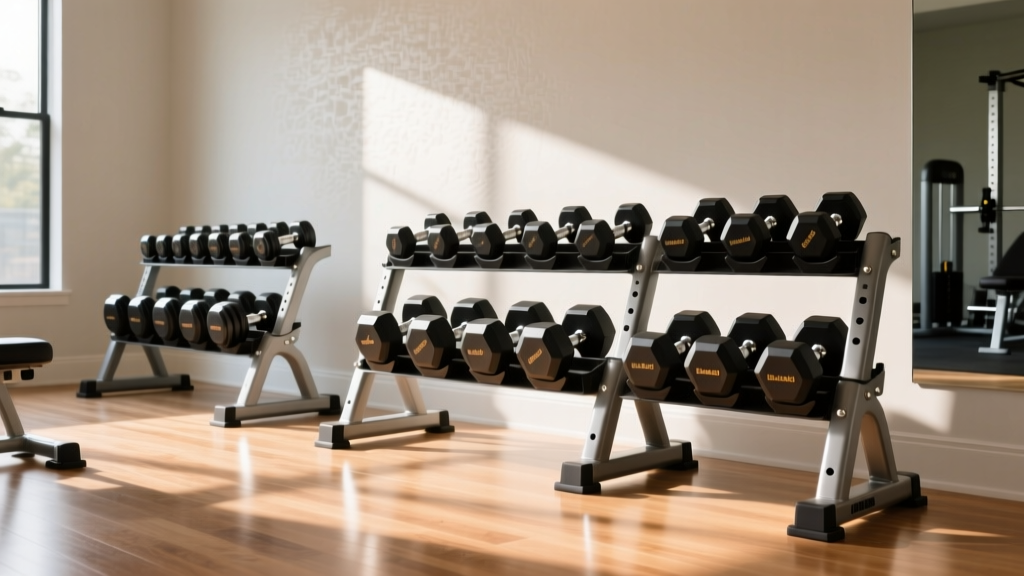
Horizontal 2-tier racks, like the Yes4All or Marcy 2-Tier models ($160–$210), represent the sweet spot for intermediate home gyms. These racks store 10 to 15 pairs of dumbbells across two shelves, typically positioned at shin-height and hip-height.
- Value Proposition: Drastically improves racking ergonomics. By keeping the heaviest dumbbells (60–100 lbs) on the bottom tier, you can deadlift or hinge them into place rather than pressing them overhead with exhausted shoulders.
- The Failure Mode: The bottom shelf often sits just 4 to 6 inches off the floor. This creates a severe toe-stubbing hazard and makes retrieving the heaviest pairs mechanically awkward, requiring a deep, rounded-back squat to grab them.
- Verdict: Excellent value for garages with ample floor space, provided you practice proper hip-hinge retrieval techniques.
Tier 3: The 3-Tier Commercial Grade ($300 - $550)
Stepping into the premium budget tier, we find 3-tier horizontal racks constructed from 11-gauge or 7-gauge steel, such as the Rogue Fitness 3-Tier Dumbbell Rack or the Titan Fitness equivalent ($399–$525). These units are engineered to hold 1,000+ pounds and feature angled top shelves and optimized tray spacing.
- Value Proposition: True ergonomic alignment. The three tiers map perfectly to human biomechanics: bottom tier for heavy hinge-retrieval, middle tier for standard hip-level racking, and an angled top tier for lighter isolation weights (like those used for triceps extensions or lighter pullovers) that can be safely racked with compromised grip strength.
- The Failure Mode: Spatial footprint. These racks consume 6 to 9 square feet of floor space and require 36 inches of clearance for safe maneuvering.
- Verdict: The highest long-term ROI. The heavy-duty steel prevents the shelf-bowing seen in cheaper racks when storing wide urethane dumbbells.
When budgeting for a rack, account for the width of your dumbbells. Urethane dumbbells (especially 12-sided or round varieties) are often 15-20% wider than standard cast-iron hex dumbbells of the same weight. A 'budget' 2-tier rack designed for 10 pairs of hex bells may only safely fit 7 pairs of urethane, destroying your calculated cost-per-pair value.
Comparative Value & Ergonomics Matrix
To quantify the value beyond the sticker price, we evaluate these racks based on spatial efficiency and ergonomic safety. The NSCA guidelines on facility layout emphasize that equipment placement must minimize hazardous transit paths and awkward joint angles during racking.
| Rack Tier / Type | Avg Price (2026) | Max Capacity | Footprint | Ergonomic Racking Score (1-5) |
|---|---|---|---|---|
| Tier 1: Vertical A-Frame | $85 | 500 lbs | 2.5 sq ft | 2 (High shoulder strain risk) |
| Tier 2: 2-Tier Horizontal | $185 | 800 lbs | 6.0 sq ft | 4 (Good for heavy, poor for toes) |
| Tier 3: 3-Tier Heavy Duty | $450 | 1,200+ lbs | 8.5 sq ft | 5 (Optimal biomechanical mapping) |
| Wall-Mounted Shelves (DIY) | $120 (Materials) | 400 lbs | 0.0 sq ft (Floor) | 3 (Requires heavy wall anchoring) |
Calculating the 'Cost Per Square Foot' Metric
In 2026, the true cost of home gym equipment includes the real estate it occupies. If you are paying a premium for a dedicated garage build-out or spare room, floor space is at a premium.
A 3-Tier rack costs roughly $350 more than an A-Frame, but it holds triple the weight and maps to the natural dumbbell pullovers muscles worked fatigue curve, allowing you to safely rack weights without stepping backward into a crowded gym floor. Conversely, if your gym is a tight 10x10 spare bedroom, the A-Frame or a custom wall-mounted heavy-duty shelf system (using 2x6 lumber and structural lag bolts into studs) offers a superior spatial ROI, despite the lower ergonomic racking score.
Expert Decision Framework: Which Rack Fits Your Budget?
Use this step-by-step logic tree to finalize your storage investment:
- Audit Your Heaviest Pair: If your max dumbbells exceed 70 lbs, immediately eliminate Tier 1 (A-Frames). The tipping moment generated by hoisting 70+ lbs to the second or third tier of a lightweight vertical rack is a severe liability.
- Assess Your Exercise Selection: If your programming heavily features isolation movements that exhaust the stabilizers (e.g., chest flyes, lateral raises, and pullovers), prioritize a horizontal rack with a mid-tier shelf positioned exactly at your hip crease. This allows you to 'bump' the dumbbell onto the rack using your hips and glutes rather than relying on exhausted lats and rotator cuffs.
- Measure the 'Swing Zone': Ensure you have at least 30 inches of clearance in front of the rack. Racking heavy weights requires a step-back; if you are hitting a squat rack or wall behind you, the budget rack's footprint is misleading.
The Bottom Line: A budget dumbbell rack is only a 'value' if it protects your joints and your floor. Spending an extra $150 on a 2-tier or entry-level 3-tier horizontal rack pays for itself the first time you safely rack a heavy pair of dumbbells with completely fatigued lats, avoiding a potential rotator cuff injury that would cost thousands in physical therapy.
More gear to consider
All reviews
Dumbbell Side Bend Good or Bad? Form Tips & Rack Layout Guide
Neoprene Dumbbell Setup & Exercises with Dumbbells for Flabby Arms
Olympic Barbell Knurling Guide: Pairing Steel With Beige Dumbbells

Cast Iron vs Competition Kettlebells vs a 75 Pound Dumbbell

Setting Up a Dumbbell Pull Back Station: Olympic vs Standard Plates