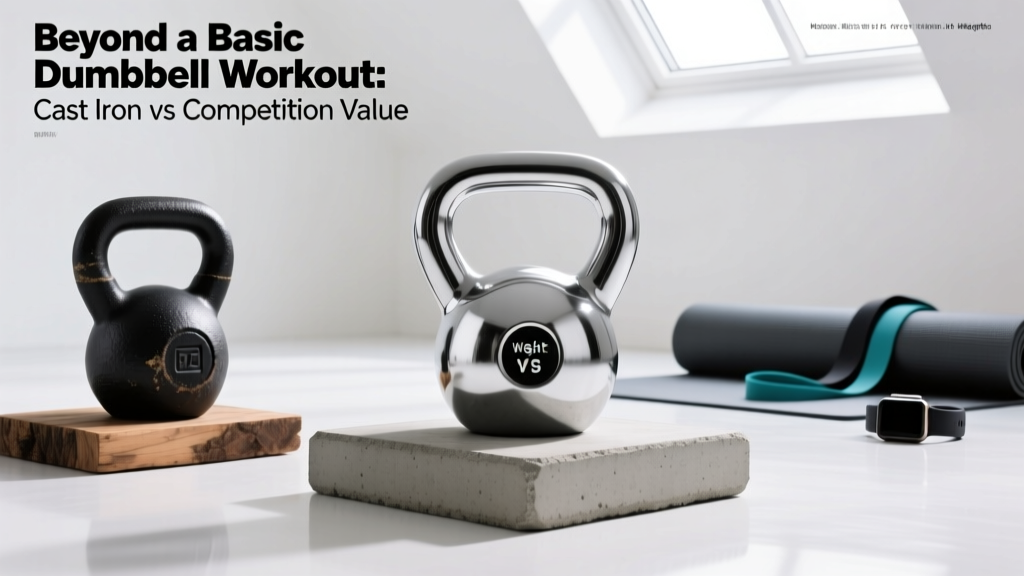
Beyond a Basic Dumbbell Workout: Cast Iron vs Competition Value
Compare cast iron vs competition kettlebells for your home gym. We break down the budget, value, and how they upgrade a basic dumbbell workout.

Transitioning from a basic dumbbell workout routine to kettlebell training is one of the most effective ways to introduce ballistic power, grip endurance, and offset-load core stability into your home gym regimen. While adjustable dumbbells and hex bells are exceptional for foundational hypertrophy, they lack the biomechanical offset required for movements like the kettlebell swing, snatch, and Turkish get-up. However, as you look to upgrade your free weight arsenal in 2026, you will immediately face a critical purchasing decision: do you buy traditional cast iron kettlebells or invest in premium competition-grade steel?
This budget breakdown and value analysis will dissect the real-world costs, dimensional differences, and long-term durability of cast iron versus competition kettlebells, helping you build a hybrid rack that maximizes every dollar.
The Baseline: Cost of a Basic Dumbbell Workout Setup
Before analyzing kettlebells, we must establish the baseline. A standard home gym basic dumbbell workout setup usually relies on a pair of adjustable dumbbells (like the Bowflex 552 at $399) or a set of rubber hex dumbbells (averaging $2.00 to $2.50 per pound). While excellent for pressing and rowing, these tools cannot safely or comfortably accommodate high-velocity hip hinges. Kettlebells fill this gap, but their pricing structure is vastly different depending on the manufacturing method.
The Cast Iron Kettlebell: The Budget-Conscious Workhorse
Cast iron kettlebells are poured into molds as a single, solid piece of iron. They are the undisputed kings of budget-friendly home gyms. As freight surcharges have largely stabilized in 2026, the cost-per-pound on raw cast iron has returned to historical norms, making them an incredibly high-value purchase for heavy, grinding movements.
Pricing and Value Proposition
On average, premium cast iron kettlebells cost between $1.50 and $2.50 per pound. For example, a 24kg (53 lb) cast iron bell from Rogue Fitness or Rep Fitness will typically retail between $85 and $115. This makes them ideal for heavy goblet squats, strict presses, and farmer's carries where dimensional consistency is less critical than raw load.
The Drawbacks: Dimensional Inconsistency
The primary flaw of standard cast iron is that the physical size of the bell scales with its weight. A 12kg cast iron kettlebell is significantly smaller than a 32kg bell. This creates two major issues:
- Handle Diameter Variance: Cheaper cast iron bells often feature thinner handles on lighter weights (28mm-30mm) and thicker handles on heavier weights (35mm+). This forces your grip to adapt to different tools, disrupting muscle memory.
- Base Flatness: Many budget cast iron bells (such as those found in big-box sporting goods stores) have rounded or uneven bases. If you attempt renegade rows or push-ups on the handles, the bell will roll, creating a severe wrist-injury hazard.
Competition Kettlebells: The Premium Standard
Competition kettlebells are manufactured from hollow steel shells, often filled with a proprietary mixture of sand and ball bearings to achieve the target weight. Their defining feature is absolute dimensional uniformity. Whether you are holding an 8kg (17.6 lb) bell or a 32kg (70.4 lb) bell, the physical dimensions remain exactly the same.
Why Pay the Premium?
According to the specifications standardized by international kettlebell sport federations, a true competition bell measures exactly 280mm in height, 210mm in width, and features a 33mm handle diameter. Brands like Kettlebell Kings and Eleiko adhere strictly to these tolerances.
This uniformity is non-negotiable for technical, high-repetition ballistic movements. When performing a kettlebell snatch, the bell must flip over your wrist and rest in the 'rack' position against your forearm. If you practice with a 16kg cast iron bell and then switch to a 24kg cast iron bell, the change in handle thickness and horn width will alter your timing, bruise your forearm, and ruin your technique. Competition bells eliminate this variable.
Expert Insight: "The 33mm handle diameter on competition bells is the goldilocks zone for human grip mechanics. It allows the bell to rotate smoothly in the palm during cleans and snatches without tearing the calluses, a common failure mode when using thicker, unregulated cast iron handles."
Data Matrix: Cast Iron vs. Competition Breakdown
To visualize the budget and specification differences, review the comparison matrix below based on average 2026 market pricing for a 16kg (35 lb) and 24kg (53 lb) bell.
| Feature | Premium Cast Iron (e.g., Rogue V2) | Competition Steel (e.g., KB Kings) |
|---|---|---|
| 16kg Price | ~$75.00 ($2.14/lb) | ~$109.00 ($3.11/lb) |
| 24kg Price | ~$110.00 ($2.07/lb) | ~$149.00 ($2.81/lb) |
| Handle Diameter | Varies (32mm - 35mm) | Uniform 33mm |
| Bell Dimensions | Scales with weight | 280mm x 210mm (Always) |
| Base Flatness | Machined flat (Premium brands only) | Perfectly flat |
| Best Use Case | Heavy grinds, squats, carries | Snatches, cleans, sport technique |
The Hybrid Budget Framework: Building Your Rack
You do not need to choose just one type. The smartest home gym owners in 2026 utilize a hybrid approach, leveraging the strengths of both styles while mitigating their respective costs. Here is a step-by-step purchasing framework based on your available budget.
- The $250 'Essentials' Tier: Skip the competition bells for now. Purchase a 16kg and a 24kg premium cast iron kettlebell. This provides enough weight for heavy goblet squats and farmer's carries, while still allowing you to learn the basic mechanics of the swing. This setup vastly outperforms a standard basic dumbbell workout for posterior chain development.
- The $500 'Hybrid Athlete' Tier: Buy a single 16kg or 20kg competition kettlebell for technical skill work (cleans, snatches, and presses) where handle consistency is paramount. Supplement this with a heavy 28kg or 32kg cast iron bell for raw strength grinds. This gives you the best of both worlds without paying the competition premium on a weight you only use for low-rep squats.
- The $1,000+ 'Sport & Mastery' Tier: Commit fully to competition kettlebells. Purchase a matched set (e.g., 12kg, 16kg, 20kg, 24kg) from a single manufacturer to ensure the paint texture, horn width, and internal fill are identical across your entire rack.
Real-World Failure Modes & Edge Cases
When analyzing value, you must consider how the equipment fails over time. Both styles have specific edge cases that can cost you money if ignored.
Cast Iron: The Coating and Rust Edge Case
Most cast iron bells are finished with a basic enamel or powder coat. If you train in an unclimate-controlled garage gym, the high humidity will eventually cause the iron to oxidize beneath the coating, leading to flaking paint and rust spots. Solution: Keep a wire brush and a bottle of 3-in-One oil in your gym. A quick monthly wipe-down prevents structural degradation.
Competition Steel: The Horn-Chipping Hazard
Competition kettlebells are painted in strict color codes (e.g., Yellow for 16kg, Green for 24kg) over a steel shell. If you drop a competition bell from overhead onto a bare concrete floor, the steel shell will not break, but the paint on the 'horns' (the sides of the handle) will chip and flake off. This creates sharp, jagged edges that will tear your hands during high-rep snatches. Solution: Competition bells must be used over horse stall mats or specialized drop pads. Never drop them on raw concrete.
Final Verdict: Maximizing Your Free Weight Investment
Upgrading from a basic dumbbell workout to a dedicated kettlebell practice is a masterclass in functional fitness. If your primary goal is general conditioning, heavy lifting, and budget efficiency, high-quality cast iron kettlebells from reputable brands offer an unbeatable return on investment. However, if you are pursuing kettlebell sport, focusing on high-repetition ballistics, or simply demand perfect biomechanical consistency across all weight classes, the premium price of competition steel is entirely justified.
By understanding the exact dimensions, pricing structures, and failure modes outlined above, you can bypass the marketing hype and build a free weight rack that perfectly aligns with your training goals and financial boundaries.
More gear to consider
All reviews
Olympic vs Standard: How to Get a Bigger Chest Using Dumbbells

Troubleshooting Dumbbell Press Variations: Olympic vs Standard Plates

Rubber Hex vs Urethane for the Dumbbell Bent-Over Lateral Raise

Budget Dumbbell Racks for a Quick 5 Minute Arm Workout with Dumbbells
Best Racks for Your Workout Plan With Dumbbells in 2026
