Smart Dumbbell Storage: Space for Step Ups With One Dumbbell
Optimize your home gym layout with smart dumbbell storage solutions. Learn how to maximize floor space for functional movements and unilateral exercises.

The Spatial Paradox of the Modern Home Gym
As we navigate the fitness landscape in 2026, home gym design has shifted dramatically. The era of hoarding every piece of cast iron available has been replaced by a focus on spatial fluidity and functional movement. Lifters no longer just want a room full of weights; they want a dynamic training environment. However, a major bottleneck in compact gym design is the storage of free weights. Bulky dumbbell racks can consume up to 15% of a standard two-car garage gym's usable floor space, severely limiting your ability to perform dynamic, unilateral exercises.
This spatial constraint becomes glaringly obvious when you attempt to perform functional, full-range movements. For example, executing step ups with one dumbbell requires significantly more clearance than a static bilateral lift. If your floor plan is choked by an oversized, poorly placed three-tier dumbbell rack, you compromise both your training efficacy and your safety. Optimizing your dumbbell storage is not just about organization; it is a critical prerequisite for creating the necessary clearance zones for athletic movement.
The Biomechanical Footprint of Unilateral Training
To understand why storage optimization matters, we must first quantify the space required for functional training. When an athlete performs step ups with one dumbbell, the biomechanical footprint extends far beyond the physical dimensions of the plyo box or bench being used.
Unilateral training demands a wider base of support and greater lateral stabilization than bilateral exercises, fundamentally altering the spatial requirements of the lifting zone.
According to biomechanical analyses from ExRx.net, the dumbbell step-up involves significant contralateral loading. When you hold a heavy dumbbell in one hand and step up, your body must counterbalance the asymmetrical load. This creates a lateral sway and a forward momentum shift.
Calculating the Clearance Zone
- The Box Footprint: A standard 3-sided plyo box takes up roughly 4 square feet.
- The Swing Radius: The loaded arm requires a 2-foot lateral clearance to prevent knurling from scraping walls or adjacent racks.
- The Dismount Zone: Stepping down and backward under load requires an additional 3 feet of unobstructed floor space to absorb impact and stabilize the pelvic tilt.
Therefore, to safely perform step ups with one dumbbell, you need a dedicated 4x8 foot clearance zone. If your dumbbell storage is not optimized and pushed into this zone, you are forced to alter your movement mechanics, which research published in the National Center for Biotechnology Information (NCBI) shows can lead to compensatory movement patterns and increased risk of knee or hip impingement over time.
Rack Typologies and Spatial Economics
Choosing the right storage solution requires analyzing the 'spatial economics' of your gym. Below is a breakdown of the most common dumbbell storage configurations available in 2026, evaluated by their footprint and utility.
| Storage Type | Footprint (Sq Ft) | Max Capacity | Avg 2026 Cost | Space Efficiency |
|---|---|---|---|---|
| 3-Tier A-Frame Rack | 12.5 sq ft | 5-50 lb pairs | $450 - $650 | Low |
| Vertical Dumbbell Tower | 4.0 sq ft | 5-50 lb pairs | $250 - $350 | High |
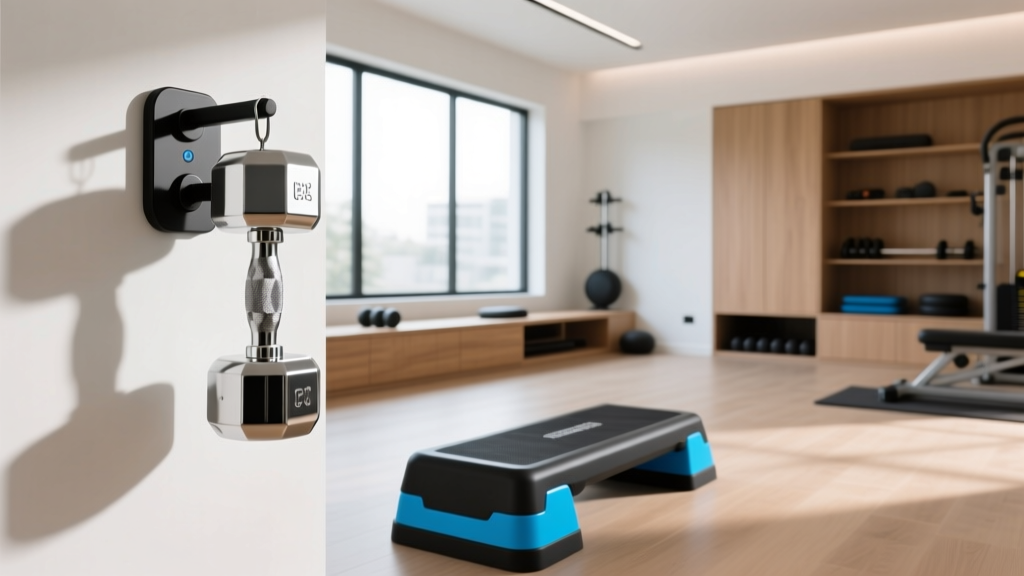
| Wall-Mounted Saddle Brackets | 0.0 sq ft (Floor) | 5-25 lb pairs | $120 - $200 | Maximum |
| Adjustable Dumbbell Set | 1.5 sq ft | 5-50+ lbs (dial) | $350 - $500 | Maximum |
Deep Dive: The 3-Tier A-Frame
The traditional 3-tier A-frame (like the Rogue 3-Tier Dumbbell Rack, measuring 44.5 x 24 x 51 inches) is the gold standard for commercial gyms but a spatial nightmare for micro-gyms. While it offers excellent visibility and easy access, the 24-inch depth and angled shelves mean it protrudes into walking paths. Furthermore, the urethane saddles on cheaper 2026 models often suffer from delamination after 18 months of heavy use, leaving sharp metal edges that can tear the rubber coating on your dumbbells.
The Vertical Tower Alternative
Vertical towers, such as the REP Fitness Vertical Dumbbell Rack, reduce the footprint to a mere 24x24 inch square. By stacking the weights vertically, you reclaim up to 8 square feet of floor space—exactly enough to create the dismount zone needed for step ups with one dumbbell. However, vertical racks introduce a unique failure mode: asymmetrical tipping. If a user loads the top tiers with 50-pound dumbbells while the bottom tiers are empty, the center of gravity shifts dangerously high. Always anchor vertical towers to the floor or a wall stud if your layout places them near high-traffic movement zones.
Strategic Layout Zoning: The Triangle of Movement
Space optimization is not just about the size of the rack; it is about where you place it. In compact gym design, we utilize a framework called the 'Triangle of Movement' to ensure functional exercises are never bottlenecked by storage equipment.
The Triangle of Movement Framework
Point A (The Anchor): Your squat rack or rig. This is the heaviest, most permanent fixture.
Point B (The Storage): Your dumbbell and kettlebell racks.
Point C (The Functional Zone): The open floor space for plyo boxes, sleds, and unilateral movements.
The Rule: Point B must never intersect the sightline or swing-radius between Point A and Point C. Place your dumbbell storage against a solid, windowless wall, leaving the center of the room entirely clear for Point C.
By pushing a vertical dumbbell tower into a corner or utilizing wall-mounted brackets, you preserve the central 8x10 foot area of your gym. This open expanse allows you to seamlessly transition from heavy goblet squats at the rig to step ups with one dumbbell on a 24-inch box, without having to shuffle equipment out of the way mid-superset.
Edge Cases and Storage Failure Modes
When designing your layout, beware of these common equipment and spatial failure modes that compromise both safety and space:
- The 'Swing Zone' Collision: Never place a dumbbell rack adjacent to a kettlebell training area. The arc of a heavy kettlebell swing extends up to 4 feet behind the athlete. A misplaced dumbbell rack in this zone is a severe impact hazard.
- Wall-Mount Stud Failure: If you opt for wall-mounted storage to save floor space, ensure you are mounting into structural studs, not just drywall. A pair of 40-pound dumbbells exerts over 100 lbs of sheer force on the bracket. Use 3/8-inch lag screws driven at least 2.5 inches into the center of the stud.
- Rubber Degradation on Angled Shelves: On budget A-frame racks, the constant friction of dragging rubber hex dumbbells up angled metal rails will eventually strip the rubber casing. Look for racks with replaceable UHMW (Ultra-High Molecular Weight) polyethylene saddle guards to protect both the rack and your weights.
The Ultimate Space Saver: Adjustable Dumbbells
If your primary goal is maximizing floor space for functional movements like step ups with one dumbbell, the most effective storage solution is to eliminate the rack entirely. In 2026, adjustable dumbbell technology has reached near-perfect parity with fixed iron.
Models like the PowerBlock Elite USA or the Nuobell 80 replace up to 28 pairs of fixed dumbbells. A single Nuobell set occupies a footprint of just 16 x 8 inches. By switching to adjustables, you instantly reclaim 10 to 15 square feet of floor space. This allows you to keep a 24-inch plyo box permanently set up in the center of your gym, ensuring you always have the unobstructed clearance required for safe, explosive unilateral training.
Final Thoughts on Gym Fluidity
Designing a home gym is an exercise in spatial geometry. By understanding the biomechanical footprint of the exercises you perform, you can make smarter equipment purchasing decisions. Ditching the massive commercial A-frame rack in favor of vertical towers, wall mounts, or high-end adjustables is not a compromise on quality; it is an upgrade to your gym's functionality. Clear the floor, protect your clearance zones, and ensure that when it is time to perform step ups with one dumbbell, your environment supports your movement rather than restricting it.
More gear to consider
All reviews
Smart Dumbbell Storage for Standing Side Bends with Dumbbells & More

Market Trends: Dumbbell Racks for Any Tricep Exercise With Dumbbells

Dumbbell Rack Trends 2026: Storage for Heavy RDLs & Muscles Worked
Power Rack vs Squat Rack vs Stand: Work Shoulders with Dumbbells
2026 Trends: Dumbbell Racks & Alternatives to Incline Dumbbell Press
