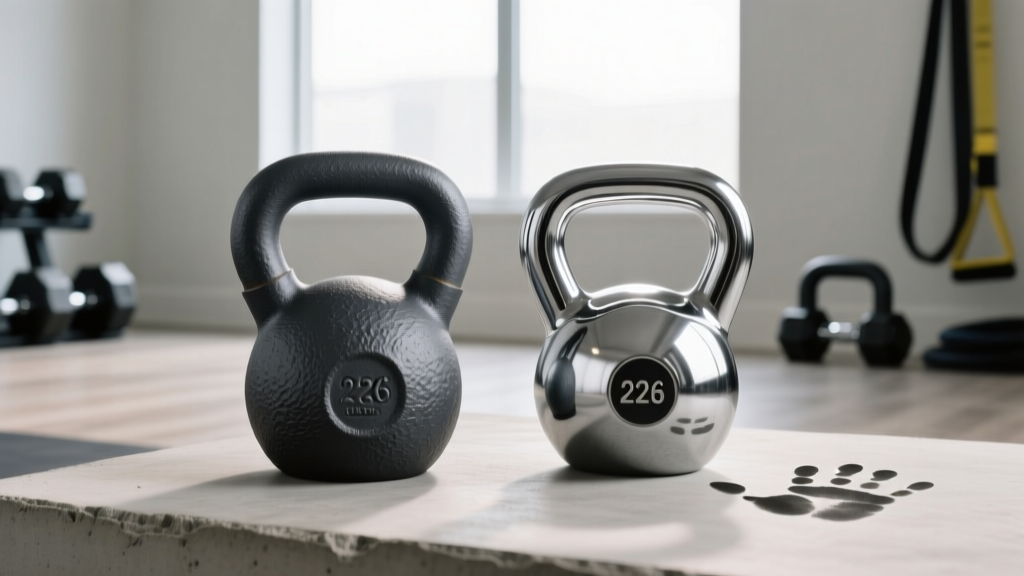
Beyond a 12 Pound Dumbbell Set: Cast Iron vs Competition Kettlebells
Outgrown your 12 pound dumbbell set? Discover our expert hands-on review of cast iron vs competition kettlebells to elevate your home gym in 2026.

The Limitations of a 12 Pound Dumbbell Set for Ballistic Training
Most home gym owners begin their fitness journey with a basic neoprene or rubber-coated 12 pound dumbbell set. It is an accessible, budget-friendly starting point that works exceptionally well for isolation movements like lateral raises, tricep kickbacks, and rehabilitation exercises. However, as your strength and conditioning goals evolve, a 12 pound dumbbell set quickly becomes a severe bottleneck for dynamic, full-body ballistic training.
The fundamental issue lies in the biomechanics of the tool. A dumbbell features an inline center of mass; the weight is distributed equally on both sides of the handle. When you attempt a hip-hinge movement like a swing or a snatch with a dumbbell, the inline weight distribution forces your wrists into awkward angles and limits the natural arc of the bell. Furthermore, the thick, straight handle of a standard dumbbell makes the "rack position" (resting the weight on your forearm) nearly impossible without bruising your wrist.
To unlock true posterior chain power, endurance, and functional mobility, you must transition to kettlebells. But stepping into the kettlebell market reveals a major fork in the road: Cast Iron vs. Competition Kettlebells. This hands-on buying guide breaks down the exact specifications, pricing, and use cases for both styles to help you make the right investment for your training modality.
Cast Iron vs. Competition: The Core Dimensional Differences
Before diving into specific brand reviews, it is critical to understand how these two styles differ in physical geometry. According to the Kettlebell Kings Buying Guide, the primary distinction lies in how the bell scales with weight and the intended grip mechanics.
| Feature | Standard Cast Iron | Competition Steel |
|---|---|---|
| Handle Diameter | 32mm - 35mm (varies by weight) | 33mm (strict uniform standard) |
| Horn Width | Narrow to Medium | Wide (optimized for forearm rack) |
| Bell Dimensions | Grows larger as weight increases | Uniform (280mm x 210mm) across all weights |
| Material & Fill | Solid cast iron, e-coat or powder coat | Hollow steel shell, filled to adjust weight |
| Primary Modality | Hardstyle (SFG), Grinds, General Fitness | Girevoy Sport (GS), High-Rep Ballistics |
Hands-On Review: Top Cast Iron Picks for the Home Gym
Cast iron kettlebells are the gold standard for Hardstyle training—a system popularized by Pavel Tsatsouline and detailed in the StrongFirst Kettlebell Swing Guide. Hardstyle emphasizes maximum tension, explosive power, and heavy "grinds" like the Turkish Get-Up and strict military press.
1. Rogue Fitness Cast Iron Kettlebell
Price Range: $3.50 - $4.50 per pound (e.g., ~$56 for a 16kg bell)
Finish: E-Coat (Electrophoretic Deposition)
Handle Diameter: 35mm (on 16kg and above)
Expert Take: Rogue’s cast iron bells are a staple in serious garage gyms. The e-coat finish is vastly superior to cheap powder coating; it bonds at a molecular level, preserving the aggressive knurling while preventing rust and chalking. The 35mm handle is on the thicker side, which is excellent for building grip strength during heavy farmer’s carries and goblet squats, but lifters with smaller hands may find it fatiguing during high-rep snatches. The wide, flat base makes it incredibly stable for renegade rows and push-up variations.
2. Kettlebell Kings Powder Coat Series
Price Range: $2.20 - $2.80 per pound
Finish: High-grade Powder Coat
Handle Diameter: 33mm (up to 20kg), scaling up slightly on heavier bells
Expert Take: If you are upgrading from a light 12 pound dumbbell set and want a forgiving entry point into cast iron, Kettlebell Kings offers the best value-to-performance ratio. The 33mm handle on their lighter bells is much more forgiving for the wrist during the clean and snatch. The powder coat is slightly textured, absorbing chalk well for sweaty summer garage sessions. However, be warned: dropping powder-coated bells on concrete will eventually lead to chipping, so invest in horse-stall mats for your lifting area.
Expert Insight: The "Rack Position" Test
When transitioning from dumbbells to kettlebells, the "rack position" (where the bell rests against the forearm between reps) is often a painful shock. Cast iron bells have narrower horns. If you are performing high-rep cleans, a smaller cast iron bell (like a 12kg) can dig into the radial nerve of the wrist. Competition bells, with their wide, flat horns, distribute this weight across the meat of the forearm, drastically reducing bruising during endurance sets.
Hands-On Review: Top Competition Kettlebells for Technical Lifters
Competition kettlebells are governed by strict international standards. Whether you are lifting a 12kg or a 32kg bell, the physical dimensions remain exactly the same. This ensures that your technique, grip, and rack position never have to adapt to a changing bell size as you get stronger. They are essential for Girevoy Sport (GS), which focuses on high-rep, fluid endurance.
1. Kettlebell Kings Competition Steel
Price Range: $4.50 - $6.00 per pound
Material: Hollow Steel Core
Handle Diameter: Strict 33mm
Expert Take: These are the premier choice for GS athletes and technical purists. The 33mm handle is universally accommodating, and the window (the space between the handle and the bell) is perfectly sized to allow the hand to slide in and out during the "drop" phase of the snatch without tearing calluses. The color-coded bodies (e.g., Yellow for 16kg, Green for 24kg) make them visually striking and easy to organize. Because they are hollow steel filled with a weighting material, they have a slightly different acoustic feedback and center of mass compared to solid iron, which actually aids in the fluid pendulum swing of GS techniques.
2. Onnit Competition Kettlebell
Price Range: $5.00 - $7.00 per pound
Material: Precision-machined Steel
Handle Diameter: 33mm
Expert Take: Onnit’s competition bells feature a slightly smoother handle finish right out of the box, which is a double-edged sword. It prevents callus tearing during 10-minute GS long-cycle sets, but requires more chalk for heavy grinds. The dimensional tolerance on Onnit bells is exceptional; you will find zero variance in the horn width or base flatness, making them ideal for precise stacking and juggling flows.
Decision Framework: Which Style Fits Your Training?
Choosing between cast iron and competition isn't just about aesthetics; it is about aligning your equipment with your physiological goals.
- Choose Cast Iron If: Your training revolves around Hardstyle (SFG/StrongFirst), heavy 5x5 strength programs, Turkish Get-Ups, and you want a durable, drop-resistant tool for general physical preparedness (GPP). The thicker handles and solid iron construction are unmatched for raw strength building.
- Choose Competition If: You are training for Girevoy Sport, high-rep endurance (e.g., the 10-minute snatch test with hundreds of reps), or you have smaller hands that require a strict 33mm handle. The uniform dimensions also make them superior for complex flow routines and hand-balancing acts.
- The Hybrid Approach: Many elite home gyms stock competition bells for snatch and jerk days (to save the forearms), and heavy cast iron bells for presses, squats, and carries (to maximize grip and tension).
Frequently Asked Questions
Can I just use my 12 pound dumbbell set for kettlebell swings?
While you can mimic the hip-hinge pattern with a dumbbell, the inline center of mass prevents the proper "float" at the top of the swing. Furthermore, gripping a dumbbell by the head or handle for ballistic movements compromises wrist safety and limits your range of motion. Upgrading to at least a 12kg or 16kg kettlebell is highly recommended for authentic posterior chain development.
Why are competition kettlebells so much more expensive?
Manufacturing a hollow steel shell that maintains exact international dimensional tolerances (280mm x 210mm) while accurately hitting specific weight targets requires advanced welding, precision filling, and quality control. Cast iron bells are simply poured into sand molds, making them significantly cheaper to produce at scale. You can view the manufacturing standards on the Rogue Fitness Kettlebell specification pages for a direct comparison in production methodologies.
What weight should I buy when upgrading from light dumbbells?
If you are maxing out a 12 pound dumbbell set for overhead presses, a 12kg (26 lbs) cast iron kettlebell is the logical next step for strict presses and Turkish Get-Ups. For lower-body and ballistic movements like swings and goblet squats, you should immediately jump to a 16kg (35 lbs) or even 20kg (44 lbs) bell, as the legs and hips are significantly stronger than the shoulders.
More gear to consider
All reviews
PewDiePie Dumbbells Trend: 2026 Loadable Plate Market Analysis
Best Dumbbell Racks & Storage for Functional Training with Dumbbells (2026)

Upgrading Chest Workouts With Dumbbells and Bench: Olympic Barbell Weight & Knurling Mistakes
Barbell Collar Types & Single Arm Dumbbell Overhead Carry Mistakes

Urethane vs Rubber Hex Dumbbells 22.5 lbs: Space & Rack Guide