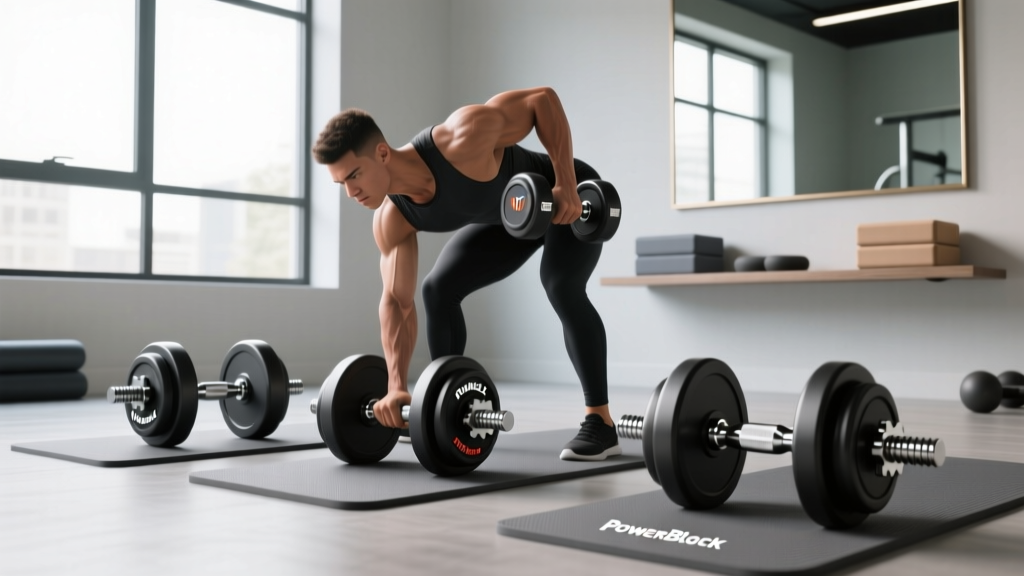
Best Adjustable Dumbbells for Bent Over Dumbbell Raises 2026
Discover the best adjustable dumbbells for bent over dumbbell raises in 2026. We compare Nuobell, Bowflex, and PowerBlock for rear delt isolation.

Why Your Adjustable Dumbbells Might Be Ruining Your Rear Delts
When outfitting a home gym in 2026, adjustable dumbbells are the undisputed kings of space efficiency. However, not all adjustable mechanisms are created equal—especially when it comes to isolation movements. If your training split relies heavily on posterior chain and shoulder health, you have likely encountered the unique frustrations of performing bent over dumbbell raises with poorly designed adjustable weights.
Bent over dumbbell raises (also known as rear delt flyes) require a precise mind-muscle connection, a full range of motion (ROM), and strict stabilization of the scapula. According to biomechanics data published by ExRx, the transverse abduction of the shoulder joint during this movement is highly sensitive to external resistance profiles and grip ergonomics. When you hinge at the hips and fight gravity, the physical footprint of your dumbbells dictates whether you achieve peak posterior deltoid contraction or simply smash your weights together.
In this head-to-head review, we evaluate the top adjustable dumbbells on the market specifically through the lens of rear delt isolation. We will break down the Nuobell 80lb, the Bowflex SelectTech 552, and the PowerBlock Elite USA to determine which model truly supports the biomechanics of the bent over dumbbell raise.
The Contenders: Head-to-Head for Rear Delt Isolation
1. Nuobell 80lb Adjustable Dumbbells: The Ergonomic Champion
The Nuobell 80lb has rapidly become the gold standard for home gym isolation work, and its dominance in the bent over dumbbell raise comes down to one critical factor: its traditional footprint. Unlike dial-based systems, Nuobell utilizes a seamless twist-lock handle mechanism that expands and contracts the internal steel splines.
- Overall Length: 14.5 inches at max weight, shrinking to just 10.5 inches at lower weights.
- Head Width: Traditional rounded profile, mimicking standard urethane hex dumbbells.
- The Rear Delt Advantage: Because the medial ends of the Nuobells are compact and rounded, you can achieve a full stretch at the bottom of the eccentric phase without the handles colliding with your torso or each other. Furthermore, the 35mm knurled steel handle allows for the micro-rotations in the wrist that physical therapists recommend to avoid extensor carpi ulnaris strain during lateral and rear flyes.
- Failure Mode Check: At a 45-degree torso hinge, gravity pulls the internal weight plates downward. Nuobell's anti-rattle spline design ensures zero metallic clanking during the slow, controlled eccentric phase of the raise, preserving your mind-muscle connection.
- 2026 Pricing: Approximately $449 per pair.
2. Bowflex SelectTech 552: The Bulky Runner-Up
The Bowflex SelectTech 552 remains a massive seller due to its accessible dial system and widespread availability. However, for bent over dumbbell raises, its physical dimensions present a distinct mechanical disadvantage.
- Overall Length: A fixed 15.75 inches, regardless of the weight selected.
- Head Width: The dial housing adds significant bulk to the medial and lateral ends (roughly 6.5 inches across the widest point).
- The Rear Delt Disadvantage: When performing bent over dumbbell raises, the goal is to bring the arms up and slightly back to achieve peak contraction of the posterior deltoid and rhomboids. Because the Bowflex 552 does not shrink in length when you dial down to 10 or 15 lbs, the bulky medial ends will physically clash before your rear delts reach full contraction. This forces you to either widen your grip (altering the torque on the shoulder joint) or cut the ROM short.
- Failure Mode Check: The plastic dial housing is prone to cracking if the dumbbells are set down too aggressively after a heavy set of bent-over rows, though this is less of an issue for the lighter weights used in raises.
- 2026 Pricing: Approximately $399 per pair.
3. PowerBlock Elite USA: The Rear-Delt Dealbreaker
PowerBlock dumbbells are legendary for their indestructible, welded-steel cage designs. They are phenomenal for heavy pressing and goblet squats. For bent over dumbbell raises? They are a biomechanical nightmare.
- Overall Dimensions: A fixed blocky cage measuring roughly 8.5 x 4.5 x 4.5 inches.
- The Rear Delt Disadvantage: The enclosed cage design forces your hand into a strict, fixed neutral grip. During a bent over dumbbell raise, your wrist naturally wants to pronate slightly at the top of the movement to fully engage the infraspinatus and posterior deltoid. The PowerBlock cage restricts this natural wrist articulation, transferring undue shear force to the radioulnar joint.
- Failure Mode Check: The open gaps in the cage can accidentally pinch fingers or scrape against your thighs if you use a wide stance to stabilize your hip hinge during the exercise.
- 2026 Pricing: Approximately $399 per pair.
Comparison Matrix: Rear Delt Flye Performance
| Feature | Nuobell 80lb | Bowflex 552 | PowerBlock Elite |
|---|---|---|---|
| Weight Range | 5 - 80 lbs | 5 - 52.5 lbs | 5 - 50 lbs (Base) |
| Length Adjustability | Yes (Shrinks at lower weights) | No (Fixed 15.75") | No (Fixed Block) |
| Wrist Ergonomy for Flyes | Excellent (Traditional Handle) | Good (Contoured Grip) | Poor (Caged Restriction) |
| Medial Clashing Risk | Very Low | High | Moderate |
| Rattle at 45° Hinge | None (Spline Lock) | Low | None (Solid Cage) |
Execution Guide: Perfecting the Bent Over Raise with Adjustable Weights
Having the right equipment is only half the battle. The American Council on Exercise (ACE) emphasizes that improper torso angle and scapular retraction are the primary reasons lifters fail to isolate the rear delts, inadvertently shifting the load to the mid-traps or biceps brachii.
Pro-Tip: The Chest-Supported Hack
If you are using heavier adjustable dumbbells (like the 80lb Nuobells) and find that your lower back fatigues before your rear delts during the bent over dumbbell raise, utilize an incline bench. Set the bench to a 30-to-45-degree angle, lie face down, and perform the raises. This completely removes the hip-hinge stabilization requirement, allowing you to take the posterior deltoids to absolute failure safely.
- The Hinge: Stand with feet shoulder-width apart. Hinge at the hips until your torso is nearly parallel to the floor. Maintain a neutral spine to prevent lumbar shear force.
- The Grip: Let the adjustable dumbbells hang straight down with a neutral grip (palms facing each other). The compact heads of the Nuobells should rest comfortably against your outer thighs without tangling.
- The Concentric Phase: With a slight bend in the elbows (roughly 10-15 degrees), raise the dumbbells out to the sides. Focus on pushing the weight away toward the walls, rather than just lifting up.
- The Peak Contraction: Pause at the top. If your dumbbells clash before your arms are in line with your torso, your equipment is restricting your ROM. Squeeze the shoulder blades together.
- The Eccentric Phase: Lower the weight slowly over a 3-second count. Adjustable dumbbells with loose internal tolerances will rattle here; high-quality splines will remain silent, keeping tension on the muscle.
Final Verdict: Which Should You Buy in 2026?
If your programming heavily features isolation movements like bent over dumbbell raises, lateral raises, and tricep extensions, the Nuobell 80lb is the undisputed winner for 2026. Its ability to shrink in physical footprint as you drop the weight, combined with a traditional, unrestrictive handle, perfectly mirrors the biomechanics required for posterior shoulder health and hypertrophy.
The Bowflex 552 is a fine general-purpose tool for presses and curls, but its fixed, bulky length makes it a frustrating choice for high-rep rear delt flyes. The PowerBlock Elite, while virtually indestructible, should be avoided by anyone prioritizing joint-friendly wrist articulation during transverse abduction movements.
Frequently Asked Questions
Can I use adjustable dumbbells for heavy bent-over rows instead of raises?
Yes. For heavy bent-over rows (which target the latissimus dorsi and rhomboids rather than the posterior deltoid), the PowerBlock Elite actually excels. The caged handle provides immense structural integrity for pulling heavy loads (50+ lbs) without the mechanical vulnerability of plastic dial housings.
Why do my wrists hurt during bent over dumbbell raises?
Wrist pain during this movement is often caused by forced pronation or supination against a restrictive handle. According to data regarding joint mechanics highlighted by the Cleveland Clinic, improper wrist alignment during shoulder abduction can lead to compensatory strain in the forearm extensors. Switching to a traditional cylindrical handle (like Nuobell or standard hex dumbbells) allows the wrist to self-align with the shoulder's natural path of motion.
What weight should I use for bent over raises?
The posterior deltoid is a relatively small muscle group. In 2026, the prevailing consensus among hypertrophy coaches is to prioritize metabolic stress over mechanical tension for this specific movement. Most lifters will see optimal results using 10 to 20 lbs per hand for sets of 15-20 reps, focusing on a 2-second isometric pause at the peak of the contraction.
More gear to consider
All reviews
Mastering Glute Bridges With Dumbbells: Best Loadable Picks 2026

Olympic vs Standard Plate Setup & Incline Dumbbell Press Weight Kg

Lunges with Dumbbells for Women & Power Rack vs Squat Rack vs Stand

EZ Curl Bar vs Straight Bar: Budget, Value, and the Dumbbell Emoji

Power Rack vs Squat Rack vs Stand: Dumbbell Woodchop Workout
