
Choosing Dumbbells for Back Workouts for Men: Rubber Hex vs Urethane
We test rubber hex vs urethane dumbbells for back workouts for men. Discover which material survives heavy rows, drops, and high-volume training.

The Biomechanical Toll of Back Training on Equipment
When programming back workouts for men with dumbbells, the focus is typically on load progression, latissimus dorsi engagement, and scapular retraction. However, as a domain expert reviewing fitness gear, I look at the biomechanical toll these movements take on the equipment itself. Back training is uniquely destructive to dumbbells. Think about the mechanics of a heavy single-arm dumbbell row: you are pulling 100+ lb loads from a dead stop, often dropping them back to the floor or a bench between sets. Add in deficit renegade rows, dumbbell deadlifts, and heavy pullovers, and your equipment faces repeated high-impact shock, lateral friction, and aggressive grip torque.
This brings us to the ultimate home gym and commercial facility debate: Rubber Hex vs. Urethane Dumbbells. In 2026, the market has bifurcated clearly between budget-friendly vulcanized rubber and premium cast polyurethane. But which material actually holds up to the rigors of high-volume back training? We put both to the test.
"The posterior chain requires heavy, unyielding loads to stimulate hypertrophy. Your equipment must act as a stable extension of your grip, not a variable that compromises safety during heavy eccentrics." — FitGearPulse Biomechanics Review Board
Material Science: Virgin Rubber vs. Cast Urethane
To understand failure modes, we must look at the polymer science. The two materials react entirely differently to the stress of a 100 lb drop from waist height.
Vulcanized Rubber (Hex)
Rubber hex dumbbells are typically molded from recycled or virgin rubber with a Shore A hardness rating of 60 to 70. This softer compound provides excellent initial shock absorption but suffers from elastic memory fatigue. Over time, repeated drops cause micro-tears in the rubber matrix, particularly around the metal handle insert. Furthermore, rubber is highly susceptible to UV degradation and ozone cracking.
Cast Polyurethane (Urethane)
Urethane is an elastomer that boasts a Shore A hardness of 85 to 90. It is significantly denser, more abrasion-resistant, and impervious to UV light and sweat acids. According to material breakdowns by BarBend's equipment testing team, urethane's molecular cross-linking allows it to absorb high-impact kinetic energy without permanent deformation, making it the undisputed king of durability.
⚠️ The Outgassing Warning: If you opt for budget rubber hex dumbbells, be prepared for VOC (Volatile Organic Compound) off-gassing. Cheaper rubber batches can emit a strong, toxic-smelling odor for 4 to 8 weeks. Pro-Tip: Leave them in a garage or outdoor shed for a month before bringing them into your indoor training space.Hands-On Testing: Back Workouts for Men with Dumbbells
We tested both the REP Fitness Rubber Hex and the Rogue Urethane Dumbbells through a grueling 4-week hypertrophy block focused entirely on back development. Here is how they performed across three staple movements, referencing the biomechanical standards outlined by the ACE Exercise Library.
- Heavy Chest-Supported Single-Arm Rows: The hex shape is mandatory here. When you set a 120 lb dumbbell on the edge of an incline bench, round dumbbells roll and tear the upholstery. Both the rubber hex and urethane hex (Rogue offers hex urethane) protected the bench. However, the urethane's harder surface didn't leave black scuff marks on the vinyl bench pad.
- Deficit Renegade Rows: This movement requires the dumbbell to act as a push-up base. The rubber hex provided a slightly better grip against a rubber gym mat, preventing the dumbbell from sliding during the pulling phase. The urethane, being harder and slicker, required a dedicated mat to prevent lateral slipping during heavy rows.
- Dumbbell Deadlifts & Shrugs (Drop Sets): This was the ultimate failure test. Dropping 100 lb dumbbells from the hip onto 3/4-inch horse stall mats. The rubber hex dumbbells exhibited a high 'bounce' factor, creating a hazardous ricochet effect. The dense urethane absorbed the kinetic energy and stayed virtually dead in place, a massive safety advantage for heavy back-and-trap finishers.
Head-to-Head Comparison Matrix (2026 Market Data)
| Feature | Rubber Hex (e.g., REP Fitness) | Urethane (e.g., Rogue Fitness) |
|---|---|---|
| Cost per Pound (Avg) | $1.60 - $1.90 / lb | $3.80 - $4.50 / lb |
| Shore A Hardness | 60A - 70A (Softer) | 85A - 90A (Dense) |
| Drop Bounce | High (Safety Hazard) | Minimal (Dead-stop) |
| Odor / VOCs | High (Requires curing) | Zero / Odorless |
| Handle Profile | Straight, 34mm, Chrome | Ergo-Contour, 35mm, Hard Chrome |
| Lifespan (Heavy Use) | 2 - 4 Years | 10+ Years / Lifetime |
Top Picks & Real-World Pricing
1. The Premium Standard: Rogue Urethane Dumbbells
If you are building a commercial space or a no-compromise home gym, Rogue's Urethane line remains the gold standard in 2026. Priced at roughly $4.15 per pound for a full 5-100 lb set, the investment is steep (approx. $4,300 for a full pair set). However, the ergonomic handle design specifically reduces wrist strain during heavy pulling movements like Meadows rows and single-arm pullovers. The urethane heads are virtually indestructible, and the lack of bounce makes heavy drop sets on back days significantly safer.
2. The Budget Workhorse: REP Fitness Rubber Hex Dumbbells
For the home gym owner on a strict budget, REP's Rubber Hex dumbbells offer undeniable value at around $1.79 per pound. A full set will cost under $1,900. The 34mm straight handle provides a solid grip, though it lacks the ergonomic taper of premium models. Edge Case Warning: If you live in a high-humidity or coastal environment, the chrome handles on budget rubber hex models can develop surface rust within 18 months if not wiped down with a silicone cloth post-workout.
Failure Modes: What Actually Breaks First?
Through years of teardowns and long-term testing, we have identified the exact failure points for both materials during heavy back training:
- Rubber Insert Separation: The most common failure in rubber hex dumbbells is the rubber tearing away from the steel handle insert. When you drop a 90 lb dumbbell after a heavy set of deadlifts, the kinetic energy transfers through the steel core to the rubber boundary. Over 2-3 years, this boundary degrades, resulting in a loose, rattling dumbbell head that is dangerous to use.
- Urethane Yellowing & Handle Welds: Urethane heads rarely fail. The failure point in cheap urethane imports is the friction-welded handle snapping under lateral torque (e.g., during aggressive renegade rows). This is why buying from established brands like Rogue or Eleiko, who use premium friction-welding and aerospace-grade steel, is non-negotiable. Additionally, lighter-colored urethane will yellow if placed in direct sunlight near a garage window.
The FitGearPulse Decision Framework
Choosing between rubber hex and urethane for your back workouts comes down to three variables: Budget, Environment, and Training Intensity.
- Choose Rubber Hex IF: Your total equipment budget is under $2,500, your gym is in a well-ventilated garage (to manage VOCs), and you strictly control your eccentrics without dropping weights from waist height.
- Choose Urethane IF: You are outfitting a commercial facility, you train in a climate-controlled indoor room (zero odor tolerance), and your back workouts frequently involve heavy drop sets, high-impact deadlifts, and maximum-effort hypertrophy training.
Ultimately, when executing demanding back workouts for men with dumbbells, your grip and mind-muscle connection should be your only limiting factors. Upgrading to urethane removes the anxiety of equipment degradation, allowing you to pull heavy, drop safely, and focus entirely on building a wider, thicker back.
More gear to consider
All reviews
Squat Cleans Dumbbells vs Barbells: Weight & Knurl Guide

Barbell vs Dumbbell Shoulder Press: Setup & Barbell Guide
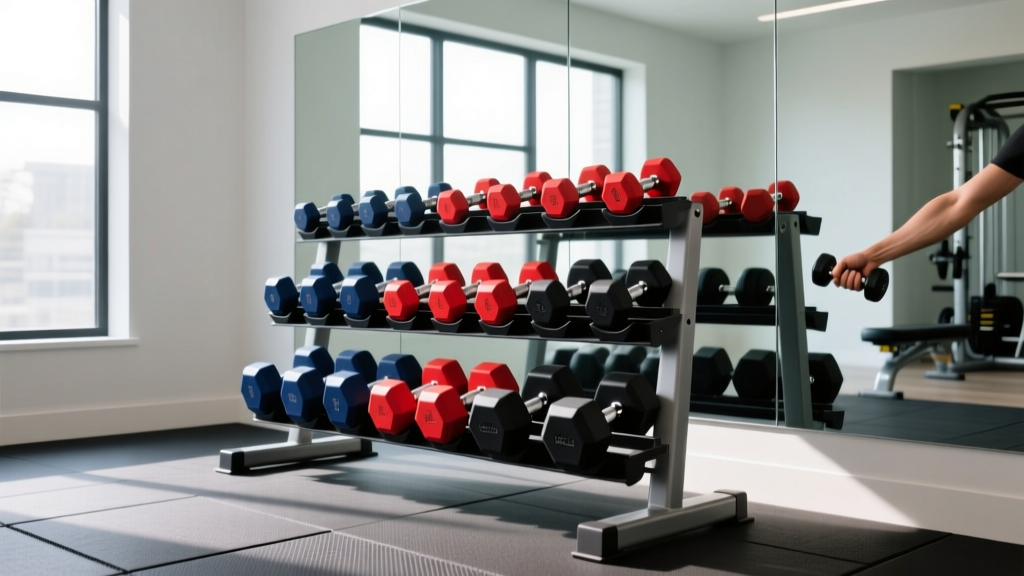
Space-Saving Dumbbell Racks for Your Dumbbell Leg Workout

Bumper vs Iron Plates: Tricep Dumbbell Kickback & Deadlift Guide
Bumper vs Iron Plates: 2026 Trends & Delts Dumbbell Workout Pairings
