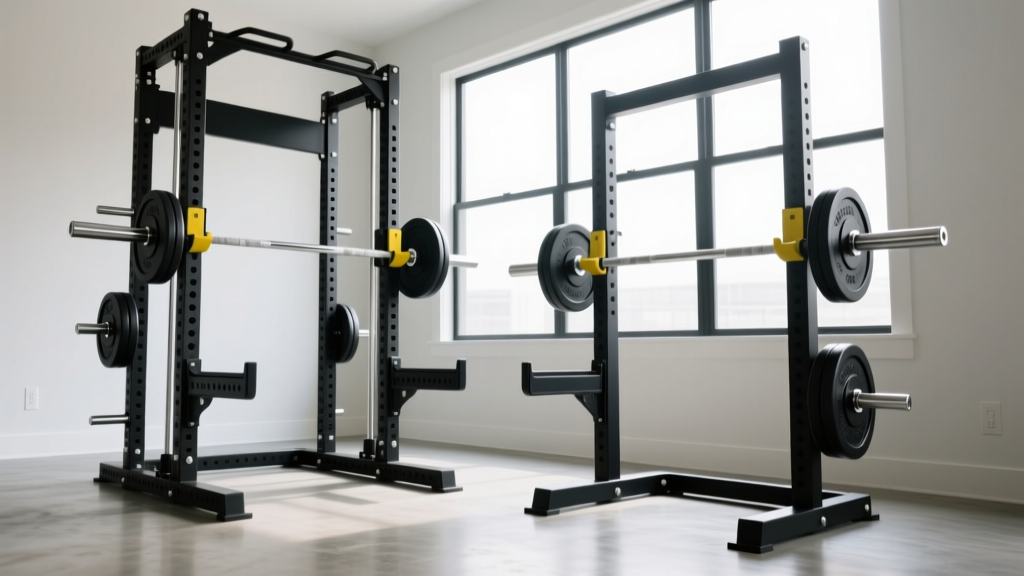
Power Rack vs Squat Rack vs Stand: Bench Dumbbell Chest Press
Compare power racks, squat racks, and squat stands for the bench dumbbell chest press. Expert safety tips, spacing specs, and 2026 buying advice.

When building a home gym or upgrading a commercial facility, the debate between a power rack, a squat rack, and a squat stand usually centers around barbell squats and overhead presses. However, if your primary upper-body mass builder is the bench dumbbell chest press, the spatial geometry, safety spotting mechanisms, and bench clearance requirements drastically shift the buying calculus. As lifters push past the 80-pound dumbbell threshold, the logistical nightmare of staging heavy weights and the catastrophic risk of a failed rep demand a highly specific equipment setup.
In this comprehensive 2026 head-to-head comparison, we evaluate full cages, half racks, and minimalist stands strictly through the lens of the bench dumbbell chest press. We will dissect upright spacing, spotter arm efficacy, and the hidden failure modes that generic buying guides often overlook.
The Spatial Geometry of Heavy Dumbbell Pressing
Unlike the barbell bench press, where the bar travels on a fixed horizontal plane and rests on external J-cups, the bench dumbbell chest press requires the lifter to manually hoist independent weights into position. This introduces two critical spatial challenges:
- The "Knee-Pop" Clearance: To get heavy dumbbells (90+ lbs) into the starting position, lifters use a knee-flick technique. The bench must fit securely inside the rack without the uprights obstructing the lifter's knees or elbows during the staging phase.
- The Bailout Zone: When a barbell press fails, the bar drops straight down onto safety pins. When a dumbbell press fails, the weights fall outward and downward, often bouncing off the torso or floor. The rack's internal width and spotter arm placement must account for this erratic drop path.
Power Racks (Full Cages): The Ultimate Dumbbell Sanctuary
A full power rack, such as the REP Fitness PR-4000 or the legendary Rogue R-3, features four uprights that create an enclosed cage. For the bench dumbbell chest press, this is the undisputed champion of safety and utility.
Why Full Cages Dominate Dumbbell Pressing
- Internal Spotter Arms: Power racks allow you to mount 24-inch or 30-inch safety spotter arms inside the cage. If you fail a rep with 100-pound dumbbells, you simply open your hands and let the weights drop onto the internal safeties, which are set just below your wrist height at maximum stretch.
- Optimal Inside Width: Most premium 2026 power racks feature a 43-inch inside width. A standard flat bench is 12 inches wide, leaving roughly 15.5 inches of clearance on either side of the bench. This provides ample room for wide-grip dumbbell pressing and elbow tucking without scraping the uprights.
- Accessory Integration: Full cages allow for the attachment of lat pulldown modules and landmine bases, turning your dumbbell press station into a comprehensive hypertrophy hub.
The Drawbacks
The primary barrier to entry is footprint and cost. A standard 43-inch power rack with a 24-inch depth requires roughly 8x4 feet of dedicated floor space. Furthermore, outfitting a cage with specialized flip-down safeties or pin-pipe systems will push the total investment well past the $1,000 mark in 2026.
Half Racks (Squat Racks): The Compromise
Half racks, like the Titan T-3 Half Power Rack, feature two main front uprights and a rear stabilizing base. They are designed to save space while maintaining a high weight capacity. But how do they handle the bench dumbbell chest press?
The Staging Dilemma
In a half rack, the bench is usually positioned slightly behind the front uprights. When performing a heavy dumbbell press, the uprights are directly in your peripheral vision and can physically obstruct the path of the dumbbells if you prefer an ultra-wide grip or a deep, stretched flye-press hybrid.
Furthermore, half racks often utilize external spotter arms that extend forward from the front uprights. While these are perfect for catching a failed barbell squat, they are virtually useless for a dumbbell bench press. If you fail a dumbbell rep, the weight falls behind the uprights, entirely missing the forward-facing safety arms. To use a half rack safely for dumbbells, you must purchase specialized internal cross-member safeties that span the gap between the uprights behind the J-cups.
Squat Stands: Minimalist but Dangerous?
Squat stands, such as the Rogue SML-2C Monster Lite Squat Stands, are essentially two independent metal pillars with a wide base. They are incredibly popular for garage gyms with low ceilings and tight budgets. However, for the bench dumbbell chest press, they present severe ergonomic and safety flaws.
CRITICAL SAFETY WARNING: Standard squat stands utilize external spotter arms that extend outward from the uprights. When performing a heavy bench dumbbell chest press, a failed rep drops the weight between the uprights, completely bypassing the external safety arms. Never use standard squat stands for heavy dumbbell pressing without specialized internal catchers.The Base Interference Issue
To prevent tipping, squat stands feature wide, heavy base feet (often 24x24 inches or larger). When you slide a flat or adjustable bench into position, the legs of the bench frequently collide with the base of the stands. This prevents you from sliding the bench far enough back, forcing you to press the dumbbells directly in line with the uprights, which restricts your range of motion and increases the risk of the dumbbell colliding with the steel post during the concentric phase.
Head-to-Head Comparison Matrix
| Feature | Power Rack (Full Cage) | Half Rack (Squat Rack) | Squat Stand |
|---|---|---|---|
| Dumbbell Safety | Excellent (Internal Safeties) | Moderate (Requires add-ons) | Poor (External arms fail) |
| Inside Width | 43" to 49" (Ideal) | 43" to 49" | 43" to 49" (Base obstructs) |
| Bench Alignment | Flush, unobstructed | Slight upright interference | Base collision common |
| Avg 2026 Cost | $899 - $1,400+ | $599 - $899 | $350 - $550 |
The "Knee-Pop" Clearance Test: A Practical Framework
Before finalizing your rack purchase for dumbbell pressing, perform this mental clearance test based on the equipment specifications provided by the manufacturer:
- Measure Your Bench Pad: Standard flat benches are 12 inches wide. Adjustable benches can taper to 10 inches at the seat but remain 12 inches at the shoulders.
- Calculate the Elbow Spread: Lie on your bench and simulate the bottom position of a dumbbell press. Measure the distance from the outside of your left elbow to the outside of your right elbow. For most lifters using 90+ lb dumbbells, this span is between 45 and 52 inches.
- Evaluate the Uprights: If your elbow span exceeds the inside width of the rack (e.g., a 43-inch rack), your elbows or the dumbbell handles will strike the uprights at the bottom of the movement. If you are a larger lifter or prefer a wide grip, you must seek out a 49-inch wide power rack, or utilize specialized offset J-cups that allow you to press slightly outside the cage.
According to biomechanics analyses detailed in BarBend's guide to the dumbbell bench press, the ability to achieve a deep, unobstructed stretch at the bottom of the movement is the primary driver of pectoral hypertrophy. If your rack's uprights choke your range of motion, you are leaving significant muscle growth on the table.
Expert Verdict: Which Should You Buy?
If your training heavily prioritizes the bench dumbbell chest press, the equipment hierarchy is clear:
1. The Undisputed Winner: The 43-Inch Power Rack
Invest in a full cage with 3x3 uprights and 1-inch Westside hole spacing. Purchase a pair of 24-inch pin-and-pipe safety spotter arms. This setup allows you to micro-adjust the safeties to sit exactly one inch below your wrist at maximum stretch, providing a psychological safety net that allows you to train to true muscular failure without a spotter.
2. The Budget Alternative: Bolt-Down Squat Stands (With Caveats)
If ceiling height or budget strictly forbids a full cage, you can use squat stands, but you must alter your training protocol. You cannot safely train to failure. Alternatively, you must invest in a specialized "spotter catch" system that bridges the gap between the stands, or rely heavily on the "dump and roll" bailout technique, dropping the dumbbells to the floor rather than risking a crush injury.
3. The Half Rack: Proceed with Caution
Half racks are phenomenal for Olympic lifting and barbell squats, but their forward-facing footprint makes them the most awkward option for staging heavy dumbbells. Unless you can source internal cross-member safeties compatible with your specific model, look elsewhere for a dedicated dumbbell pressing station.
"The bench dumbbell chest press offers superior joint articulation and unilateral hypertrophy compared to the barbell, but it demands a rigorous approach to environmental safety. Your rack is not just a storage unit; it is your mechanical spotter. Choose the geometry that protects your sternum."
Ultimately, optimizing your bench dumbbell chest press requires looking past the marketing photos of loaded barbells and focusing on the internal dimensions, safety arm orientation, and bench clearance of your chosen rack. In 2026, with premium steel prices stabilizing, there has never been a better time to invest in a full power rack that respects the biomechanics and safety requirements of heavy dumbbell training.
More gear to consider
All reviews
Calf Dumbbell Workouts: Troubleshooting Neoprene Weight Limits
Power Rack vs Squat Rack vs Stand: Tungsten Dumbbell Setup
Pectoral Fly Dumbbell Guide: Best Adjustable Sets 2026
Olympic vs Standard Plates Setup and Light Dumbbell Training Guide

Cast Iron vs Competition Kettlebells vs Dumbbell Glute Bridge on Bench