Dumbbell Forearm Rotation: A Beginner's Neoprene Guide
Learn how to safely perform the dumbbell forearm rotation at home using neoprene-coated weights. Step-by-step form, routines, and gear tips.

The Biomechanics of Forearm Rotation (And The 'Offset' Secret)
If you have ever tried to perform a dumbbell forearm rotation by gripping the center handle of a standard dumbbell and twisting your wrist, you have likely felt a frustrating lack of resistance—or worse, a sharp pinch in your wrist joint. This is because true forearm rotation (pronation and supination) occurs at the radioulnar joints, not the wrist joint itself. To isolate the pronator teres and supinator muscles, you must create a lever arm.
This is where the offset grip comes in. By gripping the head of the dumbbell rather than the handle, you turn the weight into a lever, forcing your forearm muscles to work through a full rotational range of motion. According to the ExRx Exercise Directory, targeting these specific stabilizers is crucial for overall grip strength and elbow health, yet it is frequently misunderstood by beginners.
Why Neoprene Dumbbells Are Ideal for This Movement
When performing offset rotations, the dumbbell is resting against the fleshy part of your palm and fingers. Bare cast iron, chrome, or rubber-coated weights can slip when your hands get sweaty, creating a dangerous lever that could drop onto your foot or strain your wrist.
Neoprene-coated dumbbells solve this problem. The textured, slightly porous neoprene shell provides a high-friction grip that locks the dumbbell head into your hand. Furthermore, forearm isolation work requires high repetitions (15-25 reps) and lighter loads. Neoprene sets are typically manufactured in lighter increments (1 lb to 15 lbs per dumbbell), making them the perfect tool for this specific biomechanical need.
Expert Insight: The Grip Advantage
Neoprene's high-friction surface allows you to maintain a secure hold on the dumbbell head with roughly 20% less grip force than smooth vinyl or chrome. This means your flexor muscles fatigue from the actual rotation, rather than giving out early from simply trying to hold the weight.
Step-by-Step: Executing the Dumbbell Forearm Rotation
Follow this precise sequence to perform the movement safely and effectively using a neoprene hex dumbbell.
Step 1: The Setup and Stance
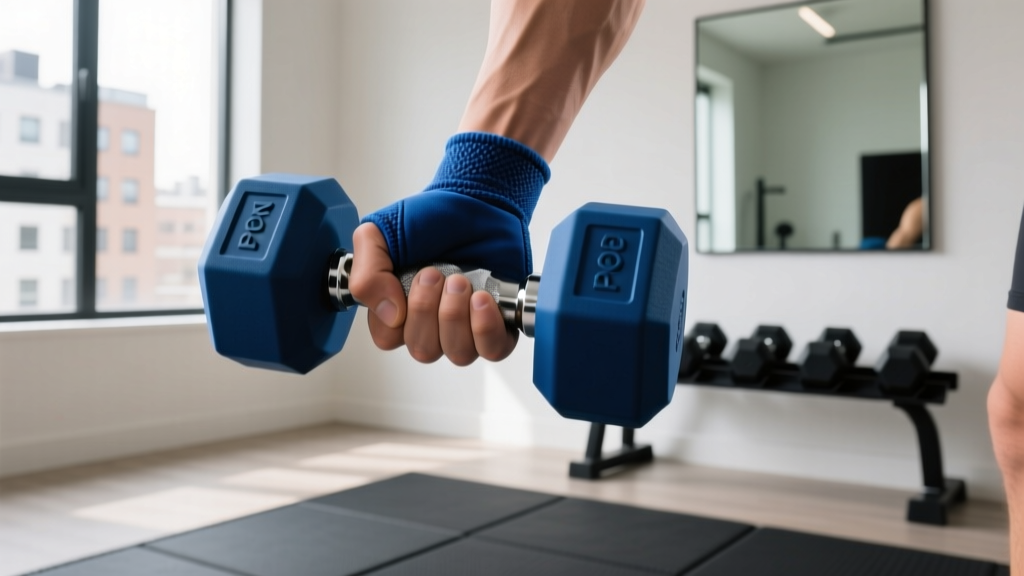
Sit on a flat bench or a sturdy chair. Rest your right forearm on your right thigh, just above the knee. Your hand and the dumbbell should extend past your kneecap, allowing a full range of motion without your knuckles hitting your leg.
Step 2: The Offset Grip
Select a light neoprene dumbbell (beginners should start with 3 lbs to 5 lbs). Do not grab the handle. Instead, grip the top head of the hex dumbbell. Wrap your fingers around the flat or slightly rounded edges of the neoprene coating. Your thumb should be on one side, and your four fingers on the other, creating a clamp.
Step 3: The Pronation (Inward Turn)
Start with your palm facing the ceiling (supinated). Slowly allow the weight of the dumbbell head to pull your hand inward and downward until your palm faces the floor. Stop immediately if you feel a pinching sensation in the wrist. The rotation should come from the forearm twisting, not the wrist bending laterally.
Step 4: The Supination (Outward Turn)
Engage your supinator muscle (the muscle on the top/outside of your forearm) to twist the weight back up to the starting position. Pause for one second at the top, squeezing the forearm.
Pro Tip: Keep your elbow pinned to your inner thigh or ribcage. If your elbow flares outward, your shoulder's rotator cuff takes over the movement, completely defeating the purpose of the forearm isolation.
Beginner Forearm Programming Matrix
Forearm muscles are highly endurance-oriented, composed of a dense mix of slow-twitch and fast-twitch fibers. Research highlighted by Harvard Health Publishing emphasizes that grip and forearm endurance are vital indicators of overall functional health and longevity. Therefore, your training matrix should prioritize time-under-tension over sheer load.
| Exercise Variation | Sets | Reps | Tempo (Eccentric/Concentric) | Rest |
|---|---|---|---|---|
| Offset Dumbbell Rotation (Pronation/Supination) | 3 | 15 - 20 | 2 sec down / 1 sec up | 45 sec |
| Standard Neoprene Wrist Flexion (Palm Up) | 3 | 12 - 15 | 2 sec down / 1 sec up | 60 sec |
| Standard Neoprene Wrist Extension (Palm Down) | 3 | 12 - 15 | 2 sec down / 1 sec up | 60 sec |
| Neoprene Dumbbell Farmer's Hold (Static Grip) | 2 | 30 - 45 sec hold | N/A (Isometric) | 60 sec |
Common Beginner Mistakes and Troubleshooting
⚠️ Warning: Avoid Ulnar/Radial Deviation
Beginners often confuse forearm rotation (twisting the doorknob motion) with wrist deviation (waving side-to-side). If your wrist is bending sideways toward your thumb or pinky, you are stressing the delicate ligaments of the carpal tunnel. Keep the wrist perfectly straight and rigid; let the radius bone cross over the ulna bone to create the rotation.
- Mistake 1: Using Too Much Weight. The lever arm created by holding the dumbbell head multiplies the perceived weight. A 10 lb dumbbell held by the head can feel like 25 lbs at the end of the range of motion. Fix: Drop down to a 3 lb or 5 lb neoprene weight until the mind-muscle connection is established.
- Mistake 2: Rushing the Eccentric. Letting gravity snap the wrist into pronation. Fix: Count a full two seconds on the downward phase to maximize micro-tears in the pronator teres.
- Mistake 3: Ignoring the Extensors. Focusing only on the heavy, gripping muscles on the underside of the arm. Fix: Always pair rotation work with reverse wrist curls to maintain structural balance and prevent tennis elbow.
Building Your 2026 Home Forearm Kit
If you are outfitting a home gym specifically for arm and forearm isolation, you do not need an expensive adjustable set. Adjustable dumbbells (like Bowflex or Nuobell) are actually poor choices for the offset grip because their bulky, mechanical heads are uncomfortable and awkward to hold.
Instead, invest in fixed neoprene hex dumbbells. Here is what to look for in the current market:
Recommended Specs for Forearm Work
- Coating: Virgin neoprene (avoid cheap vinyl which peels and becomes slippery).
- Shape: Hexagonal heads (prevents rolling when placed on the floor and provides flat edges for the offset clamp grip).
- Handle Diameter: Standard 1.25 to 1.5 inches (for the standard wrist curl variations).
- Price Target: Expect to pay between $1.40 and $1.80 per pound in 2026. A pair of 5 lb neoprene dumbbells should cost roughly $15 to $18 total.
Top Brand Picks: The Yes4All Neoprene Coated Dumbbells and the CAP Barbell Neoprene Hex Dumbbells remain the gold standards for home use. They feature cast iron cores that are perfectly balanced, ensuring the offset lever doesn't pull unpredictably to one side.
Frequently Asked Questions
Can I use a kettlebell for forearm rotations?
While kettlebells are excellent for grip strength, their handle geometry and thick horns make the offset grip highly awkward and potentially unsafe for isolated pronation/supination. Stick to fixed neoprene hex dumbbells for this specific movement.
How often should I train my forearms?
Because the forearms are used in almost every pulling and holding exercise (like deadlifts, rows, and pull-ups), they recover quickly but are easily overworked. Aim for 2 dedicated forearm sessions per week, placed at the very end of your upper-body workouts. Never train forearms before heavy compound lifts, as grip fatigue will compromise your primary lifts.
Will neoprene dumbbells degrade from sweat?
Neoprene is highly resistant to moisture and salt. However, if you sweat heavily, wipe the dumbbell heads down with a damp cloth after your workout. Over several years, the oils from your skin can cause low-grade neoprene to become slightly tacky, but premium brands (like CAP and Yes4All) use UV and oil-resistant coatings that last for years in a standard home gym environment.
More gear to consider
All reviews
Bulgarian Split Squat Dumbbell Weight: Neoprene Guide
Beyond Dumbbell Shoulder Side Raises: Barbell Collar Types Compared

Rubber Hex vs Urethane: Dumbbell Select Weight Maintenance Guide

Iron vs Bumper Plate Care: Upgrading Workout with Dumbbells for Women

Bumper vs Iron Plate Care: Longevity & Underhand Dumbbell Rows
