Barbell vs Dumbbell Bench Press Setup: Collar & Clamp Guide
Master your barbell vs dumbbell bench press setup. This walkthrough covers rack dimensions, safety spotter arms, and a deep-dive barbell collar comparison.

The Architecture of the Press: Spatial and Rack Requirements
When engineering a dedicated pressing station, understanding the spatial and biomechanical differences between the barbell vs dumbbell bench press is the first step in a complete setup walkthrough. While both movements target the pectoralis major, anterior deltoids, and triceps brachii, their equipment footprints and safety protocols diverge significantly.
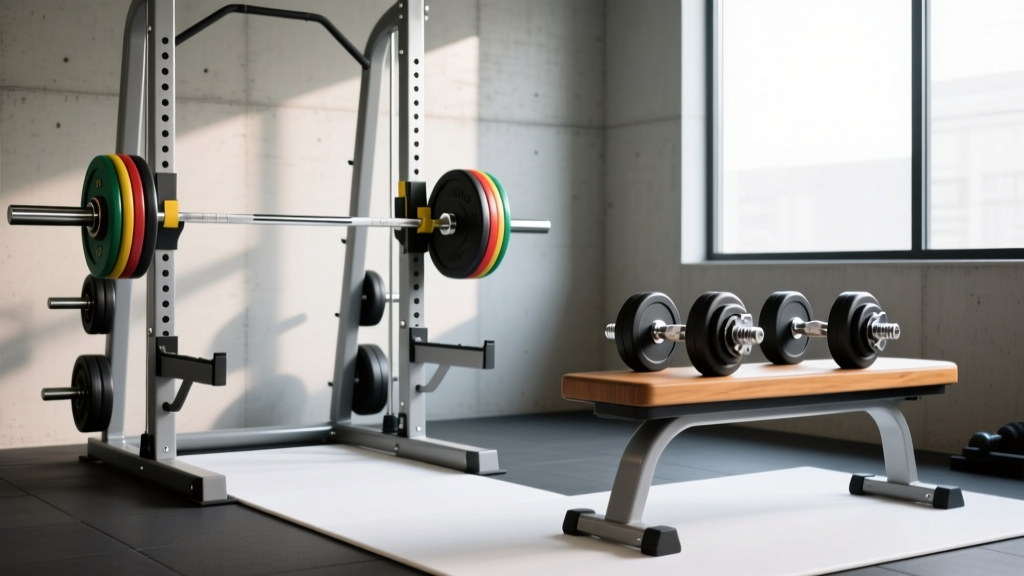
A standard Olympic barbell setup requires a power rack or squat stand with an inner width of 48 to 49 inches to accommodate the 51.5-inch distance between the barbell sleeves. According to biomechanical data cataloged by ExRx, the bar path requires unrestricted vertical clearance, meaning your rack must be at least 84 inches tall to allow for safe racking at full arm extension. Conversely, a dumbbell bench press setup demands lateral clearance. You need a minimum of 6 to 8 square feet of open floor space beside an adjustable FID (Flat/Incline/Decline) bench to safely kick heavy dumbbells up and drop them at the end of a set without striking uprights or spotter arms.
Securing the Load: Barbell Collar and Clamp Types Comparison
The most critical, yet frequently overlooked, component of the barbell bench press setup is the collar. When a 225-pound barbell is dropped onto safety spotter arms, the kinetic energy transfers laterally through the sleeves. If your collars fail, plates shift, altering the bar's center of gravity and potentially causing a catastrophic tipping hazard. Here is a deep-dive comparison of the three primary collar types on the market in 2026.
1. Spring Collars (The Budget Trap)
Standard chrome spring collars cost between $12 and $18 per pair. They rely on tensile spring tension to grip the 50mm Olympic sleeve. While they are lightweight and fast to apply, their clamping force rarely exceeds 20 pounds of lateral shear resistance. During an eccentric overload or an emergency drop onto spotter arms, the bar whip (the oscillation of the steel shaft) easily breaks the spring collar's friction grip, causing plates to slide outward. They are acceptable for light accessory work but represent a severe safety liability for heavy bench pressing.
2. Clamp-Style Collars (The Commercial Standard)
Clamp-style collars, such as the Lockjaw Pro Olympic Clamps (retailing around $29.95), utilize a high-density nylon resin body with a TPU (Thermoplastic Polyurethane) inner lining and a steel-reinforced locking clasp. By leveraging mechanical advantage through the clamp lever, these collars generate approximately 150 pounds of radial clamping force. They are the undisputed standard for commercial gyms and serious home setups, offering a balance of speed, durability, and safety. The primary failure mode is long-term degradation of the TPU lining after 3 to 5 years of heavy use, which reduces friction against the steel sleeve.
3. Competition Spinlock Collars (The Elite Choice)
For competitive powerlifters and Olympic weightlifters, machined aluminum spinlock collars are mandatory. The Rogue HG 2.0 Collars (priced at $65.00) and IWF-certified USA Weightlifting approved Eleiko competition collars (upwards of $95.00) use a threaded aluminum hub with a rubberized inner grip and a tightening lever. These collars generate over 300 pounds of clamping force and add exactly 2.5 kilograms (5.5 pounds) of calibrated weight to the bar. They completely eliminate plate shift, even during the most violent bar whip oscillations.
| Collar Type | Model Example | Clamping Force | Price Range | Primary Failure Mode |
|---|---|---|---|---|
| Spring | Generic Chrome | ~15-20 lbs | $12 - $18 | Slips during bar whip or drops |
| Clamp / Lockjaw | Lockjaw Pro Olympic | ~150 lbs | $25 - $35 | TPU lining degradation over time |
| Competition Spinlock | Rogue HG 2.0 / Eleiko | 300+ lbs | $65 - $95+ | Thread stripping if cross-threaded |
The Dumbbell Variable: Loadable Handles and Security
When transitioning to the dumbbell side of the barbell vs dumbbell bench press debate, collar requirements change entirely. Standard fixed-weight hex or urethane dumbbells require no collars. However, if your setup utilizes loadable Olympic dumbbell handles (such as the Rogue Loadable Dumbbell Handles or Ironmaster Quick-Lock systems), securing the plates is even more complex.
Loadable dumbbell sleeves are typically only 8 to 10 inches long, compared to the 16.3-inch sleeves on a standard barbell. Standard barbell collars often do not fit or leave zero room for actual weight plates on a dumbbell handle. For these setups, you must purchase specialized 1-inch or 2-inch mini-collars, or use the proprietary threaded spinlock nuts that come with the handles. Never attempt to use a standard barbell clamp on a loadable dumbbell; the lever will strike the floor or your body during the descent of the press.
WARNING: The Physics of Asymmetrical DropsIf a loadable dumbbell collar fails mid-rep, the plates will slide off the sleeve. Unlike a barbell, which is supported by two spotter arms, a dumbbell is held independently. An immediate 40-pound weight shift on one side of your body will cause severe rotational torque on the rotator cuff and thoracic spine. Always double-check loadable dumbbell locking mechanisms before initiating a floor kick-up.
Complete Setup and Installation Walkthrough
Follow this step-by-step installation protocol to configure your power rack and bench for maximum safety and biomechanical efficiency.
- Establish the Bench Baseline: Place your flat bench inside the power rack. The center of the bench should align perfectly with the center of the uprights. Lie down and extend your arms; the barbell should rest directly over your eyes or slightly behind them (towards the uprights) to ensure you do not strike the rack during the unracking phase.
- Set the J-Cup Height: Adjust the J-cups so that when you lie flat with your chest expanded and shoulder blades retracted, your elbows are at a 90-degree angle or slightly less when gripping the bar. You should not have to lift your shoulders off the bench to unrack the weight.
- Install Safety Spotter Arms: This is non-negotiable for solo barbell benching. Insert the spotter straps or pin-pipe safeties into the uprights. Set them exactly 1 to 2 inches below your fully expanded chest height. Test this without weight: lower the empty bar to your chest, then exhale completely to deflate your lungs. The bar should rest on the safeties while your chest is fully deflated, allowing you to slide out from under the load if you fail a rep.
- Load and Collar Sequence: Load plates symmetrically, starting with the heaviest bumpers or cast-iron plates closest to the collar of the sleeve. Apply your chosen clamp-style or spinlock collars immediately. Never load one side of the barbell with more than two 45-pound plates before loading the other side, as this can tip an unanchored squat stand.
- Dumbbell Drop Zone Configuration: If alternating to dumbbell presses, remove the barbell and J-cups entirely. Clear a 3-foot radius on both sides of the bench. Ensure your flooring consists of at least 3/4-inch thick vulcanized rubber mats to absorb the impact of dropped dumbbells and protect the underlying concrete or subfloor.
Frequently Asked Questions
Can I use the same collars for deadlifts and bench presses?
Yes, but the stress profiles differ. Deadlifts subject collars to high vertical shear and rotational torque when the bar is dropped on the platform. Bench presses subject collars to lateral shear when the bar hits the spotter arms. Clamp-style collars like the Lockjaw Pro handle both exceptionally well, but competition spinlocks are preferred for heavy deadlift drops to prevent sleeve marring.
Why do my plates still rattle even with tight clamps?
Rattling is caused by the manufacturing tolerance gap between the 50mm barbell sleeve and the 50.5mm plate center hole. Even with 300 pounds of clamping force from a Rogue HG 2.0 collar, the plates will vibrate audibly during the eccentric lowering phase. This is a function of cast-iron plate tolerances, not a failure of the collar's grip.
Is the dumbbell bench press safer for solo lifters?
From a crushing-hazard perspective, yes. If you fail a dumbbell rep, you can simply drop the weights to the floor or your thighs. However, the barbell bench press is statistically safer for shoulder joints when proper spotter arms are installed, as the fixed hand position prevents the extreme external rotation and adduction that often leads to pectoral tears during heavy dumbbell flyes or presses.
More gear to consider
All reviews
Standard vs Olympic Plates for the Dumbbell Around the World Exercise

Beginner Guide to Dumbbell Rows With Neoprene Weights

EZ Curl Bar vs Straight Bar: Beyond the Dumbbell Bench Press Workout

Bumper Plate vs Iron Plate Guide & Top Pec Workouts With Dumbbells
Bumper Plate vs Iron Plate Comparison: Upgrading Beyond 75 lb Dumbbells
