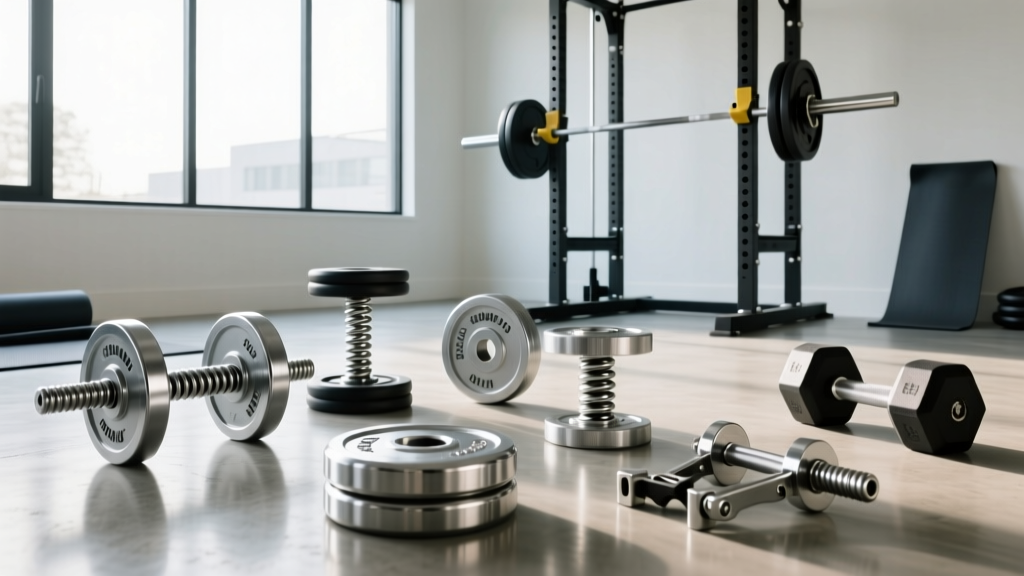
Barbell Collar Types: Beyond Dumbbell Exercises for Posture
Master your transition from dumbbell exercises for posture to heavy barbell lifts. Compare spring, aluminum, and clamp collars with 2026 pricing and specs.

The Biomechanical Bridge: From Posture Correction to Heavy Loading
In the modern strength and conditioning landscape, foundational programming often begins with targeted dumbbell exercises for posture. Movements like single-arm dumbbell rows, goblet squats, and farmer's walks are critical for correcting thoracic kyphosis, addressing scapular dyskinesis, and building the unilateral stabilizer strength required for heavier loads. However, once a lifter establishes structural integrity and transitions to heavy bilateral barbell training—such as back squats, deadlifts, and Olympic variations—the equipment requirements shift dramatically.
While dumbbells rely on fixed or adjustable internal mechanisms, barbells depend on external retention. The humble barbell collar is the single most vital safety component in your home or commercial gym. A failing collar during a heavy clean and jerk or a high-rep barbell cycling WOD doesn't just ruin a set; it alters the bar's moment of inertia, causing catastrophic plate shifts that can lead to severe spinal or joint injuries. According to safety guidelines emphasized by the National Strength and Conditioning Association (NSCA), securing Olympic sleeves with appropriate, high-tension collars is non-negotiable for dynamic lifts.
This 2026 in-depth buying guide compares every major barbell collar and clamp type on the market, breaking down material science, failure modes, and exact pricing to help you protect your lifts.
Comprehensive Barbell Collar and Clamp Types Comparison Matrix
Not all collars are created equal. The market is segmented into four primary categories, each engineered for specific training modalities. Below is our 2026 benchmark comparison chart.
| Collar Type | Primary Material | Locking Mechanism | Avg. Price (Pair) | Weight | Best Application |
|---|---|---|---|---|---|
| Spring Collars | High-Carbon Steel | Radial Tension | $25 - $40 | ~0.5 lbs | General Powerlifting, Basic Gym Use |
| Aluminum Locking | 6061 CNC Aluminum | Threaded Screw / Cam | $45 - $65 | ~1.2 lbs | Heavy Squats, Presses, Home Gyms |
| Composite Clamps | Glass-Filled Nylon | Lever-Action Jaw | $20 - $35 | ~0.8 lbs | CrossFit, High-Rep Barbell Cycling |
| Calibrated Competition | Cast Steel / Zinc | Threaded / IWF Spec | $150 - $220 | Exactly 2.5 kg | Olympic Weightlifting, Meets |
Deep Dive: Collar Categories, Specific Models, and Failure Modes
1. Spring Collars: The Traditional Standard
Spring collars utilize 4mm to 5mm high-carbon steel wire bent into overlapping coils. When compressed, they exert radial tension against the barbell sleeve.
- Top Model: Eleiko Olympic Spring Collars (~$38/pair).
- The Good: Incredibly fast to apply and remove; universal fit across almost all sleeve tolerances.
- The Bad & Failure Modes: Metal fatigue is the primary enemy. After roughly 1,000 to 1,500 applications, the steel loses its temper, reducing clamping force by up to 40%. Furthermore, they offer zero protection against barbell whip during dynamic movements.
2. Aluminum Locking Collars: The Heavy-Duty Workhorse
For static, heavy lifts where plate shift is unacceptable, CNC-machined aluminum collars are the gold standard. They feature an internal threading or cam-lever system that physically crushes the collar body against the steel sleeve.
- Top Model: Rogue Fitness Aluminum Collars (~$45/pair).
- The Good: Near-zero plate rattle. The inclusion of Delrin or Teflon inner washers prevents the aluminum from gouging and scratching your barbell's zinc or chrome finish.
- The Bad & Failure Modes: Slower to apply. If the internal Delrin washer cracks or falls out, the bare aluminum will permanently scar your barbell sleeves. Additionally, the threaded bolt mechanism can strip if over-tightened with excessive torque.
3. Composite / Plastic Clamp Collars: The Speed Demon
Constructed from injection-molded, glass-filled nylon, these lever-action clamps (often generically referred to by the pioneer brand, Lock-Jaw) snap over the sleeve and lock via a mechanical jaw.
- Top Model: Lock-Jaw Pro Olympic (~$30/pair).
- The Good: Unmatched speed. You can secure a 400lb barbell in under 3 seconds, making them mandatory for high-intensity interval training and CrossFit competitions.
- The Bad & Failure Modes: Environmental vulnerability. Glass-filled nylon becomes highly brittle in sub-50°F (10°C) temperatures. If you train in an uninsulated garage gym in the winter and drop a barbell loaded with composite collars, the hinges can shatter on impact.
4. Calibrated Competition Collars: The IWF Mandate
In Olympic weightlifting, the collar isn't just a safety device; it's part of the total lifted weight. The International Weightlifting Federation (IWF) strictly mandates that competition collars must weigh exactly 2.5 kilograms each.
- Top Model: Eleiko or DHS Calibrated Steel Collars (~$180+/pair).
- The Good: Absolute precision, indestructible build quality, and maximum sleeve compression.
- The Bad: Prohibitive cost and extreme weight make them impractical for 99% of home gym owners.
Olympic barbell sleeves are nominally 50mm in diameter. However, manufacturing tolerances mean actual sleeve diameters range from 49.8mm (often seen on budget import bars) to 50.4mm (common on premium needle-bearing bars like Eleiko or Urethane-coated Rogue bars). Clamp-style composite collars are highly sensitive to this variance. A clamp tuned for a 50.4mm sleeve will slide dangerously loose on a 49.8mm budget bar. Spring and threaded aluminum collars adapt to these micro-variances much more effectively.
Step-by-Step: Matching Collars to Your Training Progression
How do you choose? Use this decision framework based on your current training phase.
- Phase 1: Rehab & Posture (The Dumbbell Phase)
If your routine is heavily focused on dumbbell exercises for posture, core stabilization, and physical therapy, your barbell usage is likely limited to light, controlled movements (e.g., strict presses, light RDLs). Recommendation: Standard Spring Collars ($25). - Phase 2: Strength Building (The Power Phase)
You are now squatting, benching, and deadlifting heavy loads with slow eccentrics. Plate rattle is distracting and dangerous. Recommendation: Aluminum Locking Collars ($45). - Phase 3: Conditioning & Dynamics (The Athletic Phase)
You are incorporating power cleans, snatches, and high-rep touch-and-go deadlifts. Speed of loading is paramount. Recommendation: Composite Clamp Collars ($30), provided your gym stays above 50°F.
Frequently Asked Questions (FAQ)
Can I use standard spring collars for Olympic weightlifting?
While you physically can, it is highly discouraged. The rapid deceleration and extreme barbell whip generated during a missed snatch or heavy clean will easily overcome the radial tension of a spring collar, causing plates to slide outward. This shifts the center of gravity mid-lift, drastically increasing the risk of a rotational wrist or shoulder injury.
Do aluminum collars damage barbell sleeves?
Not if maintained properly. Premium aluminum collars feature a sacrificial inner lining made of Delrin (acetal resin) or high-density polyethylene. This plastic liner takes the friction. However, if you drop the collar on concrete and deform the inner ring, or if the liner wears through, the bare aluminum will act like a lathe and shave the zinc right off your barbell.
Why do my plastic clamp collars leave black marks on my bar?
This is a common issue with cheaper, non-glass-filled nylon clamps. The friction and heat generated during heavy, chalky lifts cause micro-abrasions on the plastic, transferring residue to the steel. Wiping your barbell sleeves with a nylon brush and 3-in-One oil weekly will mitigate this buildup.
Final Thoughts on Gym Safety
Progressing from targeted dumbbell exercises for posture to moving massive loads on a barbell is a rewarding journey that demands respect for physics and equipment limits. Your barbell collars are the final fail-safe between a successful personal record and a gym-floor disaster. Invest in the retention system that matches your specific training modality, check your sleeve tolerances, and inspect your collars for metal fatigue or plastic stress fractures every six months. In 2026, there is no excuse for compromised safety in the weight room.
More gear to consider
All reviews
Setup Guide: Bent Over Dumbbell Raise & Olympic Barbell Knurling

Beyond the 15 Minute Dumbbell Workout: 2026 Kettlebell Market Guide

Lat Pulldown Alternatives: Dumbbell Care (Rubber Hex vs Urethane)
EZ Curl Bar vs Straight Bar: Upgrading Your Dumbbell Workout Regimen
What Do Dumbbell Presses Work? 2026 Adjustable Dumbbell Setup & Review
