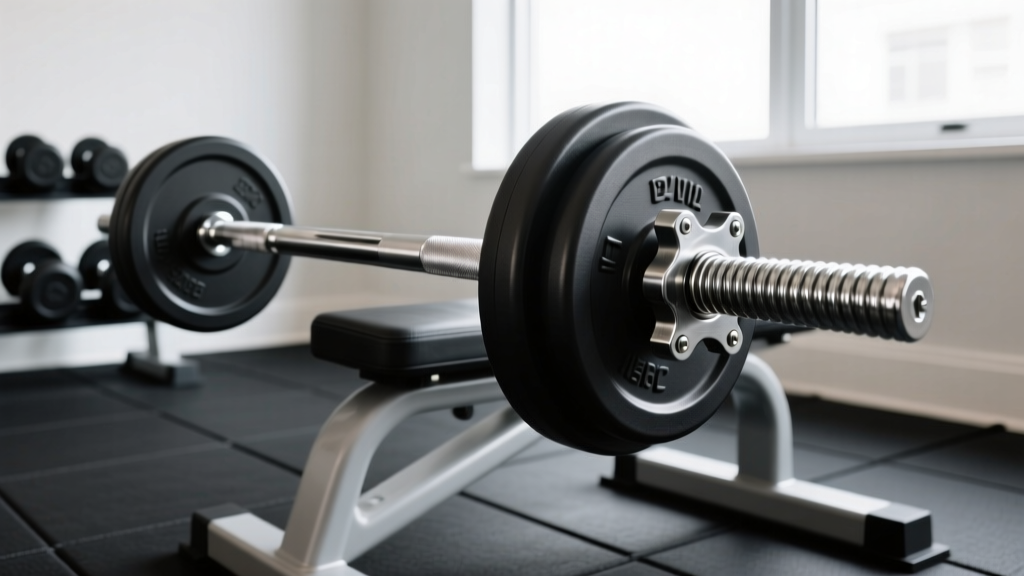
Barbell Collar Setup: Securing Handles for the Dumbbell Chest Raise
Master barbell collar installation for loadable dumbbells. Compare clamp types and learn safety setups for heavy dumbbell chest raise movements.

The Evolution of Loadable Dumbbells and Weight Security
For advanced lifters, standard fixed-weight dumbbells often cap out at 100 to 120 pounds in most commercial and home gyms. When your strength progresses beyond this threshold, particularly for isolation and stabilization movements like the heavy dumbbell chest raise (often executed as a floor or bench fly variation), loadable Olympic dumbbell handles become essential. However, transitioning from fixed implements to loadable handles introduces a critical safety variable: securing the plates.
Unlike a standard 7-foot barbell where plates are stacked deeply on a long sleeve, loadable dumbbell handles typically feature compact 10-inch to 12.5-inch sleeves. This limited real estate means your choice of barbell collar or clamp is not just a convenience—it is the primary failure point between a successful set and a catastrophic injury. In this complete setup and installation walkthrough, we will compare collar and clamp types, detail the exact installation procedure, and analyze the biomechanical stresses specific to the dumbbell chest raise.
⚠️ Safety Warning: Never use standard spring collars on loadable dumbbell handles for rotational movements. The short sleeve length and high torque of the dumbbell chest raise can easily compromise low-tension spring collars, leading to plate slippage and severe rotator cuff injuries.Collar vs. Clamp: A Mechanical Comparison Matrix
Before loading your handles, it is vital to understand the mechanical differences between the primary securing mechanisms available on the market. The terms 'collar' and 'clamp' are often used interchangeably, but their engineering differs vastly.
| Type / Model | Mechanism | Avg. Price (Pair) | Grip Force | Best Application |
|---|---|---|---|---|
| Lever-Action Collar (e.g., Rogue AX Collars) |
Aluminum body with TPU lining and cam-lever lock | $45.00 | High (Radial Compression) | Heavy loadable dumbbells, Olympic lifting |
| Squeeze Clamp (e.g., Lock-Jaw Pro) |
Glass-reinforced nylon with internal TPU teeth | $35.00 | Medium-High (Friction Fit) | Quick changes, standard barbell work |
| Spring Collar (e.g., Harbinger HG2) |
Heavy-gauge steel spring tension | $12.00 | Low-Medium (Tension Only) | Light accessories, straight-bar curls |
| Spin-Lock Collar (e.g., Traditional Chrome) |
Threaded steel nut on a threaded sleeve | $15.00 | Very High (Mechanical Thread) | Standard 1-inch non-Olympic handles |
For Olympic-sized (2-inch / 50mm) loadable dumbbell handles, lever-action collars like the Rogue AX Collars are the gold standard. The cam-lever mechanism applies uniform radial compression against the sleeve, preventing the collar from spinning independently of the handle—a crucial factor when the implement rotates in your grip.
Step-by-Step Installation Walkthrough
Proper installation is just as important as the equipment you choose. Follow this exact sequence to ensure maximum security on a 12.5-inch loadable dumbbell sleeve (such as the Rogue or Titan Fitness models).
- Sleeve Preparation: Wipe the dumbbell sleeve with a dry microfiber cloth. Remove any accumulated chalk, sweat, or oxidized metal dust. A slick sleeve reduces the coefficient of friction, allowing even high-end clamps to slide under heavy rotational torque.
- Plate Sequencing: Load your largest diameter plates first (e.g., 45lb or 25lb bumpers/steel plates), followed by smaller fractional plates. Ensure the plates are seated completely flush against the handle's inner flange.
- Collar Positioning: Slide the lever-action collar or clamp onto the sleeve. Push it firmly against the outermost plate. Crucial Detail: Leave exactly 1mm to 2mm of space between the plate and the collar's inner face before locking. If you jam it too tightly by hand, the lever mechanism will bind and fail to engage the TPU lining fully against the steel sleeve.
- Engaging the Lock: For lever collars, pull the lever outward and snap it flush against the collar body. You should hear a distinct metallic click. For squeeze clamps, compress the handles until the internal teeth bite into the sleeve, then release.
- The 'Shake Test': Grip the dumbbell handle and aggressively shake it laterally. If you hear a metallic 'clack' or see the plates shift, the collar is not seated properly. Unlock, push the collar 1mm deeper, and re-engage.
Biomechanical Stress: The Dumbbell Chest Raise
Why does this level of meticulous setup matter specifically for the dumbbell chest raise? According to biomechanical analyses documented in the ExRx biomechanics database, movements that involve a wide arc of motion with extended moment arms (like flies, raises, and pullovers) place exponential torque on the wrist and shoulder joints.
During a heavy dumbbell chest raise, the lifter's arms act as long levers. If a plate shifts even a quarter-inch outward on the sleeve, the center of mass of the dumbbell changes. This asymmetrical weight distribution forces the lifter's stabilizing muscles—specifically the rotator cuff and the anterior deltoid—to instantaneously compensate for the shifting load. In the bottom position of a chest raise, where the pectoral muscles are fully stretched and vulnerable, a sudden shift in the dumbbell's balance frequently results in severe pec tears or shoulder subluxations.
"When performing unilateral or independent free-weight isolation movements, the implement becomes an extension of the skeletal lever. Any mechanical play in the weight securing system translates directly into joint instability at the end-range of motion."
Sleeve Tolerance and Machining Edge Cases
Not all loadable dumbbell handles are machined equally. When sourcing equipment from various specialty fitness retailers, you will encounter different sleeve finishes:
- Bright Zinc / Chrome: Highly smooth. Requires collars with aggressive TPU (thermoplastic polyurethane) linings to prevent slipping during the dumbbell chest raise.
- Black Oxide: Offers a slightly higher coefficient of friction due to its matte, micro-porous finish. Squeeze clamps perform exceptionally well here.
- Stainless Steel: The most durable but often the most slippery. Lever-action collars with high cam-lever tension are mandatory.
Troubleshooting and Maintenance
Even the best barbell collars degrade over time. To maintain a safe setup for your loadable dumbbells, implement the following maintenance schedule:
1. Inspecting TPU Linings
Every 90 days, inspect the inner lining of your clamps. If the TPU shows deep grooves or 'memory rings' from the sleeve, the clamp has lost its radial compression capability. Replace the inserts or the entire collar immediately.
2. Spring Fatigue in Squeeze Clamps
If you use glass-reinforced nylon squeeze clamps, the internal stainless steel springs can lose tension after thousands of compression cycles. Test the tension by attempting to twist the clamp off the sleeve by hand. If it rotates with moderate force, the spring is dead.
3. Cleaning the Lever Hinge
Chalk dust inevitably works its way into the hinge pin of lever-action collars. Use compressed air and a drop of 3-in-One oil on the hinge pin monthly to ensure the lever snaps fully into the locked position without binding.
Frequently Asked Questions
Can I use standard barbell clamps on 1-inch standard loadable dumbbells?
No. Standard 1-inch dumbbell handles require threaded spin-lock collars. Friction-based Olympic clamps will not fit the 25mm sleeve diameter and will slide off immediately under load.
Do I need two collars per dumbbell?
Yes. Unlike a barbell where you use one collar per side, a loadable dumbbell requires one collar on its single sleeve. Therefore, a 'pair' of collars secures a pair of dumbbells.
Are bumper plates safe for loadable dumbbell chest raises?
Bumper plates are safe, but their thick profile (often 2.5 to 3 inches per 10lb plate) limits how much weight you can load on a 10-inch sleeve. For heavy chest raises, thin steel calibrates or fractional plates are preferred to maximize sleeve space and ensure the collar has adequate surface area to grip.
More gear to consider
All reviews
Cast Iron vs Competition Kettlebell Care: Upgrading Your Dumbbell Back Workout at Home
Best Neoprene Dumbbells for Home Gyms & Dumbbell Waiters Curl

Maximizing Dumbbell Lunges Benefits: Adjustable Dumbbell Setup & 2026 Review

Space Layouts for Alternate Incline Dumbbell Curls: Hex vs Urethane

Bumper vs Iron Plate Maintenance & Dumbbell Lateral Press Care
