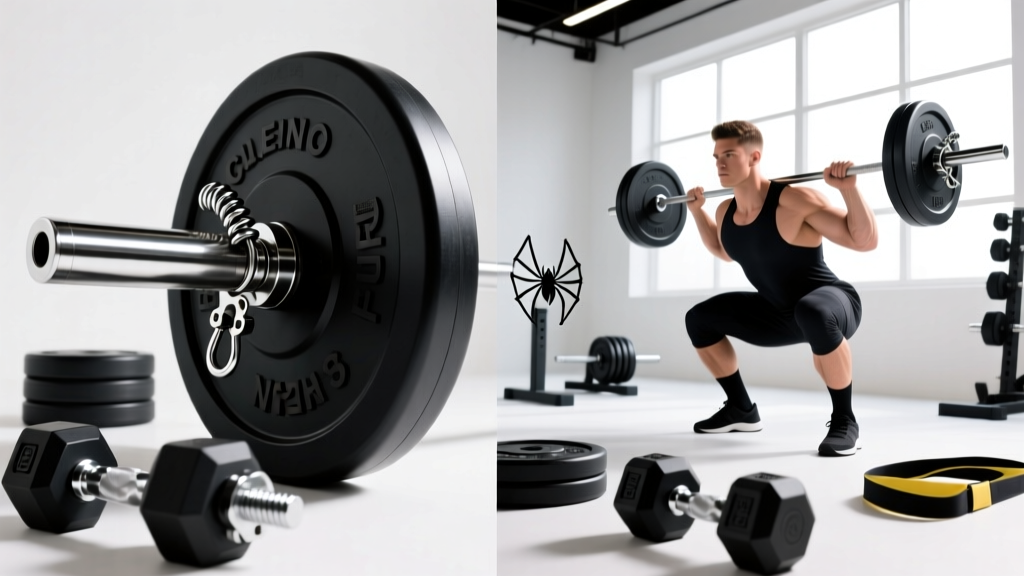
Barbell Collar Guide: Heavy Lifts & Dumbbell Spider Curl
Compare barbell collar and clamp types for 2026. Discover the best locking mechanisms for heavy squats and strict isolation like the dumbbell spider curl.

Introduction: The Unsung Heroes of the Rack
When building a comprehensive free weights and racks setup, lifters obsess over barbell whip, rack stability, and plate calibration. Yet, the most critical safety component in your gym is often the cheapest: the barbell collar. Whether you are bracing for a 400lb back squat or meticulously setting up for an isolation superset featuring the dumbbell spider curl, securing your plates is non-negotiable. In 2026, the market is flooded with varying clamp technologies, from basic torsion springs to aerospace-grade locking mechanisms.
This in-depth buying guide compares the primary barbell collar and clamp types available today. We will break down lateral holding forces, material durability, and specific use cases, ensuring your equipment is as safe as it is effective.
Expert Safety Warning: According to safety guidelines emphasized by the National Strength and Conditioning Association (NSCA), failing to secure weight plates is a leading cause of asymmetric loading injuries. A shifting plate alters the bar's center of gravity mid-lift, which can result in severe spinal torsion during squats or catastrophic wrist tears during curls.The Physics of Plate Shift and Lateral Holding Force
Before comparing models, we must understand lateral holding force—the amount of outward pressure a collar can withstand before a plate slides. When you drop a barbell from the top of a power clean, the deceleration forces the plates outward. Cheap collars fail here. Furthermore, during strict isolation movements, even minor plate shifts ruin the biomechanical intent of the exercise. This is why understanding collar mechanics is vital for every phase of your training.
The 4 Primary Barbell Collar Categories
1. Spring / Snap Collars
The traditional chrome or plastic-coated spring collar relies on torsion springs to clamp onto the bar sleeve. While ubiquitous in commercial gyms, they are the weakest link in a serious home gym.
- Pros: Extremely fast to load and unload; very cheap (usually under $15 per pair).
- Cons: Low lateral holding force (typically 15-25 lbs); springs suffer metal fatigue and lose tension within 6 to 12 months of heavy use.
- Best For: Light Olympic lifting, technique work, and group fitness classes where speed matters more than heavy load security.
2. Clamp / Cam-Lock Collars
Clamp collars use a lever-action cam to squeeze a nylon or aluminum ring against the bar sleeve. The Rogue HG 2.0 Collars are the industry benchmark here, utilizing glass-filled nylon that resists cracking under extreme pressure.
- Pros: High lateral holding force (150+ lbs); lightweight (approx. 0.55 lbs per collar); highly durable.
- Cons: Can be slightly slower to lock than spring collars; nylon variants can warp if left in direct, intense UV sunlight for years.
- Best For: CrossFit, powerlifting, and general strength training. They are the undisputed workhorses of the modern garage gym.
3. Locking Jaw / Polycarbonate Collars
Lock-Jaw collars feature a unique polycarbonate build with a secondary locking tab that prevents the primary lever from accidentally bumping open. Priced around $35 per pair in 2026, they offer a middle ground between standard clamps and competition gear.
- Pros: Secondary safety lock prevents accidental release; excellent grip on slightly worn or oxidized barbell sleeves.
- Cons: Heavier than standard nylon clamps; the locking tab mechanism can accumulate chalk dust and require periodic cleaning.
- Best For: Heavy deadlifts, strongman training, and environments where bars are frequently dropped from overhead.
4. Competition / Calibrated Collars
Mandated by the International Weightlifting Federation (IWF), competition collars are massive, precision-engineered pieces of steel or heavy-duty aluminum. They weigh exactly 2.5 kg (5.5 lbs) each and serve as calibrated weight, not just safety devices.
- Pros: Absolute maximum holding force; counts toward the total barbell weight; indestructible under normal use.
- Cons: Very expensive ($90 to $150+ per pair); heavy and cumbersome to handle quickly.
- Best For: Olympic weightlifting competitions, elite powerlifting meets, and calibrated plate training.
Comparison Matrix: Clamp Types Head-to-Head
| Collar Type | Model Example | Lateral Force | Weight (Each) | Price Range (2026) |
|---|---|---|---|---|
| Spring / Snap | Harbinger Bio-Fit | ~20 lbs | 0.25 lbs | $10 - $15 |
| Cam-Lock Clamp | Rogue HG 2.0 | 150+ lbs | 0.55 lbs | $13 - $18 |
| Locking Jaw | Lock-Jaw Pro | 120+ lbs | 0.75 lbs | $30 - $40 |
| Competition | Eleiko IWF Collar | 500+ lbs | 5.50 lbs | $95 - $150 |
Biomechanics & Safety: Collars in Isolation Movements
While heavy compound lifts pose obvious crushing hazards, isolation exercises present unique biomechanical risks when collars fail. Consider the programming of an arm day where an athlete transitions from heavy barbell rows to strict isolation work like the dumbbell spider curl. The dumbbell spider curl relies on independent weights to allow for natural wrist supination and a deep stretch at the bottom of the movement.
However, if a lifter opts for the barbell or EZ-bar equivalent of this movement on a spider bench, collar security becomes paramount. During a strict spider curl, the arms are entirely isolated, and the lifter cannot use body english to stabilize the load. If a 2.5lb or 5lb plate shifts outward by just one inch during the concentric phase, the moment arm changes instantly. This alters the resistance curve, shifting the load unevenly between the left and right bicep, and placing dangerous shear stress on the distal bicep tendon of the overloaded arm. Using a high-tension cam-lock collar ensures the weight distribution remains perfectly symmetrical, preserving the mind-muscle connection and protecting your joints.
"In strict isolation movements, symmetry is everything. A shifting plate doesn't just ruin the set; it introduces micro-traumas to stabilizing tendons that are already under maximum tension." — Dr. Stuart McGill, Biomechanics Expert (Paraphrased Principle)
2026 Buying Framework: How to Choose
When outfitting your home gym or commercial facility, use this decision framework to select the right collar:
- Assess Your Drop Frequency: If you regularly drop barbells from overhead (snatches, cleans, or high-rep WODs), avoid spring collars entirely. Invest in Cam-Lock or Lock-Jaw collars to prevent plates from sliding and damaging your bumper plates or barbell sleeves.
- Consider Barbell Sleeve Condition: If your barbells have heavily oxidized or scratched sleeves, standard nylon clamps might struggle to grip. Lock-Jaw collars or aluminum competition collars with internal rubber linings provide superior bite on damaged steel.
- Calculate Weight Sensitivity: For bench press and strict isolation work where every fraction of a pound matters, remember that heavy competition collars add 5.5 lbs per side to your total load. Standard clamps add roughly 0.5 lbs, which is negligible for most lifters but vital for precise micro-loading.
Expert FAQ
Do I need collars for dumbbell exercises?
No. Exercises utilizing dumbbells, such as the dumbbell spider curl, do not require collars as the weight is fixed or secured via the dumbbell's internal mechanism (in adjustable models). Collars are strictly for barbells, EZ-curl bars, and safety squat bars.
Can I use standard 1-inch collars on an Olympic barbell?
Never attempt this. Olympic barbells feature 2-inch (50mm) sleeves. Using 1-inch collars on an Olympic bar with adapter sleeves is highly dangerous, as the adapters can slip, causing the collar and plates to slide off mid-lift.
How often should I replace my spring collars?
If you train 3-4 times a week, standard spring collars should be replaced every 6 to 9 months. The torsion springs lose their tension over time, drastically reducing their lateral holding force and compromising your safety.
Are aluminum collars better than nylon?
Aluminum collars (like the Rogue Aluminum Collars) offer a premium feel and excellent durability, but glass-filled nylon (like the HG 2.0) is virtually unbreakable and won't scratch your barbell sleeves if dropped. For 95% of lifters, high-quality nylon is the superior, cost-effective choice in 2026.
More gear to consider
All reviews
Bumper vs Iron Plates: Layouts & CrossFit Exercises with Dumbbells
Olympic vs Standard Plates & Amazon Basics Rubber Hex Dumbbell Hand Weight
Bumper vs Iron Plates: Budgeting for Deadlifts & Dumbbell Pull Overs

Storage Racks & Care for Exercises With 5 Pound Dumbbells

Bumper vs Iron Plates: 2026 Trends for Your Dumbbell Strength Program
