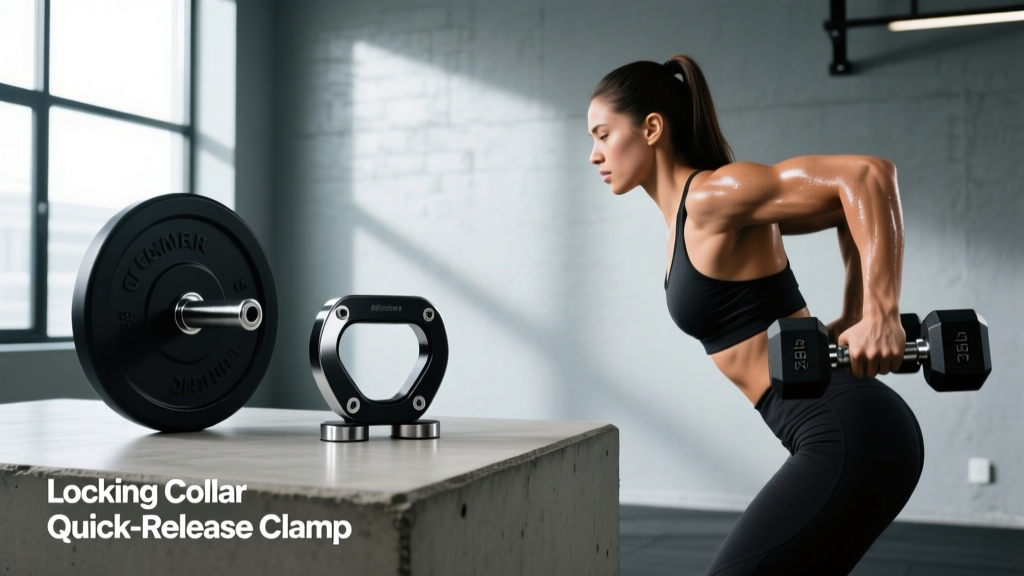
Barbell Collar Comparison & Upper Back Workouts with Dumbbells
Compare barbell collar and clamp types for heavy lifting safety, then transition to effective upper back workouts with dumbbells for complete development.

The Architecture of a Complete Back Day: Security and Isolation
Building a dense, resilient posterior chain requires a dual-phase approach to training. The foundation is laid with heavy, axial-loaded compound movements like barbell rows and deadlifts. However, the safety and efficacy of these heavy lifts rely entirely on equipment security—specifically, your choice of barbell collars. Once the heavy central nervous system (CNS) tax is paid, the workout must pivot to targeted isolation to develop the rhomboids, rear deltoids, and trapezius. This is where upper back workouts with dumbbells become the cornerstone of hypertrophy and postural correction.
In this comprehensive 2026 equipment and programming guide, we break down the exact mechanics, materials, and failure modes of modern barbell clamps, before transitioning into biomechanically optimized dumbbell routines for the upper back.
The Physics of Sleeve Security: Why Collars Matter
An Olympic barbell sleeve has a standard diameter of 50mm. When you load bumper or cast-iron plates, lateral shift during dynamic movements (like Pendlay rows or snatches) alters the moment arm of the barbell. According to biomechanics principles outlined by the National Strength and Conditioning Association (NSCA), even a minor asymmetrical plate shift of 1.5 inches can create enough rotational torque to cause a missed lift or severe wrist injury. A collar’s primary job is not just to keep plates from falling off, but to eliminate lateral micro-movements that degrade bar path stability.
Barbell Collar and Clamp Types Comparison Matrix
The fitness equipment market in 2026 offers a wide array of clamping mechanisms. Below is a detailed comparison of the four primary collar types used in commercial and home gyms.
| Collar Type | Brand/Model Benchmark | Primary Material | Avg. Price (2026) | Clamping Force & Best Use |
|---|---|---|---|---|
| Spring Clip | Rogue HG 2.0 Collars | Chrome-plated steel spring | $15 - $20 / pair | ~150 lbs force. Best for quick plate changes and standard powerlifting. |
| Lever Clamp | Lock-Jaw Pro | Glass-filled nylon | $28 - $35 / pair | High static grip. Best for CrossFit/drops where spring fatigue is a concern. |
| Spinlock | York Standard Threaded | Cast iron / Steel | $12 - $18 / pair | Infinite thread tension. Best for home gyms; slow for commercial use. |
| Competition | Eleiko IWF Competition | Anodized aluminum, steel bearings | $85 - $110 / pair | Maximum IWF-rated grip. Essential for Olympic weightlifting. |
Material Degradation and Edge Cases: What Brands Don't Tell You
When investing in clamps, understanding material failure modes is critical for long-term safety.
⚠️ WARNING: Nylon Hinge DegradationGlass-filled nylon lever clamps (like the popular Lock-Jaw series) are incredibly secure for static lifts. However, if used repeatedly for overhead drops (e.g., failed snatches or heavy cleans), the plastic latch hinge is prone to micro-fractures. Over 12-18 months of aggressive dropping, the hinge can snap mid-lift. Reserve nylon clamps for squats, bench presses, and rows; use steel spring clips or competition collars for Olympic lifts.
The Chalk Dust Factor in Competition Collars
High-end aluminum competition collars, such as those certified by Eleiko Sport, utilize internal steel roller bearings to grip the sleeve without scratching the zinc or chrome finish. The edge case here is environmental: in heavy chalk environments, magnesium carbonate dust infiltrates the bearing housing. This causes the rollers to seize, resulting in the collar sliding freely off the sleeve during a lift. Maintenance requires monthly compressed-air blowouts of the bearing mechanism.
Transitioning to Isolation: Upper Back Workouts with Dumbbells
Once your heavy barbell rows are secured and completed, the spine has endured significant shear force. To continue stimulating the posterior chain without adding compressive loads to the lumbar vertebrae, you must pivot to upper back workouts with dumbbells. Dumbbells allow for unilateral deficit correction, an extended range of motion (ROM), and varied grip angles that barbells simply cannot accommodate.
The American Council on Exercise (ACE) emphasizes that varying the angle of pull is essential for complete recruitment of the trapezius (upper, middle, and lower fibers) and the rhomboid major and minor.
1. The Chest-Supported Incline Row (Rhomboid & Mid-Trap Focus)
By removing the lower back from the equation, you can train the upper back to absolute failure safely.
- Setup: Set an adjustable bench to a 30-degree or 45-degree incline. Lie prone with a neutral-grip dumbbell in each hand.
- Execution: Drive the elbows toward the ceiling, squeezing the scapulae together at the apex. Hold the isometric contraction for 2 full seconds.
- Loading Parameter: 3 sets of 12-15 reps. Use 35-50 lb dumbbells for intermediate lifters. The 2-second pause eliminates momentum and forces the rhomboids to handle the entire load.
2. The Batwing Row (Lower Trap & Postural Correction)
The Batwing row is a staple in elite powerlifting circles to build the upper back 'shelf' required for a stable barbell squat.
- Setup: Lie completely flat on a standard horizontal bench. Let the dumbbells hang straight down to the floor with a pronated (overhand) grip.
- Execution: Pull the dumbbells toward your hip pockets, flaring the elbows out at a 45-degree angle. The goal is to touch the medial head of the dumbbell to your ribcage.
- Biomechanical Cue: Do not let your chest lift off the bench. If your sternum leaves the pad, the weight is too heavy, and you are substituting spinal extension for scapular retraction.
3. Dumbbell Reverse Flye with External Rotation (Rear Delt Focus)
'The rear deltoids are often the most underdeveloped muscle group in the upper back, leading to internally rotated shoulders and poor bench press mechanics.' — Sports Biomechanics Journal
To target the rear delts, bend at the hips (hip hinge) until your torso is nearly parallel to the floor. With a slight bend in the elbows, raise the dumbbells laterally. At the top of the movement, externally rotate your hands so the pinky side of the dumbbell points toward the ceiling. This micro-adjustment drastically increases electromyographical (EMG) activation in the posterior deltoid.
Programming Your Back Day: A 2026 Template
Integrating heavy barbell work with targeted dumbbell isolation requires careful volume management to avoid CNS burnout. Below is a proven hypertrophy and strength template:
| Exercise | Equipment | Sets x Reps | Rest Interval | RPE (Rate of Perceived Exertion) |
|---|---|---|---|---|
| Pendlay Row | Olympic Barbell + Spring Collars | 4 x 6-8 | 120-180 sec | 8.5 |
| Chest-Supported Incline Row | Adjustable Bench + Hex Dumbbells | 3 x 12-15 | 90 sec | 9.0 (2-sec pause) |
| Batwing Row | Flat Bench + Hex Dumbbells | 3 x 10-12 | 90 sec | 9.5 (Near failure) |
| Reverse Flye (External Rotation) | Neoprene/Light Iron Dumbbells | 3 x 15-20 | 60 sec | 8.0 (Burnout) |
Frequently Asked Questions
Can I use nylon lever clamps for bench pressing?
Yes, nylon lever clamps are excellent for bench pressing. Because the barbell is not being dropped from overhead or subjected to violent rotational torque (as in Olympic lifts), the static clamping force of glass-filled nylon is more than sufficient to keep plates secure during the bench press.
Why use dumbbells instead of cables for upper back workouts?
While cables provide constant tension, dumbbells require you to stabilize the weight in three-dimensional space. This recruits the rotator cuff and deep spinal stabilizers, making upper back workouts with dumbbells superior for overall joint health and functional athletic carryover.
How tight should a spinlock collar be?
A spinlock collar should be tightened until the threaded nut makes firm contact with the outermost plate, plus an additional quarter-turn by hand. Do not use a wrench or pliers, as over-torquing can strip the zinc threads on the barbell sleeve, permanently ruining the bar.
More gear to consider
All reviews
Power Rack vs Squat Rack vs Stand for Triceps Pull Down Dumbbell

Cast Iron vs Competition Kettlebells & Dumbbell Curls Muscles Worked

Olympic Barbell Knurling Guide & Water Dumbbells Weight Equivalent

Single Handed Dumbbell Row: 2026 Rack & Storage Trends

Is Cable Lateral Raise Better Than Dumbbell? Loadable Dumbbell Guide
