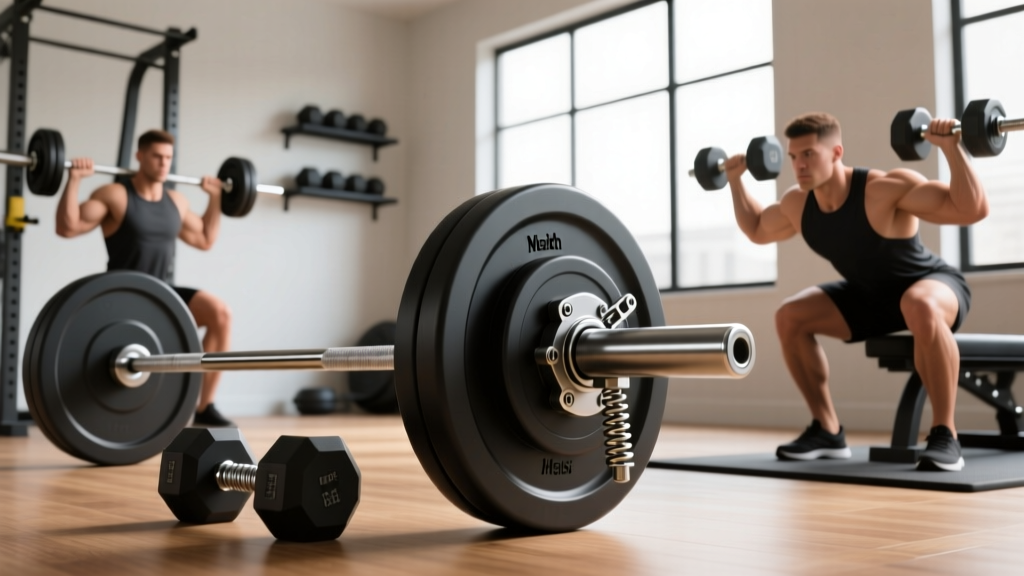
Barbell Collar vs Clamp Comparison & Dumbbell Exercises With Pictures
Compare barbell collar and clamp types for safety, then master your routine with our visual guide to essential dumbbell exercises with pictures.

The Great Debate: Barbell Collar vs. Clamp Types Comparison
Weightlifting safety and performance hinge on two critical pillars: securing your plates to prevent catastrophic shifts, and executing flawless biomechanics during accessory work. In 2026, the market for barbell securing mechanisms is more saturated than ever, leaving many lifters wondering which tool actually keeps 45-pound bumpers from sliding off a 50mm Olympic sleeve during a heavy deadlift drop. In this guide, we deliver a comprehensive barbell collar and clamp types comparison, followed by a visual breakdown of essential dumbbell movements.
Whether you are loading up for a 500lb deadlift or transitioning to high-rep accessory work, understanding the mechanical differences between spring collars, cam-lever clamps, and competition locks is non-negotiable for gym safety.
1. Spring Collars (The Traditionalist)
Spring collars, like the classic Rogue Spring Collars (priced around $15 per pair), rely on the tension of coiled steel to grip the barbell sleeve. They are lightweight, incredibly fast to apply, and cheap to replace. However, their grip strength is entirely dependent on the user's hand strength to compress the springs. On a standard 50mm Olympic bar, they provide adequate friction for bench pressing and strict pressing, but they severely lack the clamping force required for high-impact drops.
2. Clamp-Style Collars (The Workhorse)
Clamp-style collars utilize a cam-lever or screw-thread mechanism to apply direct, crushing pressure onto the sleeve. The Rogue HG 2.0 Collars ($40/pair) and the Lock-Jaw Pro 2 ($35/pair) are the undisputed kings of the commercial and home gym space. They feature an internal TPU (thermoplastic polyurethane) lining that grips the steel sleeve without scratching the zinc or chrome finish. The mechanical advantage of the lever means a lifter can apply hundreds of pounds of clamping force with a simple flick of the wrist.
3. Competition Locking Collars (The Elite Standard)
For powerlifters and Olympic weightlifters, collars are not just safety devices; they are calibrated weights. The Eleiko IWF Approved Competition Collars (approximately $85/pair) weigh exactly 2.5kg each and feature a threaded, locking screw mechanism that bites directly into the sleeve. According to International Powerlifting Federation (IPF) technical rules, competition collars must be used to secure the bar, ensuring that the lateral movement of plates is entirely eliminated during the squat and deadlift.
Head-to-Head Collar Matrix
| Collar Type | Model Example | Price Range | Grip Mechanism | Best Use Case | Drop-Test Survival |
|---|---|---|---|---|---|
| Spring | Rogue Spring Collars | $12 - $18 | Steel Coil Tension | Bench Press, Light Oly Work | Poor (Slips on impact) |
| Clamp (Lever) | Lock-Jaw Pro 2 | $30 - $45 | Cam-Lever + TPU Pad | Heavy Deadlifts, CrossFit | Excellent (Holds firm) |
| Competition | Eleiko IWF Locks | $80 - $95 | Threaded Screw Bite | IPF/IWF Meets, Max Effort | Flawless (Zero shift) |
Failure Modes: When Collars Slip and Plates Shift
To truly understand the value of a premium clamp, we must examine failure modes. The most common edge case occurs during heavy deadlift drops. When a loaded barbell hits the platform, kinetic energy travels down the bar and into the sleeves, causing a phenomenon known as 'sleeve whip' or oscillation.
Expert Warning: Over time, the TPU lining on clamp-style collars accumulates microscopic chalk dust and zinc shavings from the barbell sleeve. This creates a slippery paste that can reduce friction by up to 40%. Wipe your clamp pads with a damp microfiber cloth and isopropyl alcohol once a month to maintain maximum grip.
If a spring collar is used during a heavy drop, the oscillation can literally bounce the collar off the end of the sleeve, resulting in a 45lb plate sliding off one side. This creates an immediate, asymmetrical load that can torque the lifter's spine on the next rep. Clamp collars with fresh TPU pads, however, absorb this micro-vibration and hold the plates flush against the inner sleeve lip.
Securing Adjustable Dumbbells: Spinlocks vs. Lever Clamps
Once your barbell is secured, many lifters transition to accessory work. If you are using plate-loaded adjustable dumbbells, the securing mechanism is just as critical. Standard 1-inch spinlock collars are notoriously slow to thread and often loosen during high-rep sets due to the rotational torque of the wrist.
For Olympic 2-inch dumbbell handles, lever clamps like the Lock-Jaw Dumbbell Clamp ($25/pair) are vastly superior. They allow for rapid weight changes and provide the same cam-lever security as their barbell counterparts, ensuring your plates don't rattle or shift during unilateral movements.
Mastering the Movement: Dumbbell Exercises With Pictures
While text cues are vital for understanding biomechanics, visual learners benefit immensely from studying dumbbell exercises with pictures. Proper form prevents joint degradation and maximizes muscle fiber recruitment. Below, we break down the visual form cues for three foundational movements, referencing the ExRx Kinesiology Database and the ACE Fitness Exercise Library for anatomical accuracy.
1. Dumbbell Romanian Deadlift (RDL)

The DB RDL is a masterclass in posterior chain development. Unlike a conventional deadlift, the RDL relies on a controlled eccentric (lowering) phase to stretch the hamstrings under load.
- Visual Cue 1: Imagine closing a car door with your glutes. Your hips must travel horizontally backward before your torso tilts forward.
- Visual Cue 2: The dumbbells should act as an extension of your arms, grazing your thighs and knees throughout the descent. If the dumbbells drift forward, you will place excessive shear force on your lumbar spine.
- Execution: Lower the weight for a strict 2-second count, stopping exactly when your pelvis stops rotating backward (usually just below the knee).
2. Dumbbell Floor Press

Popularized by powerlifters to build lockout strength, the floor press removes the stretch reflex from the pectorals and shifts the burden to the triceps brachii and anterior deltoids.
- Visual Cue 1: At the bottom of the movement, your triceps should rest gently on the floor, with your elbows tucked at a 45-degree angle relative to your torso. Flaring the elbows to 90 degrees invites rotator cuff impingement.
- Visual Cue 2: Drive the dumbbells up and slightly inward, stopping just short of a hard elbow lockout to maintain continuous tension on the triceps.
3. Dumbbell Goblet Squat

The goblet squat is the ultimate diagnostic tool for squat mechanics. Holding a single heavy dumbbell vertically against your chest acts as a counterbalance, allowing lifters to achieve deeper hip and ankle flexion without falling backward.
- Visual Cue 1: Grip the top of the dumbbell tightly, pulling it into your sternum. This engages the lats and stabilizes the thoracic spine.
- Visual Cue 2: As you descend, actively pull your torso down between your thighs using your hip flexors. Your elbows should track inside your knees at the bottom position, gently pushing the knees outward to prevent valgus collapse.
Final Verdict: Building Your 2026 Rack Setup
When outfitting your gym, never compromise on the hardware that keeps you safe. For general barbell work, a high-quality clamp-style collar like the Rogue HG 2.0 offers the best balance of speed, grip strength, and durability. Reserve spring collars for light, high-speed Olympic lifting variations where rapid barbell loading is required. For competition-level security, invest in threaded locking collars.
Finally, whether you are securing a 500lb barbell or a pair of 50lb adjustable dumbbells, the execution of the lift remains paramount. Use the visual form cues and structural breakdowns provided in our dumbbell exercises with pictures guide to ensure every rep is safe, effective, and biomechanically sound.
More gear to consider
All reviews
Chest Workout with Dumbbells and Bench: Loadable Dumbbell Care

Bumper vs Iron Plate Comparison & Serratus Workout Dumbbell Guide
Cast Iron vs Competition Kettlebells & Leg Press Plate for Smith Machine
Fixing Plate Mistakes in Dumbbell Workouts for Biceps and Chest

Power Rack vs Squat Rack for CrossFit Dumbbell Exercises
