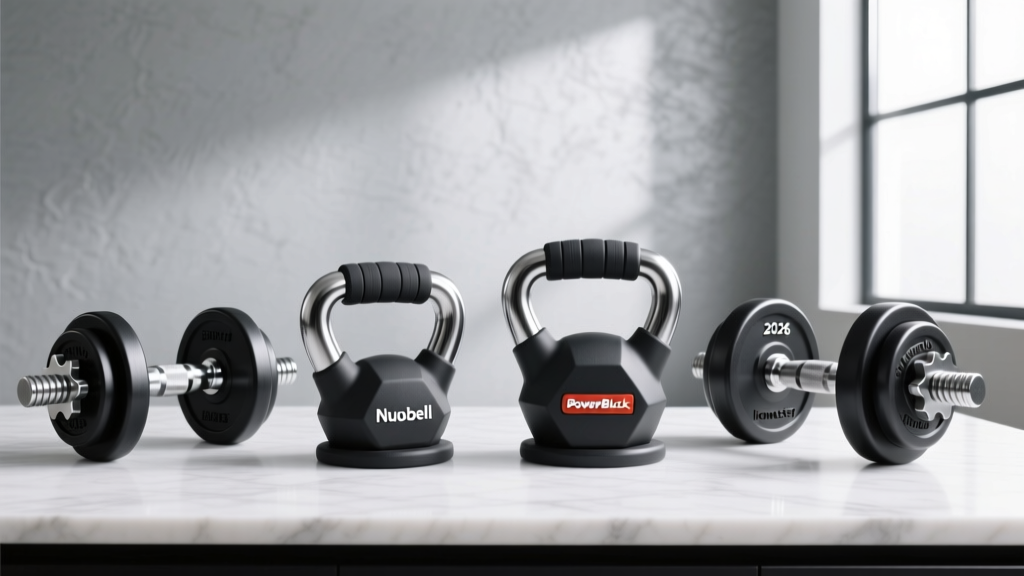
Dumbbell Cost Per Pound: 2026 Adjustable Model Comparison
We analyze the 2026 adjustable dumbbell cost per pound across Bowflex, Nuobell, PowerBlock, and Ironmaster to find the ultimate home gym value.

The Economics of Iron: Why Dumbbell Cost Per Pound Matters in 2026
Building a home gym in 2026 requires navigating a complex landscape of supply chain shifts, material costs, and spatial constraints. While commercial gyms have the luxury of dedicating 100 square feet to a full dumbbell rack, home lifters must balance budget, footprint, and functionality. This is where the dumbbell cost per pound metric becomes the ultimate equalizer. Instead of looking at the sticker price of a single adjustable set, calculating the cost per pound allows us to directly compare adjustable mechanisms against traditional fixed rubber hex or urethane dumbbells.
The Formula: To find the true dumbbell cost per pound for an adjustable set, we divide the total retail price of the pair by the maximum combined weight of both dumbbells. For example, a $400 pair that adjusts up to 50 lbs each (100 lbs total) equals $4.00 per pound.Fixed rubber hex dumbbells currently average $1.70 to $2.20 per pound, while commercial-grade urethane sets push $3.50 to $5.00+ per pound. How do the top adjustable contenders stack up when we apply this rigorous financial lens? Let us break down the Big Four.
Head-to-Head: The Big Four Adjustable Dumbbells
1. Bowflex SelectTech 552 (V2)
The Bowflex 552 remains the most recognizable adjustable dumbbell on the market. Utilizing a dual-dial system, it adjusts from 5 to 52.5 lbs per dumbbell in 2.5 lb increments (up to 25 lbs) and 5 lb increments thereafter.
- 2026 MSRP: $429 per pair
- Total Max Weight: 105 lbs
- Dumbbell Cost Per Pound: $4.08 / lb
- Failure Mode Edge Case: The internal plastic tracking gears and outer dial housing are vulnerable to impact. Dropping the dumbbell from shoulder height during a fatigued set of lateral raises can shatter the dial, locking the weight plates permanently. Bowflex has improved the V2 housing with reinforced polymers, but it remains strictly a 'no-drop' implement.
2. Nuobell 80 LB
Nuobell disrupted the market by mimicking the exact form factor of a traditional fixed dumbbell. By twisting the knurled handle, users engage a pin that selects the plates, adjusting from 5 to 80 lbs in 5 lb increments.
- 2026 MSRP: $749 per pair
- Total Max Weight: 160 lbs
- Dumbbell Cost Per Pound: $4.68 / lb
- Failure Mode Edge Case: The primary risk with Nuobell is user error during plate seating. If the handle is not twisted back to the exact zero-degree lock position, the internal retention pin may not fully engage, causing a 20 lb steel plate to detach mid-rep. Furthermore, the exposed steel plates require regular wiping to prevent oxidation in humid garage environments.
3. PowerBlock Elite EXP (90 lb Expansion Set)
PowerBlock utilizes a cage-and-pin design that prioritizes indestructibility over traditional aesthetics. The Elite EXP series is modular, allowing users to buy the base 50 lb set and expand to 70 or 90 lbs later.
- 2026 MSRP (90 lb Set): $849 per pair
- Total Max Weight: 180 lbs
- Dumbbell Cost Per Pound: $4.71 / lb
- Failure Mode Edge Case: Mechanically, the PowerBlock is nearly bulletproof. The steel pin and welded cage can survive repeated drops onto rubber flooring. The edge case here is ergonomic: the square cage restricts certain movements, such as deep goblet squats or traditional dumbbell lunges, where the blocky frame can dig into the wrists or thighs.
4. Ironmaster Quick-Lock V2 (90 lb Kit)
Ironmaster takes a traditional approach, using a screw-in locking mechanism that physically bolts the weight plates onto a solid steel handle. It is the closest an adjustable dumbbell gets to the structural integrity of a fixed pro-style dumbbell.
- 2026 MSRP (90 lb Kit): $899 per pair
- Total Max Weight: 180 lbs
- Dumbbell Cost Per Pound: $4.99 / lb
- Failure Mode Edge Case: There are virtually no mechanical failure modes; you can drop these from overhead without consequence. The 'failure' is purely temporal: changing weights requires unscrewing and rescrewing the locking pins, taking roughly 15 to 20 seconds per dumbbell. This makes them unsuitable for drop sets or fast-paced supersets.
2026 Comparison Matrix
| Model | Max Weight (Pair) | Total Cost | Cost Per Pound | Adjustment Speed |
|---|---|---|---|---|
| Bowflex 552 V2 | 105 lbs | $429 | $4.08 | 2 Seconds |
| Nuobell 80 | 160 lbs | $749 | $4.68 | 3 Seconds |
| PowerBlock Elite 90 | 180 lbs | $849 | $4.71 | 4 Seconds |
| Ironmaster V2 90 | 180 lbs | $899 | $4.99 | 20 Seconds |
The Hidden Costs: Rack Compatibility and Maintenance
When evaluating the dumbbell cost per pound, the sticker price is only the beginning of the financial equation. Home gym owners must also factor in storage and maintenance, which vary wildly between these four systems.
Storage and Footprint Economics
According to comprehensive home gym analyses by Garage Gym Reviews, spatial efficiency is often the primary driver for buying adjustable dumbbells. However, not all adjustable dumbbells fit standard commercial racks.
- Bowflex & Nuobell: Require their specific proprietary trays. If you are integrating them into a standard power rack, you will need to purchase aftermarket adapter shelves (roughly $60-$90), slightly inflating the overall cost per pound.
- PowerBlock: The square cage fits poorly on standard J-cups or saddle-style dumbbell racks. You must store them on a flat shelf or the floor.
- Ironmaster: Because they mimic traditional dumbbell dimensions, they fit seamlessly onto any standard 3-tier A-frame dumbbell rack or rack-mounted saddle, requiring zero accessory purchases.
Long-Term Maintenance and Depreciation
Fixed dumbbells require zero maintenance. Adjustable dumbbells, however, introduce mechanical complexity. Industry experts at BarBend frequently note that selectorized mechanisms require periodic cleaning to prevent dust and chalk buildup from jamming the internal pins. Nuobell and Bowflex mechanisms should be lightly lubricated with dry PTFE spray annually. Ironmaster and PowerBlock require virtually zero maintenance beyond wiping down the knurling to prevent rust.
"If your training methodology relies heavily on drop sets, rest-pause sets, or rapid supersets, the time-cost of adjusting your weights outweighs the financial savings. In those specific scenarios, buying three pairs of fixed hex dumbbells (e.g., 25s, 40s, and 60s) at $2.00 per pound is a superior investment to a single pair of screw-in adjustables."
Decision Framework: Which Setup Fits Your Budget?
The Budget & Space-Conscious Lifter
Winner: Bowflex SelectTech 552
At $4.08 per pound, it is the most affordable entry point. It perfectly serves lifters whose working sets for isolation movements (curls, lateral raises) rarely exceed 40 lbs, and who value rapid adjustment over drop-survivability.
The Bodybuilder & Heavy Presser
Winner: Nuobell 80 LB
At $4.68 per pound, you gain access to 80 lb increments while retaining the exact center of gravity and ergonomic feel of a fixed dumbbell. Ideal for heavy incline presses and rows where 52.5 lbs is simply too light.
The Cross-Trainier & Garage Lifter
Winner: PowerBlock Elite EXP
At $4.71 per pound, the cage design survives the abuse of being dropped on rubber mats during high-heart-rate conditioning circuits. The modular expansion path also allows you to spread the cost over several years.
The Powerlifter & Durability Purist
Winner: Ironmaster Quick-Lock V2
At $4.99 per pound, it is the most expensive on our list, but it is a 'buy it for life' asset. If you routinely load up 90 lbs for heavy Romanian deadlifts and shrugs, the solid steel construction provides unparalleled peace of mind.
Final Verdict on Dumbbell Cost Per Pound
When we strip away marketing hype and analyze the raw dumbbell cost per pound, the Bowflex SelectTech 552 mathematically wins the budget category at $4.08/lb. However, value is not solely defined by the lowest price. For lifters pushing past intermediate strength standards, the Nuobell 80 offers the best intersection of traditional ergonomics, high weight ceilings, and a reasonable $4.68/lb cost. Ultimately, your choice should hinge on your specific failure tolerance: if you drop your weights, avoid the dials and pins; if you need speed, avoid the screw-locks. Calculate your working weights, apply the metric, and invest in the iron that matches your training reality.
More gear to consider
All reviews
2026 Adjustable Dumbbell Review: Setup for Flat Dumbbell Flyes

Olympic vs Standard Plates: Your Bulgarian Deadlift Dumbbell Guide

Rubber vs Urethane: Care for the Rolling Dumbbell Triceps Extension

Fierce 5 Dumbbell Routine: Cast Iron vs Competition Kettlebells
Olympic vs Standard Plates: Trap Work & Shrug Exercise Dumbbell
