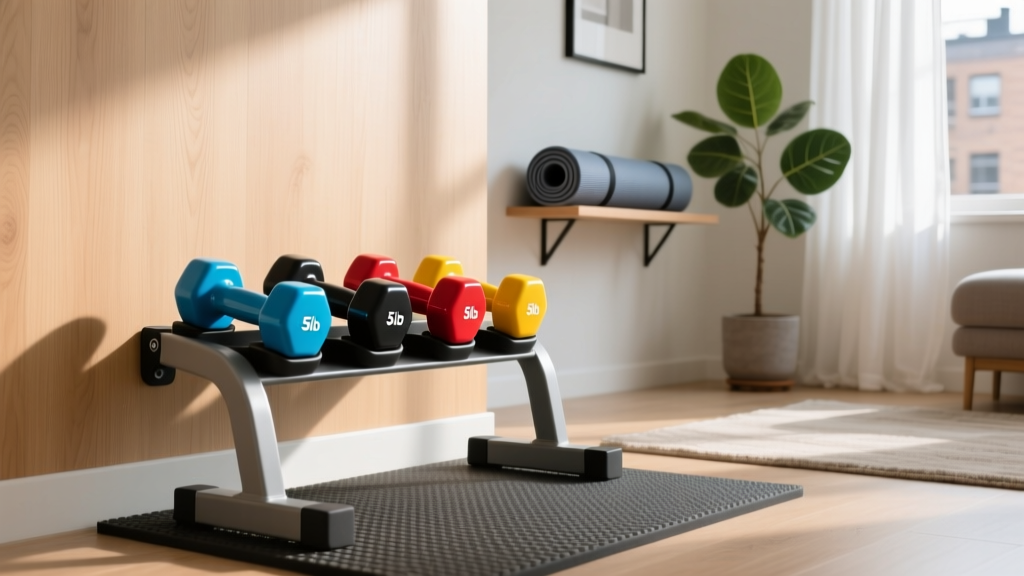
Budget Racks for Your 5lb Dumbbell Workout Set: 2026 Storage Guide
Discover the best budget-friendly storage solutions and racks for your 5lb dumbbell workout sets. Compare 2026 pricing, tiered shelves, and space-saving hacks.

The Hidden Storage Problem Behind Light Dumbbell Sets
When building a comprehensive home gym, most lifters focus heavily on storing their massive 50lb to 100lb hex dumbbells. However, the rise of high-rep, low-load training has fundamentally shifted how we equip our spaces. Whether you are following a physical therapy protocol, executing a Pilates-inspired routine, or running a high-rep 5lb dumbbell workout for muscular endurance, you likely own a massive set of light-to-medium neoprene or vinyl-coated dumbbells ranging from 3lbs to 25lbs.
The problem? Storing 10 to 20 pairs of light dumbbells creates a massive spatial footprint. Standard heavy-duty A-frame racks are engineered for thick-handled cast iron, leaving your smaller, lighter gear slipping through the cracks—literally. In this 2026 budget breakdown and value analysis, we will explore the most cost-effective, space-saving, and structurally sound storage solutions specifically designed for light dumbbell sets, ensuring your home gym remains safe, organized, and optimized for performance.
The Physiology and Gear Reality of the 5lb Dumbbell Workout
Why do home gym owners accumulate so many light dumbbells? The answer lies in modern exercise science. According to seminal research published in the Journal of Sports Science & Medicine, low-load resistance training (using light weights like 5lb dumbbells) taken to muscular failure yields similar hypertrophic and endurance adaptations as high-load training. Furthermore, the American College of Sports Medicine (ACSM) emphasizes the necessity of varied resistance levels for joint stabilization, rotator cuff rehabilitation, and muscular endurance circuits.
Because a comprehensive 5lb dumbbell workout often requires quick transitions between 3lb, 5lb, 8lb, and 10lb pairs for drop-sets and supersets, floor storage is not an option. You need a dedicated, tiered organizational system. Yet, a standard 5lb neoprene dumbbell features a handle diameter of roughly 0.9 inches and a shorter handle length (often 4.5 inches). When placed on a traditional angled A-frame rack designed for 1.2-inch handles, these smaller weights slide down the rails, clatter to the floor, and damage both the equipment and your toes.
⚠️ The Neoprene Slip Hazard: Storing small, round-ended vinyl or neoprene weights on angled steel racks creates a severe rolling hazard. In 2026, home gym safety audits still cite tripping over fallen light dumbbells as a primary cause of minor domestic fitness injuries.2026 Budget Breakdown: Tiered Racks vs. Wall Shelves vs. DIY
To determine the best value for your money, we analyzed the three most popular storage methodologies for light dumbbell sets. Below is a comparative matrix based on current 2026 market pricing, material durability, and spatial efficiency.
| Storage Solution | Est. Cost (2026) | Weight Capacity | Best Application | Primary Drawback |
|---|---|---|---|---|
| Marcy MDR-102 3-Tier Rack | $45 - $55 | 150 lbs | 3lb-15lb Vinyl Sets | Top tier sagging over time |
| CAP Barbell Flat 3-Tier (DR-3) | $65 - $80 | 250 lbs | Mixed Neoprene/Hex | Wide 24-inch footprint |
| DIY Birch Plywood Wall Shelf | $35 - $50 | 300+ lbs | Custom spaces, round ends | Requires stud anchoring |
Option 1: Commercial Flat-Paneled Tiered Racks
If you want a plug-and-play solution without breaking out the power drill, flat-paneled tiered racks are your best bet. Unlike A-frames, models like the Marcy MDR-102 or the CAP Barbell DR-3 feature flat, horizontal steel shelves with welded front lips. This completely eliminates the rolling hazard associated with round-ended vinyl dumbbells.
Value Analysis: At roughly $55, the Marcy MDR-102 offers exceptional entry-level value. However, budget-conscious buyers must be aware of a common failure mode: MDF (Medium Density Fiberboard) shelf inserts. Some ultra-cheap Amazon knock-offs use MDF shelves that suffer from "creep"—a permanent structural sagging caused by the concentrated point-load of dumbbell heads. Always verify that the rack uses solid steel or high-density particle board with steel cross-bracing.
Option 2: Wall-Mounted Floating Garage Shelves
For those with limited floor space, utilizing vertical real estate is the ultimate 2026 home gym hack. Heavy-duty garage shelving units (such as those from Husky or Gladiator) can be repurposed into premium dumbbell racks. By mounting a 4-foot long, 12-inch deep steel shelf at waist height, you create an ergonomic staging area for your 5lb dumbbell workout drop-sets.
The Edge Case: Vinyl and neoprene coatings contain plasticizers that can occasionally leach and react with certain raw metals or low-grade powder coats, leaving permanent black rings on your shelves. Pro-Tip: Line your metal wall shelves with a cheap 1/4-inch EVA foam mat or rubber drawer liner to protect both the shelf and your dumbbells.
Option 3: The DIY Baltic Birch Dumbbell Tree
If you possess basic woodworking skills, a custom DIY wall-mounted dumbbell tree offers the highest weight capacity and the lowest cost per square inch. By using 3/4-inch Baltic Birch plywood, you avoid the warping issues associated with standard construction pine.
- Cut the Shelves: Rip the plywood to 8 inches deep. Cut three 36-inch long shelves.
- Add a Front Lip: Glue and brad-nail a 1-inch x 1-inch hardwood strip to the front edge of each shelf to prevent round dumbbells from rolling off during earthquakes or accidental bumps.
- Anchor to Studs: This is non-negotiable. A full set of 3lb to 20lb dumbbells can easily exceed 300 lbs. Use 3-inch structural lag bolts driven directly into wall studs (spaced 16 inches on center). Do not rely on drywall anchors.
Step-by-Step: Organizing by Workout Frequency
Buying the rack is only half the battle; organizing it for biomechanical efficiency is the other. When setting up your storage for a high-rep 5lb dumbbell workout, implement the "Anchor Weight" methodology.
- Top Tier (Eye Level): Reserve for the lightest weights (1lb to 3lbs). These are typically used for warm-ups, rotator cuff external rotations, or physical therapy. They are light enough to safely reach up and grab without risking a shoulder strain.
- Middle Tier (Waist Level - 36" to 42"): This is the prime real estate. Place your 5lb, 8lb, and 10lb pairs here. Since the 5lb dumbbell is the undisputed anchor of light-weight home fitness—used for lateral raises, tricep kickbacks, and high-rep bicep curls—it must be at waist height for seamless transitions during supersets.
- Bottom Tier (Knee Level): Store your 15lb to 25lb pairs here. Lifting heavier weights from a lower position allows you to engage your hips and glutes (a deadlift-like hinge) rather than straining your lumbar spine by bending over awkwardly.
Real-World Failure Modes to Avoid in 2026
Through extensive testing and home gym audits, we have identified three critical failure modes that ruin budget storage setups:
1. The UV Neoprene Melt
If your home gym is in a garage or sunroom, avoid storing neoprene dumbbells on wire racks exposed to direct UV light. Over time, UV exposure combined with heat causes the neoprene to break down, becoming sticky and eventually fusing to painted metal racks. Always store coated dumbbells in climate-controlled, shaded environments.
2. The Handle-Length Gap
Many budget "universal" racks boast adjustable dividers. However, the handle length of a 5lb vinyl dumbbell is often a full two inches shorter than a 25lb hex dumbbell. If the dividers are spaced for the larger weights, the 5lb dumbbells will slide sideways, clump together, and become incredibly frustrating to untangle mid-workout. Look for racks with continuous flat shelving rather than slotted dividers.
3. Ignoring the Center of Gravity
Freestanding 3-tier racks have a relatively narrow base. If you load all your 20lb and 25lb dumbbells on the top tier and leave the bottom tier empty, the rack becomes dangerously top-heavy. Always load your storage rack from the bottom up to maintain a low center of gravity and prevent catastrophic tipping.
Final Verdict: Maximizing Your Storage ROI
Organizing a massive set of light dumbbells requires a different strategic approach than storing heavy iron. For the vast majority of home gym owners executing a daily 5lb dumbbell workout, the CAP Barbell DR-3 Flat 3-Tier Rack represents the best overall value in 2026. At under $80, it provides a stable, flat-surface footprint that completely eliminates the rolling hazards of round-ended neoprene weights, while offering enough structural integrity to hold up to 250 lbs without sagging.
However, if floor space is at an absolute premium, investing $40 in materials to build a custom Baltic Birch wall shelf anchored to your studs will yield a premium, commercial-gym aesthetic at a fraction of the cost. Whichever route you choose, prioritizing flat surfaces, proper stud anchoring, and ergonomic height placement will ensure your light dumbbell arsenal remains accessible, safe, and ready for every high-rep burnout set.
More gear to consider
All reviews
Front Rack Dumbbell Squat Trends: 2026 Storage & Rack Analysis

Best Neoprene Dumbbells for a 25 Minute Dumbbell Workout
Space-Saving Dumbbell Racks for Your Dumbbell Leg Workout
Space-Saving Squats with Dumbbells: Men's Loadable Guide

Back Workout with Dumbbells Female Guide: Barbell Weight & Knurling
