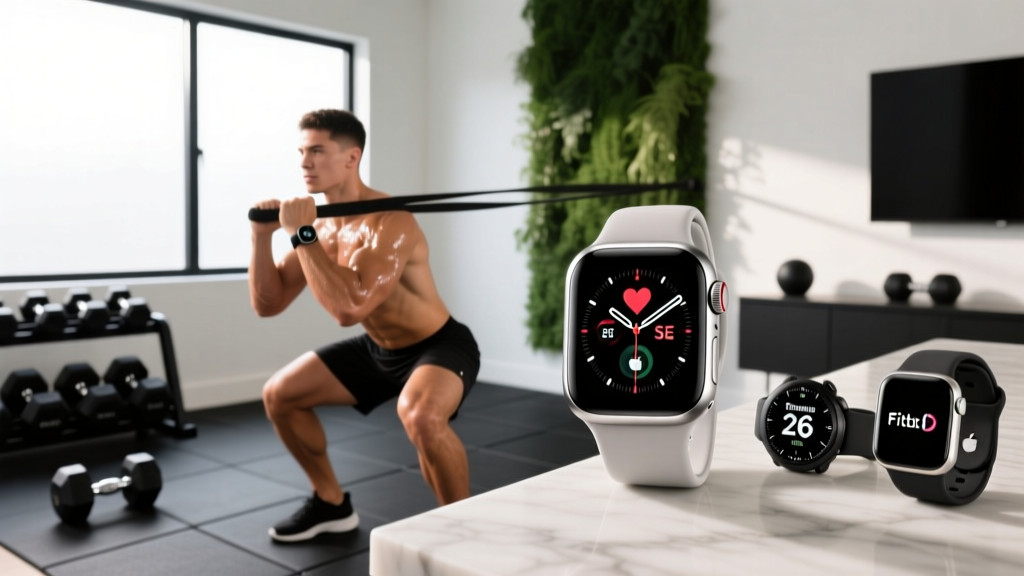
Apple Watch SE Fitness Tracker: 2026 In-Depth Buying Guide
Evaluate the Apple Watch SE as a fitness tracker in 2026. Compare specs, battery life, and accuracy against Garmin and Fitbit in our in-depth buying guide.

The Core Sensor Suite: What You Get for $249
In the crowded landscape of 2026 wearable technology, the Apple Watch SE remains the definitive entry point into the Apple ecosystem. Priced at an accessible $249, it strips away the premium titanium builds and advanced health sensors of the Series 10 and Ultra 3, focusing instead on the essentials. But for dedicated athletes and casual gym-goers alike, the critical question remains: is the hardware sufficient for serious training?
At its core, the latest SE generation utilizes Apple's 3rd-generation optical heart rate sensor and a single-band L1 GPS chip. It runs the full suite of watchOS fitness features, including the Workout app, Activity rings, and advanced running dynamics (when paired with compatible accessories). According to Apple's official SE specifications, the device is water-resistant to 50 meters (WR50), making it fully capable of tracking pool swims and open-water sessions.
Expert Insight: While the SE lacks the always-on display of its premium siblings, the raise-to-wake responsiveness in watchOS 12/13 is virtually instantaneous, mitigating the annoyance during interval workouts where quick glances are necessary.Evaluating the Apple Watch SE Fitness Tracker Accuracy
When analyzing the Apple Watch SE fitness tracker performance, we must separate steady-state cardio from high-intensity interval training (HIIT) and strength workouts. The optical sensor excels at the former but shows expected limitations in the latter.
Heart Rate Performance
For running, cycling, and rowing at a steady cadence, the SE's heart rate tracking is remarkably accurate, typically tracking within 1-3 beats per minute (BPM) of a chest strap like the Polar H10. However, during rapid heart rate spikes—such as CrossFit WODs or heavy barbell complexes—the optical sensor experiences a 3-to-5-second lag. This is a physical limitation of wrist-based photoplethysmography (PPG), not a specific flaw of the SE, but it is a vital edge case for athletes training in Zone 5.
GPS and Route Mapping
The SE relies on single-band L1 GPS. In open skies, suburban parks, and standard road routes, your pace and distance metrics will be flawless. However, if your primary training ground involves dense urban canyons (like downtown Manhattan) or heavy tree cover on mountain trails, the lack of dual-band (L1+L5) GPS becomes apparent. In these environments, the SE may exhibit minor pace drifting or route smoothing, cutting corners on your mapped strava segments.
The Missing Metrics: Edge Cases and Limitations
To make an informed purchasing decision, you must understand what Apple intentionally omitted to maintain the $249 price point. If your training relies on deep physiological recovery data, the SE may fall short.
- No Blood Oxygen (SpO2) Sensor: You cannot track acclimatization for high-altitude hikes or monitor overnight breathing disturbances.
- No ECG App: The electrical heart sensor required for electrocardiograms is absent, which is a consideration for older athletes or those with a family history of atrial fibrillation.
- No Skin Temperature Sensor: Advanced cycle tracking and nightly recovery baselines (which calculate illness onset or overtraining) are exclusive to the Series 9/10 and Ultra lines.
- No Always-On Retina Display: While battery-saving, it means you cannot glance at your wrist during a heavy deadlift to check your rest timer without physically moving your arm.
2026 Competitor Comparison Matrix
How does the SE stack up against the best non-Apple alternatives in the same price bracket? Below is a detailed comparison of the top contenders for the budget-conscious fitness enthusiast.
| Feature | Apple Watch SE | Garmin Venu Sq 2 | Fitbit Charge 6 |
|---|---|---|---|
| Price (MSRP) | $249 | $249 | $159 |
| GPS Type | Single-Band L1 | Single-Band | Built-in GPS |
| Battery Life | 18 Hours (Rated) | Up to 11 Days | Up to 7 Days |
| SpO2 / ECG | No / No | Yes / No | Yes / Yes |
| Smart Features | Excellent (LTE, Apps) | Basic (Notifications) | Good (Payments, Maps) |
"If your primary goal is meeting the CDC physical activity guidelines of 150 minutes of moderate aerobic activity per week, the Apple Watch SE's Activity Rings remain the most psychologically effective gamification tool on the market."
Battery Life in Real-World Scenarios
Apple rates the SE at 18 hours of mixed use. For fitness tracking, the real-world drain is the more critical metric. During continuous GPS-tracked outdoor runs or rides, the SE consumes approximately 8% to 11% of its battery per hour. This yields roughly 9 to 11 hours of continuous GPS tracking before the device shuts down.
For marathon runners or ultra-endurance athletes, this is a hard limitation. If you plan to run an event lasting longer than 6 hours, you will need to enable the Low Power Mode, which disables the always-on heart rate sensor and background GPS pings, severely compromising your data accuracy. For multi-day hikes, a Garmin Instinct or Forerunner series is mandatory.
However, for the 95% of users who train for 45 to 90 minutes a day, the SE's battery is perfectly adequate. A quick 30-minute charge while showering and getting ready for work provides more than enough juice to track an evening gym session and monitor sleep stages overnight. Speaking of sleep, while the SE tracks REM, Core, and Deep sleep accurately, users seeking clinical-level sleep apnea insights should consult Sleep Foundation's research on wearable sleep tracking to understand the limitations of wrist-based sensors compared to dedicated rings or mattress pads.
Final Verdict: Who Should Buy the SE?
The decision to purchase the Apple Watch SE in 2026 comes down to a simple decision framework based on your training environment and ecosystem reliance.
Buy the Apple Watch SE If:
- You are deeply integrated into the Apple ecosystem (iMessage, Apple Pay, Apple Fitness+).
- Your workouts consist primarily of gym sessions, road running, cycling, and swimming under 4 hours.
- You value smartwatch features (cellular connectivity, third-party apps, seamless notifications) just as much as fitness tracking.
- You are buying a first smartwatch or upgrading from an aging Series 3 or 4.
Pass on the SE (and look at Garmin/Fitbit) If:
- You are a data-obsessed triathlete or ultra-runner who needs multi-band GPS and 20+ hour battery life.
- You require advanced recovery metrics like HRV status, skin temperature, and SpO2 to guide your daily training load.
- You despise charging your watch daily and prefer the 'set it and forget it' nature of a 7-day battery life.
Ultimately, as a pure fitness tracker, the Apple Watch SE punches well above its weight class. It sacrifices the niche, high-end health sensors of its premium siblings but retains the core tracking accuracy and unparalleled smart features that make it the best budget wearable for the everyday athlete.
More gear to consider
All reviews
Garmin Vivosmart 5 Fitness Tracker & Body Scale Accuracy Fixes

Lintelek Fitness Tracker App Setup: Wrist vs Chest Strap HR Guide

2026 Market Trend: Budget Fitness Tracker Open Source Under $100

Chest Strap vs Wrist HR: Smart Fit Fitness Tracker Setup Guide
Scale Accuracy & the Whoop 5.0 One Health and Fitness Tracker
