
2026 Recovery Market: Home Cold Plunges vs Sharper Image Massage Guns
An in-depth 2026 market analysis of home recovery trends, comparing budget percussive tools to premium ice baths and cold plunge tub installations.

The Hourglass Framework of the At-Home Recovery Market
The at-home recovery and biohacking equipment sector has undergone a radical structural transformation over the last three years. As we analyze the 2026 landscape, the market no longer follows a traditional linear progression from budget to premium. Instead, it has adopted an "hourglass" shape. At the narrow, high-volume center sits the hyper-commoditized retail tier, while the wide, high-revenue extremes are dominated by architectural wellness integrations and clinical-grade home setups. To understand this bifurcation, we must examine two seemingly disparate data points: the mass-market penetration of the massage gun Sharper Image retails through big-box outlets, and the explosive growth of the custom ice bath and cold plunge tub for home installations.
This trend report dissects how consumer spending in the recovery space has split between impulse-driven, budget-friendly percussive therapy and high-ticket, permanent cold therapy infrastructure. By analyzing technical specifications, failure modes, and real estate integration data, we can map exactly where the recovery equipment industry is heading.
The Commodity Floor: The Sharper Image Massage Gun Effect
To understand the premium pivot, we first have to look at the bottom of the market. When evaluating the entry-level tier, the massage gun Sharper Image models (often priced between $49 and $89 at major retailers like Kohl's, Amazon, and Target) serve as a prime case study in market commoditization. Five years ago, percussive therapy was gatekept by premium brands charging $599 for 16mm amplitude devices. Today, retail brands have successfully reverse-engineered the core technology, flooding the market with viable, albeit spec-limited, alternatives.
Technical Reality of Budget Percussive Devices
While a Sharper Image or similar mass-market massage gun provides adequate superficial muscle stimulation, a teardown of these units reveals distinct engineering compromises designed to hit aggressive retail price points:
- Amplitude & Stall Force: Most retail-tier guns max out at 10mm to 12mm of amplitude with a stall force of 20 to 30 lbs. This is sufficient for surface-level blood flow but fails to reach deep fascial tissue compared to the 16mm amplitude and 60+ lbs stall force of professional-grade units.
- Motor Degradation: These units typically utilize lower-grade brushless motors that experience significant torque drop-off after 150 to 200 hours of use.
- Battery Architecture: They rely on soldered 2000mAh lithium-ion cells. Once the battery degrades (usually around the 300-cycle mark), the entire unit becomes e-waste, as the casing is ultrasonically welded rather than screwed together.
Market Impact: The proliferation of these budget devices has effectively killed the mid-tier massage gun market. Consumers now either buy a $69 retail brand for casual use or jump straight to a $400+ premium ecosystem device. This "hollow middle" has forced premium recovery brands to pivot their R&D budgets away from handheld devices and toward stationary, high-margin home equipment—specifically, cold therapy.
The Premium Ceiling: Ice Bath and Cold Plunge Tub for Home Setups
As percussive therapy became a commodity, the high-end recovery market shifted toward thermal stressors. The demand for a dedicated ice bath and cold plunge tub for home use has transitioned from a niche biohacker trend to a mainstream wellness real estate staple. In 2026, consumers are routinely spending between $4,500 and $12,000 on self-contained, temperature-controlled cold plunges from brands like Plunge, Sun Home Saunas, and Redwood Outdoors.
Unlike the disposable nature of budget massage guns, home cold plunges are viewed as durable goods and home improvement investments. According to industry data tracked by the Global Wellness Institute, the integration of wellness real estate and in-home recovery amenities is one of the fastest-growing sectors in the global wellness economy, driven heavily by the normalization of contrast therapy.
Comparative Market Matrix: Budget Percussive vs. Premium Cold Therapy
| Feature | Mass-Market Massage Gun (e.g., Sharper Image) | Premium Home Cold Plunge (e.g., Sun Home Cold Plunge Pro) |
|---|---|---|
| Average Retail Price | $59 - $89 | $5,500 - $8,500 |
| Primary Mechanism | Mechanical percussive force (10-12mm amplitude) | Thermal vasoconstriction (37°F - 45°F water) |
| Expected Lifespan | 1.5 - 2 Years | 10 - 15 Years (with chiller servicing) |
| Installation Requirement | None (Battery operated) | 20-Amp dedicated GFCI circuit; level reinforced pad |
| Consumer Perception | Impulse retail purchase / Commodity | Architectural wellness investment / Lifestyle |
Technical Deep Dive: Engineering and Failure Modes in Home Cold Plunges
The surge in home cold plunge adoption has unfortunately been met with a wave of improper installations and misunderstood technical requirements. Selling a $7,000 ice bath is only half the battle; keeping it running in a residential environment requires navigating complex thermodynamics and electrical codes.
Chiller Sizing and Thermodynamic Realities
A common failure point in the home cold plunge market is undersized cooling units. Many entry-level "premium" tubs ship with 1/2 HP (horsepower) chillers. While adequate for indoor, climate-controlled rooms, a 1/2 HP chiller will fail to maintain 40°F water in an outdoor environment where ambient summer temperatures exceed 85°F. For outdoor home installations in 2026, the industry standard has shifted to 1 HP or even 1.5 HP titanium heat-exchanger chillers. These larger units can cool 150 gallons of water at a rate of roughly 2°F to 3°F per hour, but they require significant electrical overhead.
Sanitation: The Biofilm Battle
Unlike a traditional swimming pool, a cold plunge operates at temperatures where chlorine and bromine become largely ineffective or chemically unstable. The modern standard for home ice baths relies on a dual-sanitation approach:
- UV-C Clarifiers: Utilizing 254 nm wavelength ultraviolet light to disrupt the DNA of passing bacteria.
- Ozone Generators: Injecting 50 to 100 mg/hr of ozone (O3) into the plumbing lines to oxidize organic matter.
Edge Case Warning: Ozone generators degrade over time. The corona discharge tubes inside these units typically lose 50% of their output efficiency after 18 months. Homeowners who fail to replace the ozone chip will inevitably face biofilm buildup in the plumbing lines, leading to cloudy water and skin irritation.
Electrical and Condensation Hazards
Cold therapy equipment demands rigorous adherence to the National Electrical Code (NEC). A 1 HP chiller and circulation pump combo will draw close to 15 amps under load, necessitating a dedicated 20-amp GFCI (Ground Fault Circuit Interrupter) breaker. Furthermore, a frequent real-world failure mode is condensation. When 38°F water moves through uninsulated PVC plumbing in a humid garage or outdoor patio, heavy condensation forms. If these lines are not wrapped in closed-cell Armaflex insulation, the resulting water drip will rot wooden decks, damage drywall, and create severe slip hazards.
Wellness Real Estate: The "Recovery Room" Premium
The shift from buying a Sharper Image massage gun at a retail store to installing a $10,000 cold plunge in the backyard reflects a broader macroeconomic trend: the medicalization of the home. Real estate analysts are increasingly noting the presence of dedicated "recovery rooms" or "contrast therapy zones" in mid-to-high-end residential listings.
Market Insight: Homebuyers in the 2026 luxury and upper-middle markets are no longer just looking for home gyms. They are actively seeking spaces pre-wired for 220V saunas and reinforced concrete pads capable of supporting 2,500 lbs of water weight from a filled cold plunge tub. The recovery space is becoming a primary driver of property valuation, much like the gourmet kitchen did in the 2010s.
Clinical validation continues to fuel this real estate trend. Research published in NCBI regarding Cold Water Immersion highlights the profound physiological adaptations to regular cold exposure, including reduced delayed onset muscle soreness (DOMS), optimized dopaminergic responses, and improved cardiovascular resilience. As consumers become more educated on the specific protocols required for these benefits (e.g., 11 minutes per week at sub-55°F temperatures), the demand for reliable, automated home ice baths will only accelerate.
Future Projections: Where the Recovery Market Goes From Here
The bifurcation of the recovery market is permanent. The budget tier, represented by mass-market percussive tools, will continue to race to the bottom on price, eventually becoming standard accessories bundled with fitness equipment or given away as corporate promotional items. Conversely, the home cold plunge and ice bath sector will evolve toward smarter, more integrated ecosystems.
Expect to see 2027 models featuring AI-driven chiller optimization that learns a user's plunge schedule to save energy, advanced biometric integration via wearable APIs (like Oura or Whoop) to adjust water temperature based on daily HRV (Heart Rate Variability) scores, and modular designs that allow homeowners to seamlessly link cold plunges with infrared sauna cabins for automated contrast therapy cycles. The era of the standalone recovery gadget is ending; the era of the integrated home recovery ecosystem has officially begun.
More gear to consider
All reviews
Theragun vs Hyperice: Upgrading Your TheraPro Massage Gun Setup

Best Massage Gun for Calf Muscles: 2026 Setup & Buyer Guide

Normatec vs Hyperice Boots & Best Massage Gun for Knee Relief
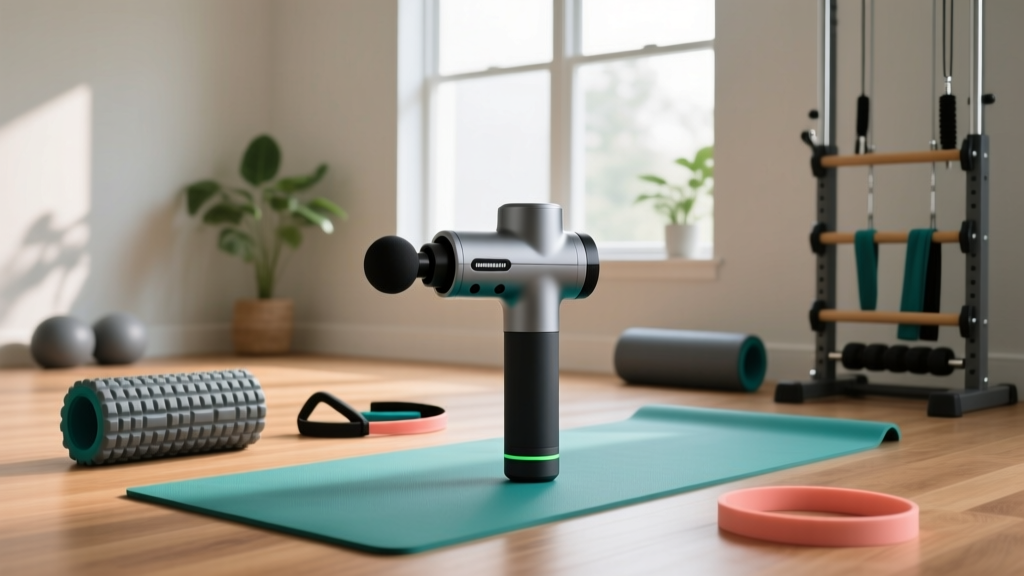
Stretching Equipment Setup & Massage Gun Lower Back Guide

Infrared Sauna Panel vs Blanket: Not an AOL Mail Recovery Tool
