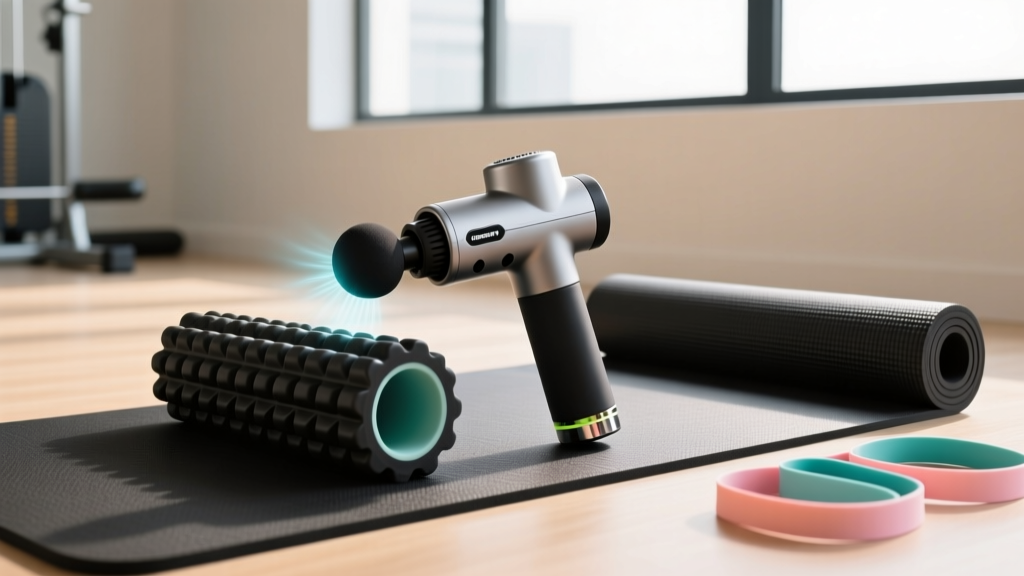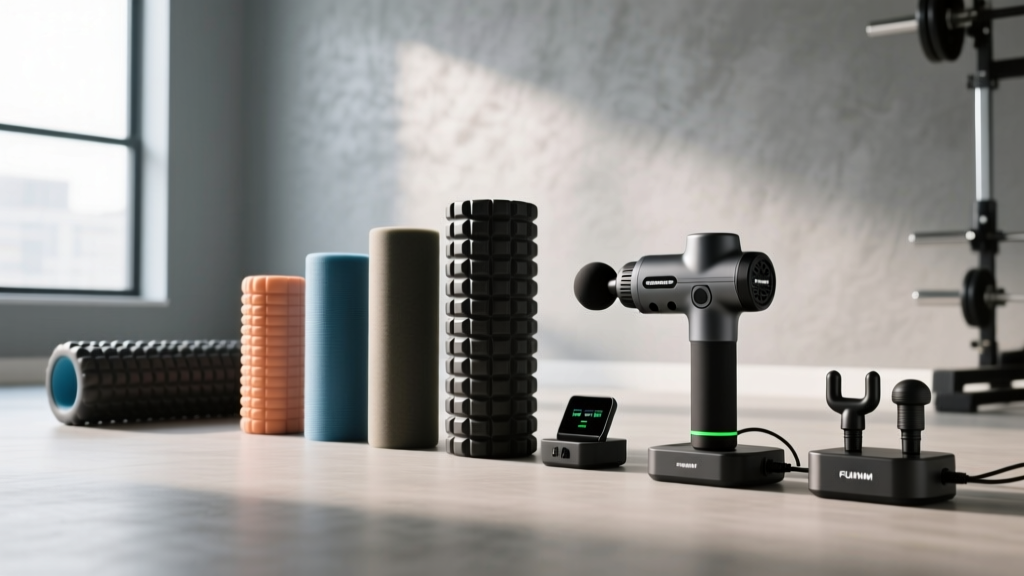
Foam Roller Guide & Massage Gun Analysis: 2026 Budget
Compare foam roller densities, sizes, and costs in our 2026 budget breakdown. Includes a percussive massage gun analysis for optimal recovery value.

The Recovery Investment: Analog Tools vs. Percussive Tech
Navigating the recovery equipment market in 2026 requires a critical eye for value. While percussive therapy devices dominate social media feeds, traditional myofascial release tools remain the backbone of athletic recovery. When conducting a thorough massage gun analysis alongside traditional foam rollers, a stark contrast in budget allocation, cost-per-use, and biomechanical utility emerges. This guide breaks down foam roller types, densities, and sizes, while benchmarking their long-term value against high-ticket percussive alternatives.
According to the National Academy of Sports Medicine (NASM), self-myofascial release (SMR) is essential for correcting muscle imbalances and alleviating trigger points. However, the efficacy of SMR is entirely dependent on the density and surface area of the tool applied. Choosing the wrong density not only wastes money but can actively impede recovery by causing localized tissue bruising or failing to reach the fascial layers.
Material Science: Decoding Foam Roller Density
The core of any foam roller value analysis lies in its material composition. Density dictates both the therapeutic depth and the lifespan of the product. In 2026, the market is segmented into three primary material categories:
1. EVA (Ethylene-Vinyl Acetate): The Budget Entry Point
EVA foam is the softest and least dense material commonly used in recovery rollers. With a typical density ranging from 30 to 40 kg/m³, EVA provides a gentle introduction to SMR.
- Best For: Beginners, rehabilitation patients, and light lymphatic drainage.
- Price Range: $12 to $18.
- The Catch: EVA suffers from rapid structural fatigue. Under daily use by an athlete weighing over 170 lbs, an EVA roller will lose its Shore hardness and permanently compress within 4 to 6 months, rendering it therapeutically useless.
2. EPP (Expanded Polypropylene): The Durability Standard
EPP is the gold standard for commercial gyms and serious athletes. It offers a firm, unyielding surface (typically 45 to 60 kg/m³) that maintains its shape under extreme compressive loads.
- Best For: Deep tissue release, IT band friction syndrome, and daily athletic maintenance.
- Price Range: $25 to $45.
- The Value: EPP rollers routinely last 3 to 5 years without measurable degradation in density, making the cost-per-use fractions of a penny.
3. Polyurethane / ABS Core: The High-Performance Tier
These rollers feature a rigid ABS (Acrylonitrile Butadiene Styrene) plastic core wrapped in high-density polyurethane or specialized elastomer skins (like the TriggerPoint GRID or RumbleRoller). They simulate the thumb-and-finger pressure of a sports massage therapist.
- Best For: Advanced athletes, targeted trigger point therapy, and breaking up dense fascial adhesions.
- Price Range: $45 to $85.
- The Value: Near-indestructible under normal human body weight. The initial investment is high, but the lifespan easily exceeds a decade.
Expert Callout: The 'Pain Scale' Misconception
A common failure mode in recovery routines is equating pain with efficacy. The American Council on Exercise (ACE) notes that excessive pressure on highly innervated areas can trigger a sympathetic nervous system response (fight or flight), causing muscles to tense rather than release. If a high-density EPP or ABS core roller causes you to hold your breath, you are using the wrong density. Step down to a medium-density EVA or a smooth-surfaced EPP until tissue tolerance improves.
Dimensional Biomechanics: Size and Surface Area
Budgeting for a foam roller also requires selecting the correct geometry for your specific biomechanical needs. Size dictates leverage, stability, and the surface area available for spinal extension.
The 36-Inch Standard (Full-Length)
Measuring 36 inches in length with a standard 6-inch diameter, this is the most versatile tool in the recovery arsenal. It is the only size that allows for full longitudinal spinal extension (lying vertically with the roller supporting the head, thoracic spine, and sacrum). This position opens the chest, counters kyphotic posture from desk work, and allows for bilateral latissimus dorsi release.
The 18-Inch Tactical Roller (Mid-Length)
Ideal for travel and targeting large bilateral muscle groups like the quadriceps and hamstrings. The 18-inch length provides enough width to stabilize the pelvis during single-leg rolling but is compact enough to store in a gym locker or carry-on bag.
The 12-to-14-Inch Targeted Roller (Short)
Designed for precision. Short rollers are optimal for isolating the calves, gluteus medius, and the suboccipital muscles at the base of the skull. Many short rollers feature a 3-inch or 4-inch diameter, which increases the localized pressure (Force = Pressure / Area), acting as a deeper, more aggressive myofascial tool.
2026 Budget Breakdown & Cost-Per-Use Matrix
To truly understand recovery value, we must compare the traditional foam roller market against the percussive therapy market. Below is a comparative budget matrix analyzing upfront costs, expected lifespans, and the real-world cost-per-use based on a regimen of 4 sessions per week over two years.
| Recovery Tool Tier | Example Models | Upfront Cost | Est. Lifespan | Cost-Per-Use (Yr 1) |
|---|---|---|---|---|
| Soft EVA Roller | Generic Amazon Basics | $15 | 6 Months | $0.14 |
| Firm EPP Roller | OPTP PRO-ROLLER | $32 | 4+ Years | $0.15 |
| ABS Core Grid | TriggerPoint GRID 13" | $45 | 10+ Years | $0.21 |
| Entry Massage Gun | Hyperice Hypervolt Go 2 | $199 | 2-3 Years | $0.92 |
| Pro Massage Gun | Theragun PRO Plus | $599 | 3-5 Years | $2.77 |
Real-World Failure Modes: When Cheap Gear Costs More
When allocating a recovery budget, consumers often attempt to save money by purchasing ultra-cheap EVA rollers or unbranded, low-tier percussive devices. This strategy frequently results in hidden costs:
- The EVA Compression Trap: Buying three $12 EVA rollers over two years ($36 total) yields a worse therapeutic outcome than buying one $32 EPP roller. The compressed EVA fails to provide the mechanical transduction required to stimulate the Golgi tendon organ, leading to autogenic inhibition failure.
- Hollow Core Warping: Some budget 'high-density' rollers use thin PVC pipes instead of solid ABS. Under repeated heavy loads, these thin cores can crack or warp, creating sharp, uneven pressure points that can cause bruising.
- Battery Degradation in Budget Guns: While outside the scope of analog rollers, it is worth noting that entry-level massage guns often use inferior lithium-ion cells that lose their maximum torque output after 18 months, effectively turning a $150 investment into a weak vibrating toy.
The Verdict: Building a Tiered Recovery Arsenal
A comprehensive massage gun analysis paired with a deep dive into foam roller material science reveals that these tools are not mutually exclusive; they are complementary. For a highly optimized $100 recovery budget in 2026, the highest ROI strategy is to purchase a premium 36-inch EPP roller ($35) for broad fascial stretching and spinal extension, paired with a targeted 12-inch ABS core roller ($45) for deep trigger point work.
Reserve the $400+ budget tier for percussive therapy devices only if you require rapid, localized neuromuscular down-regulation immediately prior to competition, or if you lack the mobility to position yourself correctly over a floor-based roller. By understanding the exact densities, dimensions, and material lifespans outlined above, you can build a recovery protocol that maximizes both physiological outcomes and financial efficiency.
More gear to consider
All reviews
Facial Massage Gun vs Heat Therapy Pads and Wraps: Troubleshooting

Normatec vs Hyperice Boots Setup & Apherma Massage Gun

Ekrin B37 Massage Gun Review: Flexibility & Stretching Guide

Heat Therapy Wrap vs. Massage Gun for Traps Relief
Home Recovery Layouts: Cold Plunges and Massage Gun for Cellulite