Infrared Sauna Blanket vs Panel: Massage Gun After Workout Synergy
Compare infrared sauna blankets and wood-paneled cabins. Learn the optimal heat therapy sequence and how to pair it with a massage gun after workout.

The recovery technology landscape in 2026 has moved far beyond simple foam rolling and ice packs. Today, elite athletes and dedicated home-gym enthusiasts are building comprehensive 'recovery stacks' that combine thermal therapy with percussive devices. The most hotly debated comparison in the heat therapy space is the infrared sauna blanket vs. wood-paneled infrared cabins. Both offer profound physiological benefits, but they differ vastly in cost, footprint, and thermal dynamics.
Furthermore, integrating these thermal modalities with percussive therapy requires precise sequencing. Many athletes default to using a massage gun after workout sessions to alleviate delayed onset muscle soreness (DOMS), but introducing infrared heat into the equation changes tissue viscosity and blood flow. In this head-to-head guide, we break down the exact specifications, failure modes, and optimal protocols for combining infrared saunas with percussive therapy.
The Physiology of Heat and Percussive Therapy
To understand which hardware setup is right for you, we must first look at the physiological cascade of combining Far Infrared (FIR) heat with percussive therapy. According to a comprehensive review published in the National Center for Biotechnology Information (NCBI), regular sauna bathing induces cardiovascular adaptations similar to moderate-intensity exercise, primarily through systemic vasodilation and increased heart rate.
When you apply a massage gun after workout exertion, the rapid percussive strokes (typically 32 to 40 hits per second) stimulate mechanoreceptors, down-regulate pain signals, and encourage lymphatic drainage. However, if your muscle fascia is cold and highly viscous, percussive therapy can sometimes cause micro-trauma. By utilizing infrared heat first, you increase tissue temperature, making the fascia highly pliable and allowing the massage gun to penetrate deeper with less surface friction.
Head-to-Head: Infrared Blankets vs. Panel Cabins
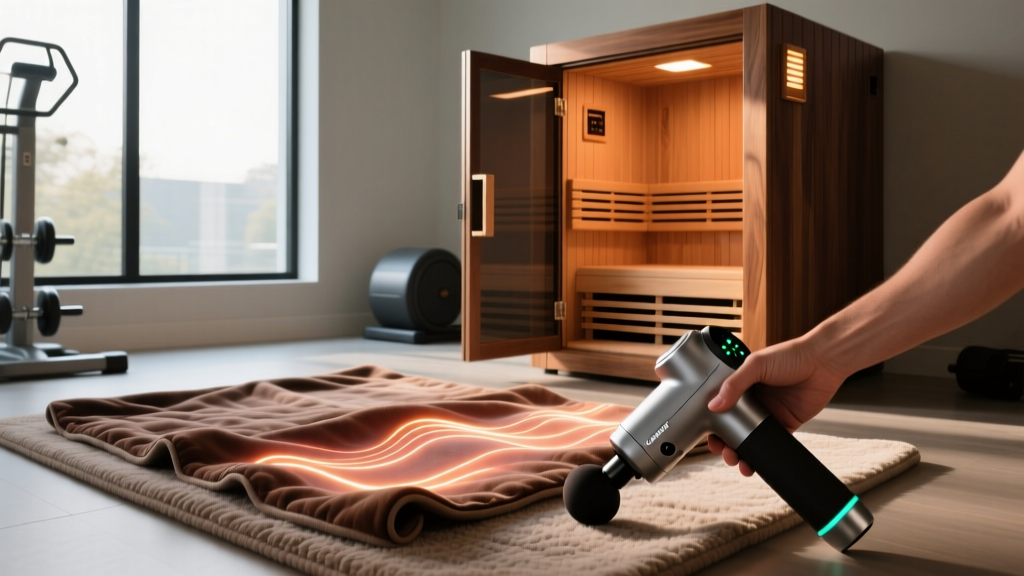
Before diving into specific protocols, let us compare the two dominant form factors in the 2026 market: the portable infrared blanket (e.g., HigherDose V4) and the traditional wood-paneled infrared cabin (e.g., Sunlighten mPulse).
| Feature | HigherDose V4 Infrared Blanket | Sunlighten mPulse 3-in-1 Cabin |
|---|---|---|
| Retail Price | $699 | $5,499 - $6,500+ |
| Max Temperature | 170°F (76°C) | 145°F (62°C) |
| Heater Technology | Carbon Far Infrared (FIR) | Carbon/Ceramic/Near Infrared (NIR) |
| EMF Levels | Ultra-low (internally shielded) | Ultra-low (patented cancellation) |
| Warm-up Time | 10 - 15 minutes | 30 - 45 minutes |
| Spatial Footprint | 2 sq ft (stored rolled up) | 12 - 16 sq ft (permanent fixture) |
| Electrical Draw | Standard 120V outlet | Dedicated 120V/15A or 240V circuit |
Deep Dive: Infrared Sauna Blankets
Infrared blankets have surged in popularity due to their accessibility and space-saving design. The market leader, the HigherDose V4, utilizes a medical-grade PU leather exterior and an internal layer of carbon fiber heating elements that emit Far Infrared light. FIR penetrates the skin to a depth of about 1.5 inches, directly heating the body rather than the ambient air.
Pros and Cons of the Blanket Form Factor
- Pro - High Surface Temp: Because the blanket wraps tightly around the body, it traps sweat and can reach higher localized temperatures (up to 170°F) compared to open-air cabins.
- Pro - Portability: Ideal for apartment dwellers or those who travel to competitions.
- Con - The 'Taco Effect': Because you must lie flat, the heating elements on the bottom layer are compressed against your body weight. This can lead to uneven heating and uncomfortable hot spots on the glutes and calves.
- Con - Claustrophobia: The mummy-bag style enclosure restricts movement, making it difficult to read, use a phone, or stretch during the 45-minute session.
Deep Dive: Wood-Paneled Infrared Cabins
For those with the space and budget, wood-paneled cabins offer a vastly superior, 360-degree thermal experience. The Sunlighten mPulse 3-in-1 and the Clearlight Premier Far Infrared series utilize full-spectrum heaters. This means you get Far Infrared for deep tissue heating, Near Infrared (NIR) for skin rejuvenation and cellular ATP production, and Red Light therapy.
Pros and Cons of the Panel Cabin Form Factor
- Pro - 360-Degree Penetration: Standing or sitting upright allows infrared waves to hit the anterior and posterior chains simultaneously without pressure-point hot spots.
- Pro - Multi-Tasking: Cabins are spacious enough for seated stretching, meditation, or reading.
- Con - Electrical Requirements: Most 2-person or larger cabins require a dedicated 15-amp or 20-amp circuit. Plugging a 1500W cabin into a shared bedroom circuit will trip the breaker.
- Con - Assembly and Weight: These units weigh between 300 and 500 lbs and require 2-3 hours of meticulous tongue-and-groove assembly.
The 2026 Recovery Protocol: Sequencing Heat and Percussion
As highlighted in the Huberman Lab protocols for recovery, the sequence of your modalities dictates the physiological outcome. Using a massage gun after workout is highly effective for acute neural down-regulation, but combining it with infrared heat requires a specific timeline to avoid systemic fatigue.
💡 The Golden Rule of Sequencing: Always perform thermal therapy (sauna) before deep percussive therapy, but after your initial cool-down. Heat increases tissue elasticity; percussive therapy then capitalizes on that elasticity to remodel fascia.Step-by-Step Elite Recovery Stack
- Phase 1: The Flush (0-15 mins post-workout)
Complete your workout. Do 5-10 minutes of active cool-down (light cycling or walking) to bring the heart rate down gradually. Hydrate with 16oz of water and 500mg of sodium. - Phase 2: Thermal Vasodilation (20-60 mins post-workout)
Enter the infrared cabin or blanket. Set the temperature to 140°F (cabin) or 160°F (blanket). Remain inside for 30-45 minutes. This mimics cardiovascular strain and forces blood into the peripheral capillaries, delivering oxygen to micro-tears in the muscle. - Phase 3: Cool & Rehydrate (60-75 mins)
Exit the sauna. Take a lukewarm shower to remove sweat and halt the core-temperature spike. Drink 24oz of water with electrolytes (potassium and magnesium). - Phase 4: Percussive Remodeling (75-90 mins)
Now is the optimal time to use your percussive device. Because the fascia is warm and highly vascularized, using a massage gun after workout and sauna therapy allows for deeper strokes with less perceived pain. Spend 2 minutes per major muscle group using a dampener or soft-ball attachment at 2400 RPMs. (For verified device performance, refer to Wirecutter's extensive massage gun testing).
Verdict: Which Should You Buy?
If your budget is under $1,000 and you live in a rental or apartment, the HigherDose V4 Infrared Blanket is an undeniable winner. It delivers 90% of the cardiovascular and sweating benefits of a cabin, provided you can tolerate the restrictive 'taco' position and manage the uneven heat distribution on your back.
However, if you own your home, have a dedicated 15-amp circuit, and view recovery as a long-term health investment, a wood-paneled cabin like the Sunlighten mPulse or Clearlight Premier is vastly superior. The ability to sit upright, stretch, and receive full-spectrum (FIR + NIR) light therapy without pressure-point hot spots makes it the ultimate pairing for your post-sauna percussive therapy routines.
Frequently Asked Questions
Can I use my massage gun inside the infrared sauna?
No. The ambient heat and your own sweat will damage the lithium-ion battery and internal motor of devices like the Theragun or Hypervolt. Furthermore, the vibration of the gun can disrupt the parasympathetic nervous system state you are trying to achieve inside the sauna. Keep the devices separate.
How do I clean an infrared sauna blanket?
Because blankets are lined with PU leather or TPU, you cannot machine wash them. After every session, wipe the interior down with a microfiber cloth and a solution of 50% distilled water and 50% white vinegar. Avoid harsh chemical bleach, which will degrade the waterproof lining and expose the internal carbon heating wires to moisture.
Does Near Infrared (NIR) help with muscle recovery?
Yes. While Far Infrared (FIR) penetrates deeply to heat tissue and induce sweating, Near Infrared (NIR) operates at a cellular level. NIR wavelengths (typically 810nm to 850nm) stimulate the mitochondria to produce more ATP (cellular energy), which accelerates the repair of damaged muscle fibers. This is why full-spectrum panel cabins are preferred over FIR-only blankets for elite athletic recovery.
More gear to consider
All reviews
Lifepro Sonic Massage Gun vs Compression Boots: 2026 Guide

Can You Use a Massage Gun on Your Neck? 2026 Cupping Trends

Foam Roller Types Guide & Sealy Massage Gun Hands-On Review

What Do Massage Guns Do vs Foam Rollers? 2026 Density Guide

Infrared Sauna Blanket Guide vs Hinge Health Massage Gun Offer