
Normatec vs Hyperice Boots: Are Mini Massage Guns Worth It Instead?
We troubleshoot common Normatec vs Hyperice boot mistakes and answer if mini massage guns are worth it for leg recovery. Expert 2026 guide.

The Great Recovery Debate: Pneumatic Boots vs. Percussive Therapy
Walk into any professional locker room or elite CrossFit gym in 2026, and you will inevitably see athletes strapped into pneumatic compression boots. However, a persistent point of confusion remains in the recovery space: the Normatec vs Hyperice recovery boots comparison. To clarify the landscape right out of the gate, Hyperice acquired Normatec in 2020. Therefore, when consumers search for 'Normatec vs Hyperice,' they are usually either comparing the flagship Normatec 3 against the premium Normatec Pro, or comparing full-leg pneumatic compression against Hyperice’s localized thermal wraps (like the Venom 2 Leg).
Yet, with flagship boot systems retailing between $999 and $1,299, a massive segment of the amateur and masters athlete market is pivoting to a different question: are mini massage guns worth it as a budget-friendly, localized alternative for lower-body recovery? This guide troubleshoots the most common mistakes athletes make with pneumatic boots, clarifies the hardware ecosystem, and provides a data-driven verdict on whether a $150 mini percussive device can actually replace a $1,000 compression system.
Normatec Lineup Breakdown & Common Boot Mistakes
Before evaluating alternative therapies, we must address the mechanical and user errors that render expensive pneumatic boots ineffective. The current market leaders are the Normatec 3 ($999, 7-zone sequential compression) and the Normatec Pro ($1,299, customizable pressure mapping). Despite their advanced 2026 firmware and Bluetooth app integration, user error remains the primary cause of suboptimal recovery.
Troubleshooting the Top 3 Pneumatic Compression Mistakes
- Mistake: Setting Pressure Too High (The 'More is Better' Fallacy)
The Fix: Lymphatic fluid is superficial and easily compressed. Setting your Normatec boots above 80 mmHg when you are heavily fatigued can actually occlude lymphatic vessels, trapping metabolic waste rather than flushing it. Start at 40-50 mmHg for a gentle flush, and only increase to 70+ mmHg for deep venous return post-heavy lifting. - Mistake: Using Boots on Acute Muscle Strains
The Fix: Pneumatic compression is for Delayed Onset Muscle Soreness (DOMS) and fluid pooling. If you have a Grade 1 or 2 hamstring strain, the sheer mechanical force of sequential compression can exacerbate tissue tearing. Switch to localized thermal therapy (like the Hyperice X) for acute joint and tissue injuries. - Mistake: Ignoring the 'E-01' or 'E-02' Error Codes
The Fix: If your Normatec control unit halts and throws an E-01 error, it indicates a hose connection failure or an air leak. In 90% of cases, this is caused by debris in the quick-release hose coupling or a partially unzipped boot seam. Detach the hose, blow out the connector, and ensure the heavy-duty zipper is fully seated before restarting the cycle.
Compression boots only work if the air chambers align with your anatomy. If you are 5'4" and using the standard Tall boots, the thigh compression zones will overlap your knees, causing joint pain and stalling the device's air pump. Always measure your inseam and hip-to-knee length against the manufacturer's 2026 sizing charts before purchasing.
The Pivot: Are Mini Massage Guns Worth It for Leg Recovery?
When faced with the four-figure price tag of pneumatic boots, athletes frequently ask: are mini massage guns worth it for leg recovery? To answer this, we must separate marketing hype from biomechanical reality. Mini massage guns, such as the Theragun Mini ($149) or the Hyperice Hypervolt Go 2 ($159), utilize percussive therapy (typically 10mm to 15mm amplitude at 2,400 RPM) to stimulate mechanoreceptors, reduce localized hypertonicity, and increase regional blood flow.
However, they cannot replicate the systemic, limb-wide lymphatic flush of pneumatic boots. Mini guns are highly effective for targeting specific trigger points—like a knotted vastus lateralis or a tight calf complex—but they are entirely ineffective at moving pooled interstitial fluid from the ankle back to the thoracic duct.
Recovery Modality Comparison Matrix
| Feature | Normatec 3 Boots | Mini Massage Gun (e.g., Theragun Mini) | Full-Size Massage Gun (e.g., Theragun PRO) |
|---|---|---|---|
| Primary Mechanism | Pneumatic Sequential Compression | Localized Percussive Therapy | Deep Percussive Therapy |
| Lymphatic Flushing | Excellent (Full Limb) | Poor (Localized only) | Poor (Localized only) |
| Trigger Point Release | Poor | Good (Superficial/Mid-depth) | Excellent (Deep Tissue) |
| Portability (2026) | Low (Requires duffle bag) | High (Fits in palm/gym bag) | Medium (Bulky case) |
| Average Cost | $999 | $149 - $159 | $499 - $599 |
Troubleshooting Mini Gun Mistakes on Lower Limbs
If you decide that mini massage guns are worth the investment for your specific needs, you must avoid the common percussive therapy errors that lead to bruising and nerve irritation. According to guidelines referenced by the National Strength and Conditioning Association (NSCA), percussive devices require precise anatomical awareness.
- The Patella Error: Never use a mini gun directly on the kneecap or the tibial tuberosity. The lack of muscle padding means the percussive force transfers directly to the bone and joint capsule, risking bursitis. Use a dampener attachment and work only the quadriceps tendon above the knee.
- The IT Band Friction Mistake: Athletes often try to 'bash out' a tight Iliotibial (IT) band. The IT band is thick fascia, not muscle; it does not contract or release via percussive force. Aggressively gunning the lateral thigh causes severe bruising. Instead, target the Tensor Fasciae Latae (TFL) and the Gluteus Maximus where the fascia originates.
- Peroneal Nerve Compression: When treating the lateral calf, avoid the head of the fibula (the bony bump on the outside of the knee). The common peroneal nerve wraps around this bone, and direct percussive strikes can cause temporary foot drop or nerve stinging.
'Percussive therapy is a neurological modality as much as a mechanical one. You are signaling the nervous system to down-regulate muscle spindle activity. If you are pushing a mini gun so hard into your quad that it stalls the motor, you are triggering a stretch reflex, causing the muscle to guard and tighten further. Let the 15mm amplitude do the work.'
— Sports Biomechanist & Recovery Specialist
Step-by-Step: The Hybrid Recovery Protocol
For athletes who want the benefits of both worlds without buying the $1,299 Normatec Pro, the most effective 2026 strategy is a hybrid approach utilizing a mini gun and manual elevation.
- Step 1: Localized Release (5 Minutes)
Use your mini massage gun on the calves, hamstrings, and quads. Spend 30-45 seconds per muscle belly using a medium-soft attachment (like a foam ball). Keep the device moving at 1 inch per second. - Step 2: Manual Compression (10 Minutes)
Apply a high-quality elastic compression wrap or graduated compression socks (20-30 mmHg) from the ankle to the knee. - Step 3: Gravity-Assisted Flush (15 Minutes)
Lie on the floor and elevate your legs against a wall (legs at a 90-degree angle to the torso). This utilizes gravity to assist venous and lymphatic return, mimicking the directional flush of pneumatic boots at a fraction of the cost.
Final Verdict: Boots vs. Mini Guns
So, are mini massage guns worth it? Yes, but with caveats. If your primary goal is systemic recovery, reducing heavy-leg syndrome after a marathon, or flushing massive amounts of lactic acid and interstitial fluid, pneumatic boots like the Normatec 3 remain the undisputed gold standard. No handheld device can move volume like sequential air compression.
However, if your recovery needs revolve around localized tightness, travel portability, pre-workout neural activation, and targeting specific trigger points in the glutes or calves, a $150 mini massage gun is an exceptionally high-ROI tool. By understanding the anatomical troubleshooting steps outlined above, you can maximize the efficacy of whichever tool fits your budget and biomechanical needs.
More gear to consider
All reviews
Sauna Blanket vs Panel: Can You Take a Massage Gun in Your Carry On?

NIMBL Massage Gun & Stretching Gear: Complete Setup Walkthrough

Compression Boot & Recovery Review: Infinity Massage Gun Charger
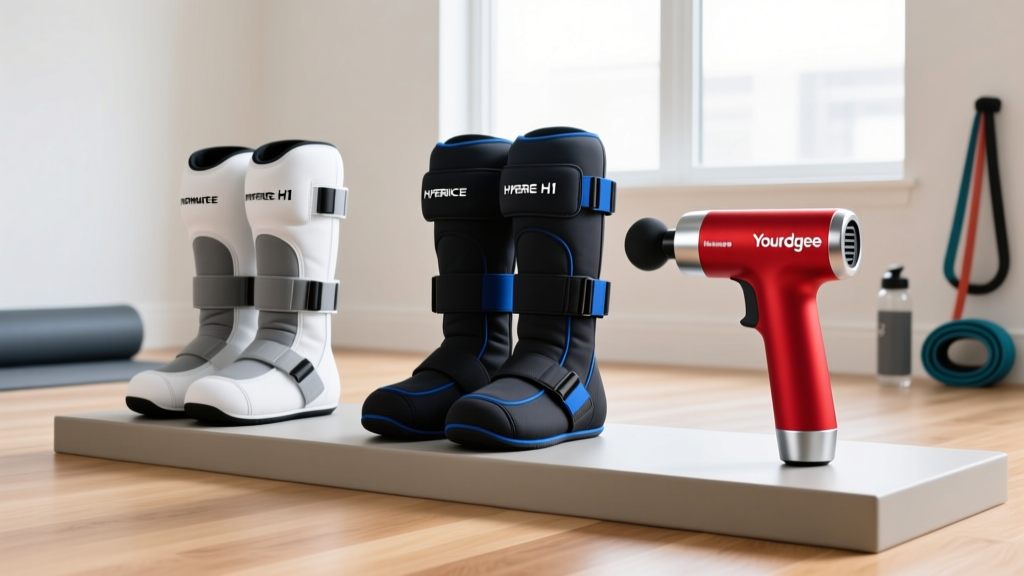
Normatec vs Hyperice Boots vs Youdgee Massage Gun 2026

Normatec vs Hyperice Boots & Revive Ultra Massage Gun Guide
