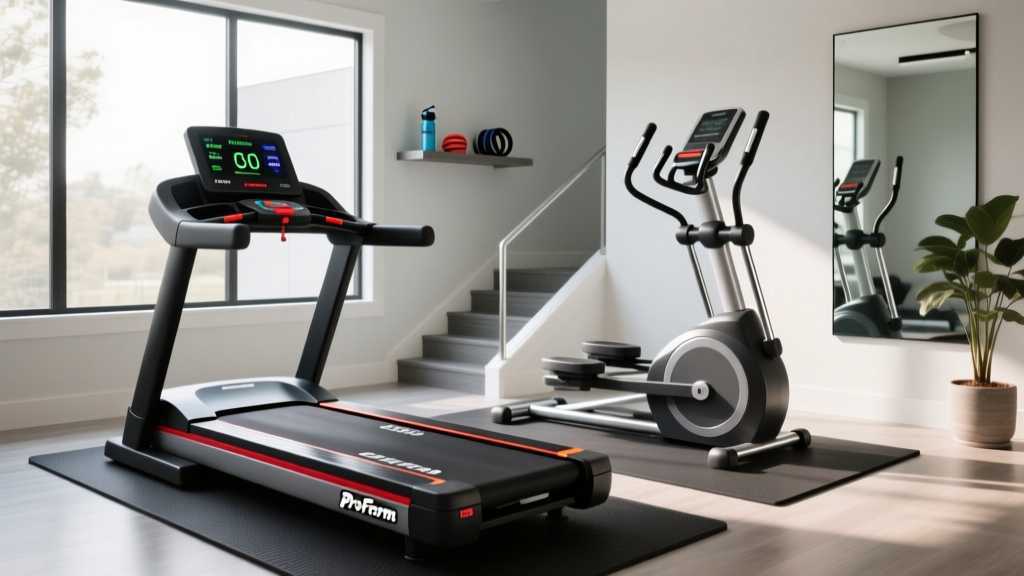
Treadmill Motor Size Guide: York Millennium Treadmill HP Analysis
Master treadmill motor sizing with our CHP guide. We analyze the York Millennium treadmill motor to reveal what really drives long-term durability.

The Hidden Metric: Why Horsepower Dictates Treadmill Lifespan
When shopping for a home cardio machine, buyers often fixate on touchscreen size, incline percentages, and subscription integrations. However, the true lifespan of your machine is dictated by a single, hidden metric: the motor's continuous horsepower (CHP) and its thermal management architecture. A underpowered motor doesn't just mean a sluggish belt; it leads to micro-hesitations during foot-strike, which alters your running biomechanics and significantly increases the risk of patellofemoral pain syndrome and Achilles strain.
In 2026, the treadmill market is flooded with budget models boasting misleading "Peak HP" numbers. To make a sound investment—typically ranging from $1,800 to $3,200 for a reliable residential unit—you must understand how motor sizing correlates to your body weight, running mechanics, and the machine's long-term failure modes. In this guide, we decode treadmill motor specifications and use the legendary York Millennium treadmill as a benchmark for light-commercial durability.
⚡ The 2026 Quick-Sizing Rule of Thumb
- Walkers (Under 180 lbs): 2.0 CHP minimum.
- Joggers (180 - 220 lbs): 2.75 CHP minimum.
- Runners & HIIT (220+ lbs): 3.5 CHP to 4.0 CHP mandatory.
Note: If your household includes multiple users with varying weights and speeds, always size the motor to the heaviest and fastest user.
Decoding HP vs. CHP: What Manufacturers Don't Tell You
The most common marketing deception in the fitness equipment industry is the conflation of Peak Horsepower with Continuous Horsepower. Consumer Reports consistently warns buyers to ignore "Peak HP" entirely. Peak HP measures the absolute maximum output the motor can achieve for a fraction of a second before the thermal cutoff switch trips or the windings melt.
Continuous Horsepower (CHP), on the other hand, measures the power the motor can sustain indefinitely during a grueling 10-mile run at a 10% incline. Modern 2026 brushless DC (BLDC) motors are vastly more efficient than the brushed motors of the past decade, but the fundamental physics of thermal dissipation remain unchanged. A motor with a larger physical housing and heavier copper windings will dissipate heat more effectively, preventing the PWM (Pulse Width Modulation) controller board from overheating and failing.
Case Study: The York Millennium Treadmill Motor Benchmark
To understand what constitutes a truly durable motor housing, fitness technicians and gym owners often look to established light-commercial models. The York Millennium treadmill series serves as an excellent benchmark for mid-tier commercial motor architecture. Unlike modern residential folding treadmills that prioritize compact aesthetics, the York Millennium was engineered around a heavy-duty 2.75 to 3.0 CHP continuous-duty DC motor paired with an oversized steel motor hood.
Why does this matter for your home gym? The York Millennium treadmill utilized a high-mass flywheel and a reinforced motor mount. When a 200-pound runner strikes the deck at 7 mph, they generate up to 3.5 times their body weight in downward impact force. This creates instantaneous friction that forces the motor controller to spike amperage to maintain belt speed. The York Millennium's robust motor mount and heavy flywheel provided crucial rotational inertia, smoothing out these amp-draw spikes.
"When evaluating used or legacy light-commercial units like the York Millennium treadmill, the physical weight of the motor assembly is a dead giveaway of its duty cycle. A motor weighing under 12 lbs will simply not survive daily 5+ mile runs by users over 200 lbs without frying the IGBT transistors on the lower control board."
— Senior Technician, Treadmill Doctor Repair Archives
Today, if you are shopping for a modern equivalent in the $2,000 to $2,800 range (such as the Sole F80 or Horizon 7.8), you should look for the same design cues found in the York Millennium: a minimum 3.5 CHP rating, a physical motor weight exceeding 15 lbs, and a heavy-gauge steel motor mount rather than plastic or thin aluminum brackets.
2026 Motor Size & User Weight Comparison Matrix
Use the table below to determine the exact Continuous Horsepower (CHP) required for your specific biomechanical profile. Sizing your motor correctly ensures the machine operates at 60-70% of its maximum capacity, drastically extending the life of the carbon brushes and drive belt.
| User Weight | Walking (2-4 mph) | Jogging (4-6 mph) | Running (6-9 mph) | Sprinting / HIIT |
|---|---|---|---|---|
| Under 150 lbs | 2.0 CHP | 2.5 CHP | 2.75 CHP | 3.0 CHP |
| 150 - 200 lbs | 2.5 CHP | 2.75 CHP | 3.25 CHP | 3.5 CHP |
| 200 - 250 lbs | 2.75 CHP | 3.25 CHP | 3.75 CHP | 4.0+ CHP (AC Motor) |
| 250+ lbs | 3.0 CHP | 3.5 CHP | 4.0+ CHP (AC Motor) | Commercial AC Only |
Thermal Failure Modes: When and Why Motors Burn Out
Even a high-quality 3.5 CHP motor will fail prematurely if subjected to specific environmental and mechanical edge cases. Understanding these failure modes is critical for protecting your investment.
- The Dry Belt Amp Spike: The most common cause of motor death is belt friction. If the deck is not properly lubricated with 100% silicone, the coefficient of friction increases. This forces the motor to draw excess amperage—often spiking from a normal 8 amps to over 14 amps. On a standard 15-amp residential circuit, this will eventually trip the breaker or melt the motor's internal windings.
- Dust Ingress and Insulation Breakdown: Treadmills act as massive vacuums, pulling pet hair, drywall dust, and carpet fibers into the motor hood. Over time, this debris coats the motor windings, acting as a thermal blanket. The motor cannot shed heat, leading to insulation breakdown and short circuits.
- Prolonged Incline Usage: Running at a 15% incline increases the gravitational load on the drive belt exponentially. Budget 2.5 CHP motors will experience severe voltage sag and hesitation under these conditions, whereas commercial-grade units (like the aforementioned York Millennium treadmill architecture) utilize larger drive pulleys to maintain torque without over-amping.
Sizing Your Motor to Your Running Mechanics
Beyond weight and speed, your specific running gait impacts motor load. Heel-strikers generate a sharper, more abrupt deceleration force upon foot contact than mid-foot or forefoot strikers. This abrupt deceleration requires the motor controller to instantly dump more current into the motor to keep the belt moving at a constant velocity. If you are a heavy heel-striker, or if you frequently perform interval training involving sudden speed jumps (e.g., 4 mph to 8 mph in 3 seconds), you must add at least 0.5 CHP to your baseline requirement to prevent belt hesitation and controller board burnout.
Frequently Asked Questions
Is an AC motor better than a DC motor for home use?
For 95% of home users, a high-quality Brushless DC (BLDC) motor is superior. AC motors (found in $5,000+ commercial gym treadmills) are incredibly durable and can run 24/7, but they are exceptionally heavy, loud, and require specialized 20-amp or 240V electrical circuits. Modern 2026 BLDC motors offer near-commercial durability while remaining compatible with standard 120V household outlets.
Does a larger motor consume more electricity?
Not necessarily. A 3.5 CHP motor operating at 50% capacity to move a 180 lb runner will actually draw less continuous current and generate less heat than a 2.0 CHP motor operating at 95% capacity to perform the exact same task. Oversizing your motor slightly improves electrical efficiency and reduces long-term wear.
How often should I clean the motor hood?
You should remove the motor hood and use a vacuum with a soft brush attachment every 3 to 6 months. If you have shedding pets or keep the treadmill in a garage or basement, inspect the motor compartment monthly to prevent thermal failure caused by dust accumulation.
More gear to consider
All reviews
Self Run Treadmill vs Motorized: Complete Setup Walkthrough

How Many Steps in 1 Hour Walk on Treadmill? 2026 Walking Pad Trends

NordicTrack Treadmill X22i vs Rowing Machine: 2026 Cardio Guide
Is StairMaster Better Than Incline Treadmill for Small Spaces?

Technogym Skillrun 7000 Treadmill vs Walking Pads: Setup & Review