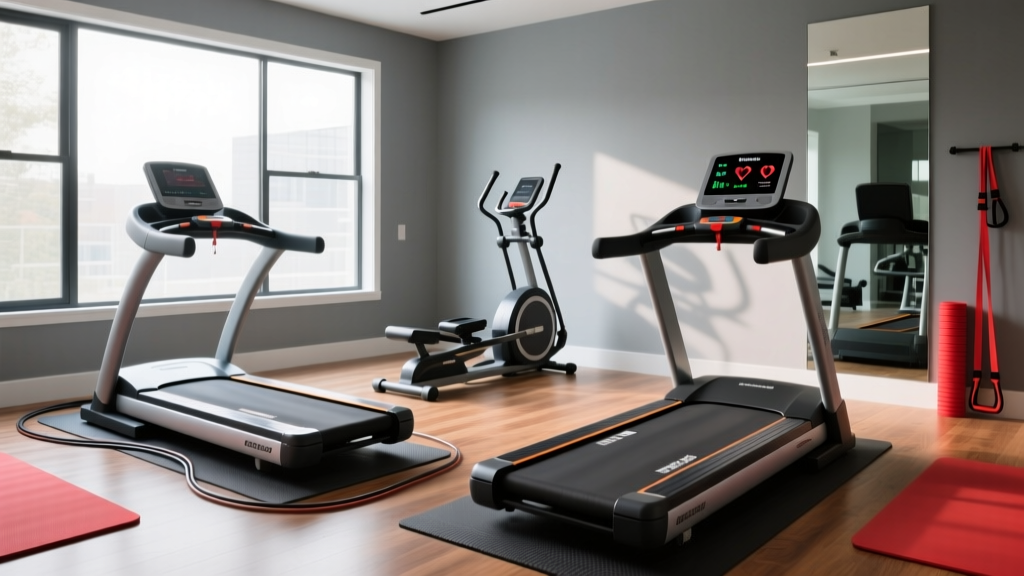
Maintaining Stationary Bike Types vs. Climbing Treadmill Longevity
Discover essential maintenance tips for stationary bike types (upright, recumbent, spin) and compare their longevity care to high-wear climbing treadmills.

The Anatomy of Cardio Wear: Bikes vs. Vertical Inclines
When outfitting a home gym in 2026, understanding the mechanical toll of your equipment is just as critical as the workout itself. Cardio machines represent a significant financial investment, and their longevity is dictated entirely by how well you manage friction, sweat, and motor stress. While Consumer Reports notes that modern magnetic resistance systems have drastically reduced moving parts, different machine architectures degrade in entirely unique ways.
This guide provides a deep-dive technical maintenance protocol for the three primary stationary bike types—upright, recumbent, and spin—while contrasting their relatively low-impact care requirements against the extreme mechanical stress endured by a high-grade climbing treadmill. By understanding these distinct failure modes, you can extend the lifespan of your fleet by 5 to 7 years.
Deep Dive: Maintaining Stationary Bike Types
Upright and Recumbent Bikes: The Bearing and Track Battle
Upright and recumbent bikes (such as the Schwinn 170 or Nautilus R618) prioritize comfort and steady-state cardio. Because they utilize enclosed magnetic resistance and poly-V belt drives, the drivetrain is largely maintenance-free. The real longevity threats lie in the user-contact points and structural tracks.
- Recumbent Seat Rails: Recumbent models feature a sliding seat carriage on a metal track. Over 12 to 18 months, household dust binds to the factory grease, creating an abrasive paste that causes stuttering and premature roller wear. The Fix: Wipe the track with isopropyl alcohol every 90 days and apply a dry PTFE spray lubricant (like Finish Line Dry Lube, ~$12). Never use wet oils or WD-40, which will strip the internal bearing grease.
- Upright Pedal Cranks: Upright bikes suffer from lateral torque during standing pedaling. The pedal cranks on models like the NordicTrack Commercial S22i can loosen, leading to stripped threads. Use a torque wrench to check the crank bolts annually, tightening them to the manufacturer's specification (typically 30-35 Nm).
- Handlebar Stem Oxidation: The adjustment pop-pins on upright stems accumulate sweat. If the pop-pin seizes, adjusting the handlebars becomes impossible. Apply a drop of 3-in-One oil to the pin shaft bi-annually.
Indoor Spin Bikes: Combating Sweat Corrosion
Spin bikes (including the Peloton Bike+, Keiser M3i, and Echelon EX-5s) are designed for high-intensity interval training (HIIT) and out-of-the-saddle climbing. This aggressive riding style generates massive amounts of sweat and extreme lateral force.
"The number one killer of indoor cycling equipment isn't friction; it's human sweat. Saline corrosion destroys bottom brackets, handlebar stems, and seat posts long before the drive belt ever fails." — FitGearPulse Lab Testing, 2025
⚠️ CRITICAL WARNING: The Sweat Guard
If your spin bike features a sweat guard (a plastic shield covering the bottom bracket and flywheel), inspect it monthly. A cracked or displaced sweat guard allows saline drip directly onto the bottom bracket cartridge. Replacing a sweat guard costs roughly $35-$50, whereas replacing a seized bottom bracket and rusted flywheel shaft can exceed $200 in parts and labor.
Bottom Bracket Replacement: Heavy riders (200+ lbs) performing out-of-saddle climbs exert lateral torque that degrades standard threaded bottom brackets. Expect to replace the 68mm BSA cartridge bearings every 3 to 4 years. The part costs roughly $25, but requires a $15 bottom bracket removal tool and a 32mm spanner wrench.
The Climbing Treadmill Challenge: High-Stress Incline Care
While stationary bike types rely on human power and lightweight magnetic brakes, a climbing treadmill operates in an entirely different realm of mechanical stress. A true climbing treadmill—such as the NordicTrack x32i Incline Trainer, which reaches a staggering 40% grade, or hybrid incline trainers—forces the machine to lift the user's entire body weight vertically.
According to the American College of Sports Medicine (ACSM) facility standards, high-incline cardio equipment requires rigorous electrical and friction monitoring. When a climbing treadmill operates at a 30% to 40% grade, the incline lift motor operates at near-maximum torque. If the walking belt lacks proper 100% silicone lubrication, deck friction increases the motor's amp draw by up to 35%. This thermal stress is the leading cause of Motor Control Board (MCB) failure and lift-motor burnout.
Climbing Treadmill Specific Failure Modes
- Lift Motor Gear Stripping: The plastic or nylon gears inside the incline lift motor can strip if the user frequently jumps on the belt while it is at a 30%+ incline. Always lower the incline to 0% before mounting or dismounting.
- Drive Belt Slippage: The extreme resistance of walking uphill causes the main drive belt (connecting the motor to the front roller) to stretch and slip. If you smell burning rubber during an incline walk, the belt tension needs immediate adjustment via the rear roller tension bolts.
- Deck Delamination: High-incline walking shifts the user's strike zone to the forefoot, concentrating friction on the front third of the deck. You must apply 100% silicone treadmill lubricant specifically to the front 18 inches of the deck every 150 miles, rather than just the center.
Maintenance Matrix: Bikes vs. Climbing Treadmills
To visualize the differing maintenance demands, refer to the comparison matrix below. This data reflects average annual upkeep for a household with 3-4 active users.
| Machine Type | Primary Wear Point | Critical Monthly Task | Est. Annual Upkeep Cost |
|---|---|---|---|
| Upright Bike | Pedal bearings, adjustment pop-pins | Wipe down pins, check crank torque | $10 - $20 |
| Recumbent Bike | Seat carriage track, backrest hinges | Clean and PTFE-lube the seat track | $15 - $25 |
| Spin Bike | Bottom bracket, handlebar stem corrosion | Inspect sweat guard, wipe frame with neutralizer | $30 - $60 |
| Climbing Treadmill | Incline lift motor, front deck friction, MCB | Silicone lube (front bias), vacuum motor hood | $50 - $120 |
Your 2026 Longevity Protocol
Implementing a structured maintenance schedule is the most effective way to protect your warranty and ensure a smooth ride. The Consumer Reports Treadmill Buying Guide consistently highlights that neglected lubrication and dust accumulation are the primary reasons for premature motor failure across all cardio categories.
✅ The 15-Minute Weekly Routine
- All Bikes: Wipe down the frame, handlebars, and seat post with a 50/50 mix of water and white vinegar (avoid harsh chemical degreasers that strip paint and corrode aluminum).
- Spin Bikes: Inspect the sweat guard for cracks. Check the pedal cages and toe straps for micro-tears.
- Climbing Treadmill: Use a vacuum with a brush attachment to clean the motor hood vents. Dust acts as an insulator, causing the motor and MCB to overheat during high-incline climbs.
The Bi-Annual Deep Service
Every six months, perform a mechanical audit. For recumbent bikes, strip the seat carriage and re-apply dry lube. For spin bikes, remove the crank arms and inspect the bottom bracket spindle for rust pitting. For your climbing treadmill, loosen the walking belt, clean the deck with a damp microfiber cloth to remove old, clumped silicone and dust, and apply a fresh 1 oz line of 100% silicone treadmill lubricant, focusing heavily on the front strike zone.
Edge Cases: When to Call a Certified Technician
While 90% of home gym maintenance can be handled with basic hand tools, certain edge cases require professional intervention. If your climbing treadmill displays an 'Incline Calibration Error' or the lift motor stutters when moving from 0% to 40%, the internal potentiometer or limit switches may be misaligned. Attempting to force the lift motor can snap the internal gear. Similarly, if a spin bike's magnetic resistance fails to adjust via the console, the issue is usually a severed servo-motor wire inside the flywheel casing—a repair that requires specialized tensioning tools to reassemble the poly-V belt correctly.
Ultimately, whether you are pedaling a recumbent bike through a steady-state zone or pushing a climbing treadmill to its maximum 40% grade, treating your equipment with mechanical sympathy is the key to a decade of reliable home fitness.
More gear to consider
All reviews
Umay Treadmill How to Use & Rowing Machine Buying and Technique Guide
Wahoo KICKR RUN Treadmill Fixes & Rowing Machine Guide

CST 505 Treadmill vs Bikes: 2026 Budget Value Analysis

Virtual Reality Treadmills: 2026 Motor & HP Comparison Guide

Upgrading From an Older Treadmill? Home Stair Climber Guide