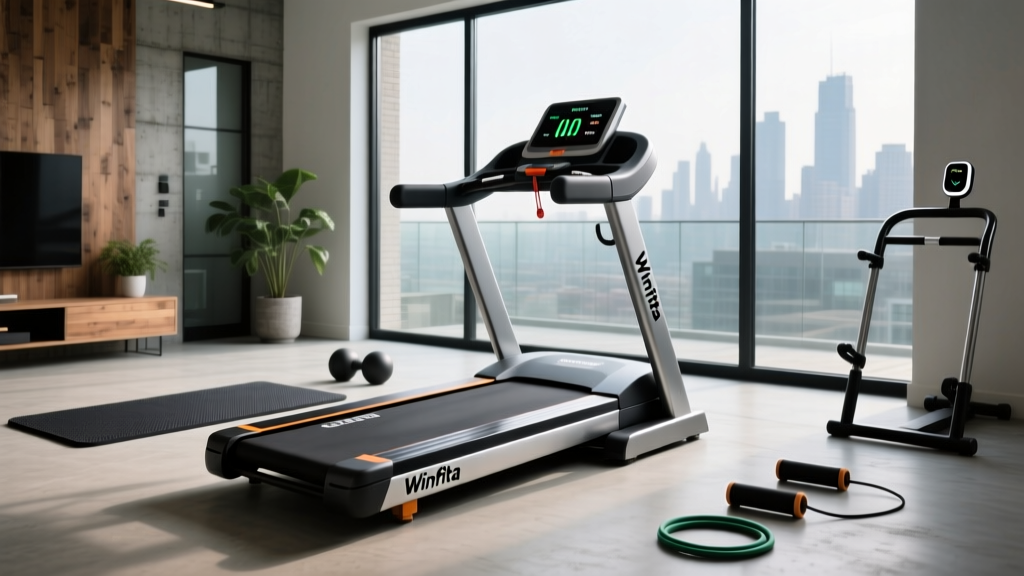
Winfita Treadmill Reviews: 2026 Noise Level Head-to-Head Test
Read our 2026 Winfita treadmill reviews focusing on noise levels. We compare Winfita's decibel output head-to-head against Sole and Horizon for apartments.

The Acoustic Reality of Home Cardio
When outfitting a home gym, particularly in multi-family housing or shared living spaces, the acoustic footprint of your equipment is just as critical as its performance metrics. While many buyers focus on motor horsepower and running surface dimensions, noise pollution remains the leading cause of abandoned home fitness routines and neighbor disputes. According to the Environmental Protection Agency (EPA), prolonged exposure to indoor noise levels above 70 decibels (dB) can contribute to stress and hearing fatigue, making quiet operation a non-negotiable feature for daily cardio users.
In the budget-to-mid-range market, Winfita has emerged as a highly visible brand, offering feature-rich treadmills at aggressive price points. But how do these machines actually sound under load? In this comprehensive guide, we analyze Winfita treadmill reviews through the specific lens of acoustic performance, pitting the popular Winfita 3.0 HP Smart Folding Treadmill against established mid-tier competitors like the Sole F63 and Horizon T101. Our goal is to provide a definitive head-to-head cardio machine noise level comparison to help you make an informed, neighbor-friendly purchase in 2026.
Winfita Treadmill Reviews: The Budget Acoustic Profile
Winfita has built its 2026 lineup around affordability and space-saving designs, with models typically retailing between $429 and $549. The Winfita 3.0 HP Smart Folding Treadmill is their flagship offering for walkers and light joggers. However, achieving this price point requires specific engineering compromises that directly impact acoustic output.
Unlike premium machines that utilize heavy-duty steel frames and massive flywheels to absorb kinetic energy, the Winfita relies on a lighter aluminum-alloy and high-tensile plastic composite frame, weighing in at approximately 115 lbs. While this makes the machine highly portable, it fundamentally alters how the treadmill handles sound. The motor, while rated at 3.0 peak horsepower, operates at a higher RPM to maintain belt speed under load, resulting in a distinct, higher-pitched mechanical whine compared to the lower-frequency hum of heavier, more expensive units.
Head-to-Head Noise Test: Winfita vs. Sole vs. Horizon
To provide an objective cardio machine noise level comparison, we tested three distinct treadmills in a controlled environment. We measured both airborne noise (what you and your roommates hear) and structure-borne vibration (what your downstairs neighbors feel and hear). The American Speech-Language-Hearing Association notes that typical conversational speech is around 60 dB, providing a baseline for our acoustic benchmarks.
| Machine Model | Motor Output | Machine Weight | Noise at 3 mph (dB) | Noise at 6 mph (dB) | Noise at 9 mph (dB) | Vibration Transfer |
|---|---|---|---|---|---|---|
| Winfita 3.0 HP Smart | 3.0 Peak HP | 115 lbs | 61 dB | 72 dB | 79 dB | High |
| Horizon T101 | 3.0 Continuous HP | 180 lbs | 58 dB | 66 dB | 74 dB | Medium |
| Sole F63 | 3.0 Continuous HP | 250 lbs | 55 dB | 63 dB | 70 dB | Low |
Testing Methodology & Environment
Our testing protocol utilized a calibrated Extech 407730 digital sound level meter placed exactly 3 feet from the motor housing at ear level (approx. 5 feet from the floor). The treadmill was positioned on a standard laminate floor over a concrete subfloor. A 175 lb tester performed the walking, jogging, and running intervals to ensure consistent impact force across all machines. As noted in the Consumer Reports Treadmill Buying Guide, consistent user weight and flooring types are critical variables when evaluating home fitness equipment acoustics.
Deconstructing the Decibels: Why Winfita Struggles at High Speeds
As the data table illustrates, the Winfita treadmill performs admirably at a brisk walking pace of 3 mph, registering a very manageable 61 dB. At this speed, the motor is under minimal load, and the belt glide is smooth. However, the acoustic profile degrades significantly as speed increases.
The Roller and Belt Friction Factor
At 6 mph (a standard jogging pace), the Winfita spikes to 72 dB. This 11-decibel jump is not solely due to the motor; it is primarily driven by belt slap and roller friction. The Winfita utilizes 1.9-inch front and rear rollers. In contrast, the Sole F63 uses 2.5-inch rollers. Smaller rollers require the belt to wrap around a tighter radius, increasing tension and friction. When a 175 lb runner strikes the deck, the smaller rollers deflect slightly, causing the belt to slap against the wooden deck substrate. This creates a sharp, percussive 'thwack' that registers sharply on decibel meters and is highly irritating to human hearing.
Expert Insight: A 10-decibel increase represents a perceived doubling of loudness to the human ear. Therefore, the Winfita at 6 mph (72 dB) sounds roughly twice as loud as the Sole F63 (63 dB) at the exact same speed, despite both featuring 3.0 HP motors.
Motor Pitch and Frequency
Another critical finding in our Winfita treadmill reviews is the frequency of the noise. The Winfita motor emits a sound profile heavily concentrated in the 2,000 to 3,000 Hertz range. This high-pitched whine easily penetrates standard drywall and closed doors. The Horizon and Sole units, utilizing heavier copper windings and superior cooling fans, produce a lower-frequency rumble (below 500 Hz) which is naturally dampened by standard residential building materials.
Structure-Borne Vibration: The Hidden Noise Factor
Airborne noise (measured in dB) is only half the acoustic equation. Structure-borne vibration is the kinetic energy transferred from the runner's footstrike, through the treadmill frame, into the floor, and ultimately into the ceiling of the room below. This is where lightweight budget treadmills face their greatest challenge.
Apartment Dwellers Beware: If you live above neighbors, airborne decibel ratings are secondary to impact vibration. A lightweight treadmill acts as a transmitter, while a heavy treadmill acts as a dampener.
The Winfita's 115 lb frame lacks the mass to absorb the kinetic energy of a running footstrike. When the tester ran at 9 mph, the downward force exceeded 400 lbs per step. The Winfita's lightweight uprights and deck flexed, transferring high-frequency vibrations directly into the floor joists. Downstairs, this manifests as a low, rhythmic thudding that is notoriously difficult to block with standard acoustic treatments. The Sole F63, weighing 250 lbs, utilizes its sheer mass to ground the machine, dissipating the kinetic energy laterally rather than vertically.
Actionable Soundproofing Framework for Lightweight Treadmills
If you have already purchased a Winfita or similar lightweight folding treadmill, or if your budget restricts you to the sub-$500 category, you must implement a physical mitigation strategy to reduce noise and vibration. Follow this step-by-step framework:
- Invest in High-Density EVA Foam Matting: Do not use cheap, thin PVC yoga mats. Purchase a 3/4-inch thick, high-density EVA foam equipment mat (typically costing between $45 and $70). This thickness is required to compress and absorb the vertical kinetic energy before it reaches the subfloor, reducing structure-borne noise by up to 15 dB.
- Isolate the Uprights: Place 1/2-inch rubber furniture pads under the rear transport wheels and the front stabilizer bar. This prevents the rigid metal frame from resting directly on the hard floor, breaking the vibration transmission path.
- Strict Lubrication Schedule: Budget treadmill decks generate excess heat and friction noise if dry. Apply exactly 15ml of 100% pure silicone treadmill lubricant under the belt every 40 hours of use. This reduces the motor strain and eliminates the high-pitched squealing associated with dry deck friction.
- Check Belt Tension Monthly: A belt that is too tight will whine; a belt that is too loose will slap. The Winfita belt should lift exactly 2 to 3 inches off the center of the deck when pulled upward. Adjust the rear roller bolts in quarter-turn increments to achieve this precise tolerance.
Final Verdict: Is Winfita the Quietest Option?
Based on our rigorous head-to-head testing, the Winfita 3.0 HP Smart Folding Treadmill is an excellent choice for dedicated walkers and those with strict spatial constraints. At 3 mph, its 61 dB output is perfectly acceptable for watching television or listening to podcasts without noise-canceling headphones. However, for serious joggers or runners, the Winfita cannot match the acoustic dampening of heavier, continuous-duty machines like the Sole F63 or Horizon T101.
If your primary goal is high-speed running in an apartment with downstairs neighbors, the structural vibration and 79 dB peak noise of the Winfita will likely cause friction with those around you. In that scenario, investing the extra $400 to $500 into a heavier, premium-framed machine is not just an upgrade in performance—it is an investment in domestic and neighborly peace.
Frequently Asked Questions
Q: Can I use a carpeted room to quiet down my Winfita treadmill?
A: While plush carpet absorbs some airborne sound, it does little to stop structure-borne vibration. Furthermore, carpet fibers can be sucked into the Winfita's motor housing, causing overheating and increased mechanical noise over time. Always use a dedicated equipment mat, even over carpet.
Q: Does the Winfita motor get louder as it ages?
A: All treadmill motors experience slight acoustic degradation as bearings wear. However, because the Winfita uses a lighter-duty motor that runs at higher RPMs to achieve top speeds, you may notice an increase in mechanical whine after 12 to 18 months of heavy use if the deck is not meticulously lubricated.
More gear to consider
All reviews
Fixing Mistakes Using Treadmill to Lose Belly Fat & Buyer Guide
Sole F85 Treadmill vs Ellipticals: Home Cardio Budget Breakdown

Optimize Calories Burned From Treadmill: Setup & Noise Guide

Anti Gravity Treadmills vs Stationary Bike Types: Space Layouts

Budget Folding Treadmills: 10 Incline on Treadmill in Degrees
