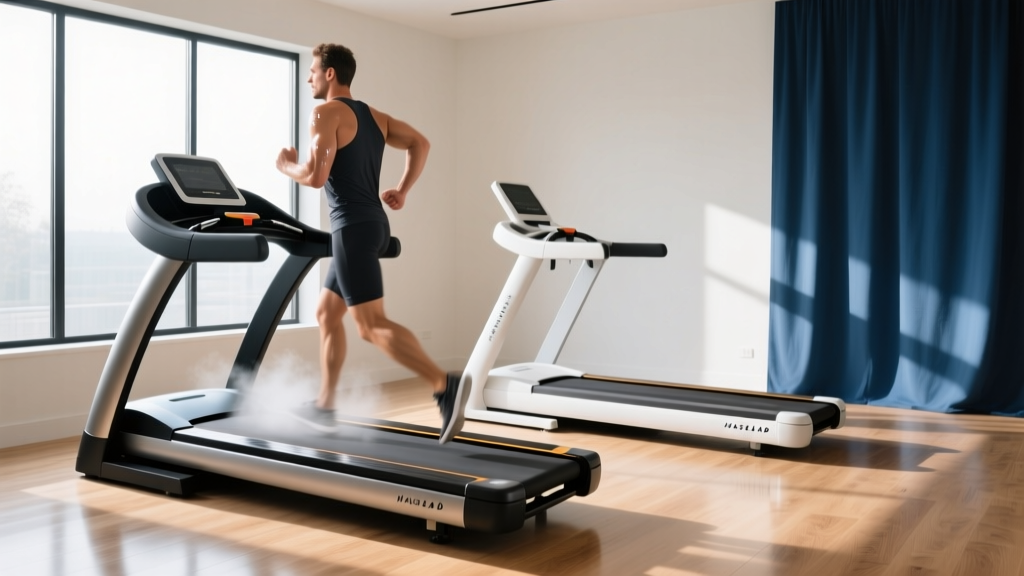
Stationary Bike Types & What Incline Should I Run on a Treadmill
Compare upright, recumbent, and spin stationary bike types. Plus, discover what incline you should run on a treadmill for optimal cross-training.

The 2026 Home Cardio Matrix: Selecting Your Stationary Bike
Building a comprehensive home cardio setup in 2026 requires more than just buying the most expensive machine on the market; it demands a strategic understanding of biomechanics, joint loading, and cross-training synergy. In the FitGearPulse testing lab, we have spent hundreds of hours evaluating the three primary stationary bike types—upright, recumbent, and spin—to determine which chassis and resistance systems actually deliver on their promises. However, because no single cycling machine covers all cardiovascular and musculoskeletal bases, we must also address the secondary half of the home gym equation. When designing a balanced weekly routine, the most common question we receive is: what incline should I run on a treadmill to properly complement my cycling days without overtaxing the central nervous system?
This expert guide breaks down the exact specifications, real-world pricing, and performance metrics of top-tier stationary bikes, followed by our data-driven treadmill incline protocols for seamless cross-training.
Deconstructing Stationary Bike Types: Upright vs. Recumbent vs. Spin
The term 'stationary bike' is a massive oversimplification. The geometry, crank length, and flywheel placement drastically alter muscle recruitment patterns. Here is our hands-on assessment of the three dominant categories.
1. Upright Bikes (The Traditionalist)
Upright bikes mimic the geometry of a standard outdoor bicycle but with a wider, more supportive saddle and a heavier frame. They engage the core and upper body slightly more than recumbent models due to the lack of a backrest.
- Top 2026 Pick: Sole Fitness B94
- Price: $1,499
- Expert Insight: The B94 features a massive 30-pound flywheel and a 200mm Q-factor (the distance between the pedals). This wider stance is excellent for users with broader hips but can cause knee valgus (inward caving) in narrower riders during high-cadence sprints. It is best suited for steady-state LISS (Low-Intensity Steady State) cardio.
2. Recumbent Bikes (The Ergonomic Savior)
Recumbent bikes place the rider in a reclined position with a full backrest and a step-through frame. This design completely removes axial loading from the lumbar spine and shifts the emphasis almost entirely to the glutes, hamstrings, and quadriceps.
- Top 2026 Pick: Schwinn 270
- Price: $899
- Expert Insight: According to Harvard Health Publishing, recumbent bikes are the gold standard for individuals managing osteoarthritis or recovering from spinal surgery. The Schwinn 270 offers 25 levels of magnetic resistance and a ventilated lumbar-support mesh that prevents the lower-back sweating common in cheaper models.
3. Spin / Indoor Cycling Bikes (The Performance Beast)
Spin bikes are built for aggressive, out-of-the-saddle riding and high-intensity interval training (HIIT). They feature a narrow saddle, drop-style or bullhorn handlebars, and a tight Q-factor to mimic a road bike's aerodynamic profile.
- Top 2026 Pick: Peloton Bike+ (Premium) / Schwinn IC4 (Value)
- Price: $2,495 / $999
- Expert Insight: The Peloton Bike+ utilizes a digital magnetic resistance system that is virtually silent and requires zero maintenance, unlike the friction pads found on older spin bikes. Its 150mm Q-factor allows for a highly efficient vertical force vector, making it the undisputed king for high-cadence interval work and standing climbs.
2026 Stationary Bike Comparison Matrix
| Feature | Upright (Sole B94) | Recumbent (Schwinn 270) | Spin (Peloton Bike+) |
|---|---|---|---|
| Primary Muscle Focus | Quads, Calves, Core | Glutes, Hamstrings | Quads, Glutes, Calves |
| Q-Factor (Pedal Width) | ~200mm (Wide) | N/A (Forward extension) | ~150mm (Narrow) |
| Flywheel Weight | 30 lbs (Front-drive) | Hidden (Magnetic) | Hidden (Digital Magnetic) |
| Best User Profile | General fitness, upright posture | Rehab, back pain, seniors | Athletes, HIIT, performance |
| Estimated Footprint | 48' x 24' | 65' x 28' | 48' x 24' |
Cross-Training Integration: What Incline Should I Run on a Treadmill?
Transitioning from the saddle to the running belt requires a shift in kinematic chain loading. Cycling is a concentric-dominant, closed-chain (mostly) movement that spares the joints from impact. Running, conversely, introduces eccentric loading and ground reaction forces equal to 2.5 times your body weight. Therefore, determining what incline should I run on a treadmill is critical for managing tissue fatigue while maximizing cardiovascular output.
The 1% Rule for Outdoor Simulation
If your goal is to simulate outdoor running mechanics on a treadmill, the scientific consensus remains steadfast. A landmark study published in the Journal of Sports Sciences (Jones & Doust) established that setting the treadmill to a 1% incline accurately offsets the lack of air resistance you would naturally face outdoors at paces faster than 7:09 per mile. If you are training for an outdoor 10K or marathon, your baseline easy runs should be set to 1% to ensure accurate energetic cost.
Goal-Specific Incline Targets
Beyond the 1% baseline, your incline should be manipulated based on your specific physiological targets and how your legs feel after heavy cycling days.
💡 Expert Callout: The Eccentric Braking EffectRunning downhill (negative incline) on advanced treadmills increases eccentric muscle damage, particularly in the quadriceps. If you have just completed a grueling 60-minute spin class focusing on heavy resistance climbs, avoid negative inclines on your treadmill the next day to prevent delayed onset muscle soreness (DOMS) from compounding.
- 0% to 1% (Neuromuscular Patterning & Recovery): Best for active recovery days. The low incline minimizes Achilles tendon strain and allows you to focus on cadence and foot-strike mechanics without overtaxing the posterior chain.
- 2% to 5% (Aerobic Base & Calf Loading): This moderate incline increases caloric expenditure by roughly 15-20% without requiring a faster running speed. It is ideal for building aerobic capacity while keeping impact forces manageable.
- 8% to 15% (Glute Activation & Low-Impact HIIT): Popularized by the '12-3-30' method, walking or jogging at a high incline shifts the workload heavily to the gluteus maximus and hamstrings. This perfectly mimics the muscle recruitment of a heavy-resistance spin bike climb but without the saddle discomfort.
When users ask what incline they should run on, they often set it to 12% or higher and immediately grab the handrails, leaning back. According to the Mayo Clinic, holding onto the treadmill console alters your natural gait, reduces core engagement, and effectively negates the caloric and biomechanical benefits of the incline. If you must hold on, the incline is too high or the speed is too fast. Pump your arms as you would outdoors.
The FitGearPulse Weekly Cross-Training Protocol
To synthesize our stationary bike reviews and treadmill incline data, here is a sample 4-day cardiovascular protocol designed for the 2026 home gym owner looking to build endurance while preserving joint health.
- Day 1: Spin Bike HIIT (Anaerobic Power)
Use a Spin Bike (e.g., Peloton Bike+). 45 minutes. Focus on high-cadence sprints (90-110 RPM) and heavy out-of-the-saddle climbs. This builds VO2 max and fast-twitch muscle fiber recruitment. - Day 2: Treadmill Incline Walk (Active Recovery & Glutes)
Set treadmill to 8% incline, 3.0 mph speed. 40 minutes. Do not hold the handrails. This flushes lactic acid from Day 1 while targeting the posterior chain without impact. - Day 3: Upright/Recumbent Bike LISS (Aerobic Base)
Use an Upright or Recumbent bike (e.g., Schwinn 270). 60 minutes at Zone 2 heart rate (60-70% of max HR). Keep resistance moderate. This builds mitochondrial density and capillary networks. - Day 4: Treadmill 1% Simulation Run (Endurance)
Set treadmill to 1% incline. 30-45 minutes at your target outdoor race pace. Focus on maintaining a 170-180 step cadence to minimize ground contact time and braking forces.
Final Expert Verdict
Choosing between upright, recumbent, and spin stationary bike types ultimately comes down to your orthopedic history and training intensity. If you want to push your lactate threshold, invest in a magnetic spin bike like the IC4 or Bike+. If you need daily movement that respects a sensitive lumbar spine, the recumbent geometry is non-negotiable. Finally, when integrating the treadmill into your routine, remember that the answer to what incline should I run on a treadmill is never 'flat'. Utilize the 1% rule for outdoor specificity, and leverage 8%+ inclines to build posterior-chain strength that will directly translate to more power in the cycling saddle.
More gear to consider
All reviews
Woodway Treadmill 4Front vs. Home Stair Climber Guide

T Series 10 Treadmill vs Stationary Bike Types: 2026 Guide

2026 Techno Treadmill Showdown: Myrun vs. Skillrun

Folding Treadmill for Small Spaces: Child Treadmill Care Guide

Home Stair Climbers & CPT Code for Nuclear Treadmill Stress Test