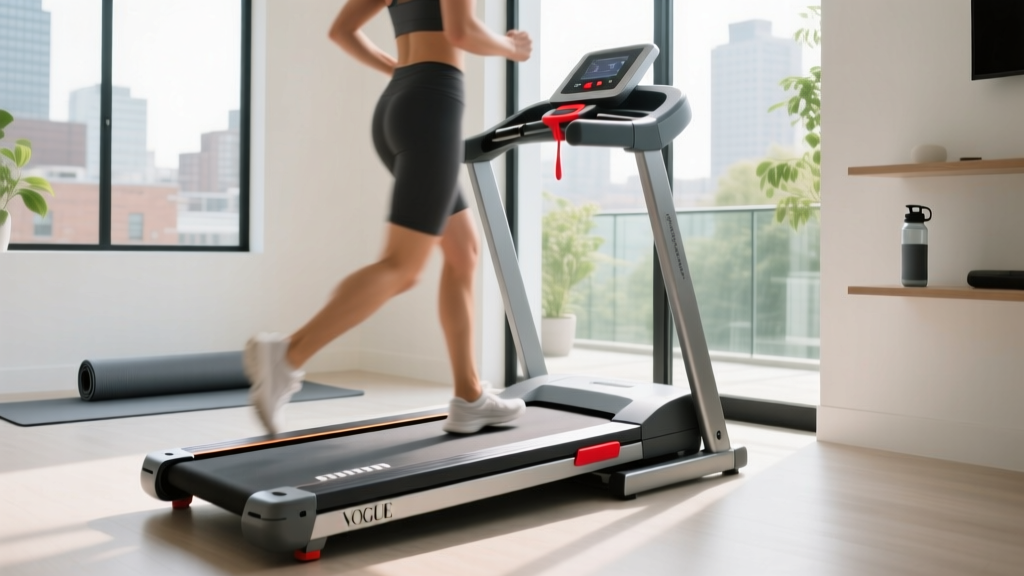
What Does Kcal Mean on a Treadmill? Compact Cardio Space Guide
Learn what kcal means on a treadmill and how to track calorie burn when downsizing to compact portable cardio equipment for small apartment layouts.

As urban living spaces shrink and remote work cements itself into our daily routines, the traditional home gym is undergoing a radical transformation. For millions of renters and condo owners in 2026, dedicating 30 square feet to a commercial-grade treadmill is simply no longer feasible. This spatial reality forces a pivot toward compact portable cardio equipment options. However, as fitness enthusiasts transition from full-sized gym machines to foldable walking pads and under-desk ellipticals, a fundamental question from their gym days often resurfaces: what does kcal mean on a treadmill, and more importantly, does that metric hold up when you downsize to portable gear?
Understanding the thermodynamics of your workout console is critical for space optimization. If you are designing a micro-apartment layout or trying to maximize Non-Exercise Activity Thermogenesis (NEAT) in a 500-square-foot footprint, you need to know exactly how your compact equipment tracks energy expenditure compared to the full-sized machines you left behind.
Decoding the Console: What Does Kcal Mean on a Treadmill?
When you look at a treadmill display, 'kcal' stands for kilocalories. In the realm of fitness and nutrition, one kilocalorie (kcal) is equal to what we colloquially call a 'Calorie' (with a capital C). Therefore, if your treadmill says you burned 350 kcal, you have burned 350 dietary Calories.
Full-sized treadmills calculate this metric using a combination of user-inputted weight, belt speed, incline percentage, and standardized Metabolic Equivalent of Task (MET) values. The physiological formula most commercial consoles use to estimate caloric burn per minute is:
The MET Caloric Formula:Kcal/min = (METs × 3.5 × body weight in kg) / 200
According to data on energy expenditure from Harvard Health Publishing, a 155-pound person walking at a moderate 3.5 mph pace on a flat surface will burn approximately 133 kcal in 30 minutes. If you increase the incline to 10%, the MET value spikes, and the treadmill's algorithm accurately reflects a higher kcal output because the mechanical work required to lift your body weight against gravity increases.
The Space-to-Burn Matrix: Compact Cardio Equipment for 2026
When space optimization is your primary constraint, you must evaluate equipment not just by its kcal output, but by its 'space-to-burn ratio'—how many calories you can realistically burn relative to the machine's physical footprint and storage dimensions. Below, we analyze three leading compact portable cardio options that dominate the small-space market.
1. UREVO Strol 2E (2-in-1 Walking Pad & Treadmill)
The UREVO Strol 2E is a marvel of spatial engineering. It features a foldable handlebar that transitions it from a 7.6 mph jogging treadmill to a low-profile under-desk walking pad. When folded flat, it measures just 54.3 x 27.6 x 6.3 inches, allowing it to slide under standard bed frames (which typically offer 7 to 9 inches of clearance). Priced around $379, its console tracks kcal based on speed and time, but lacks the incline sensors of larger units.
2. Cubii JR2 Under-Desk Elliptical
For pure space optimization, the Cubii JR2 is unmatched. Measuring 23 x 17 x 10 inches and weighing just 27 lbs, it can be stored in a closet or under a sofa. Retailing at $299, it targets the lower body while seated. Because you are seated, the MET value is significantly lower than standing cardio, meaning the kcal burn per minute is roughly 30-40% of what a treadmill registers at a brisk walking pace.
3. XTERRA Fitness ERG660W Foldable Rower
Rowing engages 86% of the body's musculature, yielding a massive kcal burn per minute. The XTERRA ERG660W features a unique 'fold-in-half' design. While in use, it requires an 8-foot track, but when folded for storage, its footprint shrinks to an incredibly dense 22 x 22 inches, fitting perfectly into a standard 24-inch deep bedroom closet. It retails for approximately $449.
| Equipment Model | Active Footprint | Storage Dimensions | Est. Kcal/30min (155lb user) | Avg. Price (2026) |
|---|---|---|---|---|
| UREVO Strol 2E | 10.4 sq ft | 54.3' x 27.6' x 6.3' | 130 - 160 kcal | $379 |
| Cubii JR2 | 2.7 sq ft | 23' x 17' x 10' | 80 - 110 kcal | $299 |
| XTERRA ERG660W | 24.5 sq ft | 22' x 22' x 55' (Folded) | 210 - 280 kcal | $449 |
Micro-Apartment Layout Blueprints & Flooring Protection
Integrating portable cardio equipment into a small apartment requires deliberate layout design. You cannot simply place a walking pad in a high-traffic walkway; it creates visual clutter and a tripping hazard. Here are expert spatial strategies for integrating these machines:
- The Under-Bed Zoning Strategy: If utilizing a walking pad like the UREVO Strol 2E, ensure your bed frame has a minimum clearance of 7 inches. To prevent dust accumulation and motor overheating, store the pad on its side using a vertical wall mount or a dedicated slim rolling cart rather than flat on the carpet where it can trap lint in the belt rollers.
- Closet Depth Mapping: Standard reach-in closets have a depth of 24 inches. The XTERRA folded rower (22x22 inches) fits perfectly, but you must account for the closet door swing and baseboard heaters. If your closet has a floor-mounted baseboard heater, the rower's base will not slide flush against the back wall, requiring you to offset the storage by 4-6 inches.
- Flooring Protection for Renters: Compact machines concentrate weight into smaller surface areas. A 150-pound user on a 27-inch walking pad creates significant point-load pressure on Luxury Vinyl Plank (LVP) or laminate flooring. Always use a high-density TPE (Thermoplastic Elastomer) mat, at least 4mm thick, cut exactly to the machine's footprint to distribute the load and dampen low-frequency vibrations that travel to downstairs neighbors.
The Kcal Translation Problem: Why Portable Consoles Overestimate
Returning to our core question—what does kcal mean on a treadmill versus a portable machine—requires a critical look at algorithmic accuracy. Full-sized treadmills use complex strain gauges and incline motors to calculate true mechanical work. Portable walking pads and budget ellipticals rely on rudimentary RPM (revolutions per minute) sensors and generic MET tables.
Because walking pads cannot measure the subtle variations in your stride length or account for the fact that you might be leaning heavily on a desk while using them, they frequently overestimate kcal burn by 20% to 30%. If your walking pad console claims you burned 250 kcal in an hour of slow strolling, the physiological reality is likely closer to 175 kcal.
Expert Tip: The NEAT MultiplierDo not rely solely on the console's kcal readout for dietary tracking when using compact gear. Instead, leverage the concept of Non-Exercise Activity Thermogenesis (NEAT). As noted by the Cleveland Clinic, NEAT encompasses all the calories burned through daily movement outside of dedicated exercise. Using an under-desk elliptical while working might only burn 100 kcal on the console, but it prevents the metabolic down-regulation that occurs from sitting completely still for 8 hours, effectively keeping your baseline daily kcal expenditure much higher.
Frequently Asked Questions
Is kcal the same as calories burned on my fitness tracker?
Yes. In fitness tracking, 'kcal' (kilocalories) and 'Calories' (capital C) are identical. If your Apple Watch or Garmin says you burned 400 Calories, and your treadmill says 400 kcal, they are referencing the exact same unit of energy.
Which compact cardio machine burns the most kcal per square foot?
The foldable indoor rower (like the XTERRA ERG660W) offers the highest kcal burn per minute due to full-body engagement. However, if you are measuring by storage footprint, the under-desk elliptical wins the space optimization metric, as it requires virtually zero dedicated floor space when not in use.
Can I trust the kcal display on a budget walking pad?
Treat budget walking pad kcal displays as a relative metric rather than an absolute one. Use it to track your progress (e.g., 'I burned 10% more kcal this week than last week based on the machine's math'), but apply a 20% discount to the raw number if you are logging it into a strict dietary app like MyFitnessPal.
More gear to consider
All reviews
Elliptical vs Treadmill Layouts: Using a Treadmill Speed Converter
ProForm 595LE Treadmill Troubleshooting & Walking Pad Comparison
Treadmill Motor Guide: Are Umay Treadmills Powerful Enough?

Echelon Stride 6s Treadmill vs Rowers: Buying Guide & Technique
Pre Postnatal Treadmill 2026: Belt Maintenance & Market Wear Trends