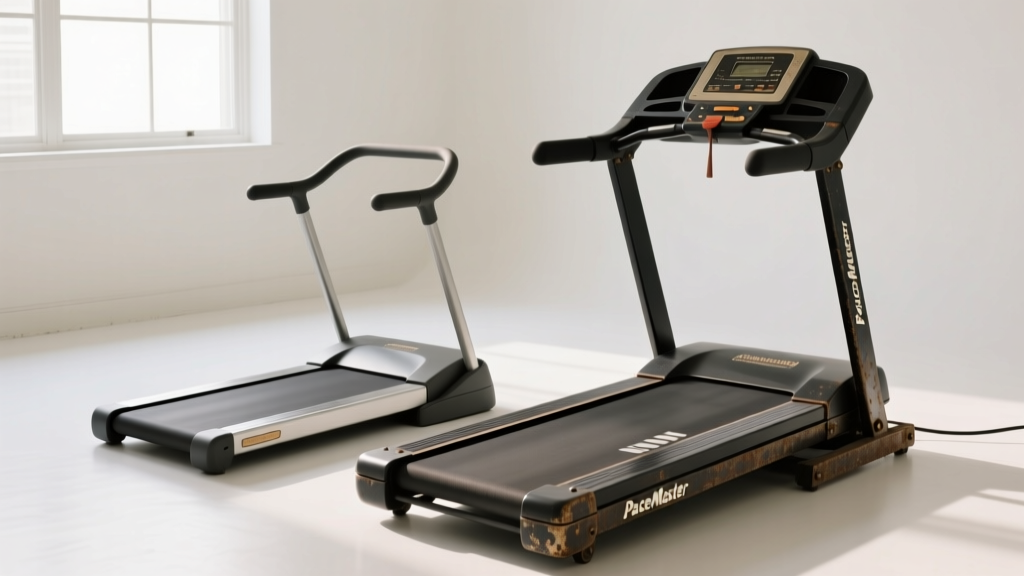
Walking Pad vs PaceMaster Bronze Basic: 2026 Treadmill Guide
Compare modern walking pads to the legacy PaceMaster Bronze Basic. Our 2026 treadmill guide covers specs, failure modes, and joint impact.

The Evolution of Home Cardio: Legacy Heavyweights vs. Modern Walking Pads
If you have been tracking home fitness trends over the last decade, you have likely witnessed a massive shift in how we approach daily cardio. In the early 2000s, the gold standard for budget-friendly home fitness was the traditional folding treadmill. Today, the market is dominated by ultra-compact walking pads designed for under-desk use and small apartments. But is newer always better?
In this comprehensive 2026 buying guide, we are conducting a highly specific teardown and comparison between a legendary legacy machine—the PaceMaster Bronze Basic—and the current generation of high-end walking pads. Whether you are trying to decide if you should repair your old folding treadmill or upgrade to a modern walking pad, this guide provides the exact engineering specs, failure modes, and biomechanical data you need to make an informed decision.
The Legacy Benchmark: Analyzing the PaceMaster Bronze Basic
The PaceMaster Bronze Basic was a staple in the mid-tier home treadmill market. Originally retailing around $899, it was engineered as a no-nonsense, heavy-duty folding treadmill. Unlike the flimsy budget models of its era, the Bronze Basic featured a robust steel frame and a reliable 2.0 Continuous Horsepower (CHP) motor.
Core Specifications and Dimensions
- Motor: 2.0 CHP (Continuous Duty), capable of sustaining 6.5 MPH without thermal throttling.
- Running Surface: 18 inches by 50 inches. This 50-inch length is critical, as it accommodates a full jogging stride for users up to 6 feet tall.
- Weight Capacity: 300 lbs, supported by a 165 lb machine footprint.
- Incline: Manual 3-position incline (rare for budget models at the time).
While it lacks the Bluetooth connectivity and interactive programming of 2026 treadmills, the PaceMaster Bronze Basic was built with physical longevity in mind. Its heavy flywheel and thick 2-ply belt provided a relatively smooth impact absorption profile compared to the rigid decks of modern ultra-thin walking pads.
The 2026 Walking Pad Contenders
Modern walking pads prioritize spatial efficiency over raw power. In 2026, the market leaders have pushed the boundaries of hinge-engineering and brushless motor technology. We are comparing the legacy PaceMaster against two current market leaders: the UREVO Strol 2E (Model URTM035) and the KingSmith WalkingPad X21.
Market Pricing Context (2026): While a used PaceMaster Bronze Basic can be found on secondary markets for $150 to $250, modern premium walking pads like the KingSmith X21 retail for $499, and the UREVO Strol 2E sits at an accessible $349.UREVO Strol 2E vs. KingSmith WalkingPad X21
The UREVO Strol 2E bridges the gap between a walking pad and a traditional treadmill by including a foldable handlebar and a 2.0 HP peak motor, allowing speeds up to 7.6 MPH. The KingSmith X21, conversely, utilizes a patented 180-degree folding hinge and a 2.5 HP peak motor, but restricts top speed to 3.7 MPH when the handlebar is folded down for safety.
Head-to-Head Comparison Matrix
| Feature | PaceMaster Bronze Basic | UREVO Strol 2E | KingSmith X21 |
|---|---|---|---|
| Motor Type | 2.0 CHP (Brushed) | 2.0 HP Peak (Brushless) | 2.5 HP Peak (Brushless) |
| Belt Dimensions | 18' x 50' | 15.7' x 47.2' | 17.3' x 47.2' |
| Max Speed | 6.5 MPH | 7.6 MPH | 3.7 MPH (Folded) / 7.4 MPH (Upright) |
| Machine Weight | 165 lbs | 61 lbs | 68 lbs |
| Max User Weight | 300 lbs | 265 lbs | 265 lbs |
Critical Failure Modes: What Actually Breaks?
As fitness equipment repair technicians will tell you, understanding how a machine fails is just as important as its spec sheet. The engineering paradigms between legacy folding treadmills and modern walking pads result in entirely different maintenance profiles.
Legacy Folding Treadmill Edge Cases (PaceMaster)
The most common catastrophic failure on the PaceMaster Bronze Basic is the Lower Control Board (LCB) capacitor degradation. After 7 to 10 years of use, the electrolytic capacitors on the motor controller board dry out, leading to erratic speed surges or complete failure to start. Additionally, the console ribbon cable, which routes through the folding hinge, is prone to micro-tears after roughly 1,000 folding cycles, resulting in dead console displays. Finally, the 18-inch belt width, while standard for its time, causes excessive edge-friction for users with a wide gait, leading to premature belt fraying.
Walking Pad Overheating and Belt Drift
Modern walking pads utilize Pulse Width Modulation (PWM) motor controllers and smaller, low-profile rollers. The primary failure mode here is thermal throttling. If a 220 lb user walks at a brisk 3.5 MPH on a KingSmith X21 for more than 45 continuous minutes, the internal temperature sensor will trigger a safety shutoff to prevent the brushless motor from melting the internal wiring harness.
Furthermore, walking pads suffer from micro-adjustment belt drift. Because they lack the heavy, adjustable rear rollers of traditional treadmills, the belt will slowly track to the left or right. Fixing this requires a specific procedure: locate the rear roller hex bolts, and turn the bolt on the side the belt is drifting toward exactly one-quarter turn clockwise. Never adjust more than a quarter turn at a time, or you will over-tension the motor drive belt.
Biomechanics and Joint Impact: Stride Length Constraints
Beyond the hardware, the physical dimensions of your treadmill dictate your biomechanical safety. According to Harvard Health Publishing, maintaining a natural stride length is vital for preventing lower back and hip flexor strain during sustained cardiovascular exercise.
'When a treadmill belt is too short, users subconsciously shorten their stride and increase their cadence. Over thousands of steps, this altered biomechanic can lead to anterior shin splints and Achilles tendonitis.'
The 50-inch belt on the PaceMaster Bronze Basic allows for a full, natural jogging stride. In contrast, the 47-inch belts on the UREVO and KingSmith walking pads physically restrict users taller than 5'8' from jogging safely. If your primary goal is to achieve the American Heart Association's recommendation of 150 minutes of moderate-to-vigorous aerobic activity per week, a walking pad is excellent for moderate walking (Zone 2 cardio). However, if you intend to do vigorous jogging or interval training, the spatial limitations of a walking pad make the legacy PaceMaster (or a modern full-size equivalent) a biomechanical necessity.
The Verdict: Who Should Upgrade in 2026?
Deciding between repairing a legacy machine like the PaceMaster Bronze Basic or investing in a 2026 walking pad comes down to your specific spatial constraints and cardiovascular goals. Use this decision framework to guide your purchase:
Stick With (or Repair) the Legacy PaceMaster If:
- You weigh over 265 lbs and require the structural stability of a 165 lb steel frame.
- You plan to jog or run at speeds exceeding 4.0 MPH, requiring a 50-inch belt for safe stride extension.
- You have a dedicated workout room and do not need to slide the machine under a sofa or desk daily.
- You prefer physical, tactile buttons over Bluetooth remote controls and smartphone apps.
Upgrade to a Modern Walking Pad (UREVO / KingSmith) If:
- You live in an apartment or multi-use space where a 61 lb footprint and under-bed storage are mandatory.
- Your cardio routine consists strictly of low-impact walking (2.0 to 3.8 MPH) while working at a standing desk or watching television.
- You want modern brushless motor technology that operates at under 45 decibels, keeping your home office quiet.
- You are willing to perform quarterly belt-tensioning maintenance to prevent tracking drift.
Ultimately, while the PaceMaster Bronze Basic represents an era of indestructible, heavy-iron home fitness, the 2026 walking pad market offers unparalleled convenience for the modern, space-conscious consumer. Assess your stride, measure your room, and choose the machine that guarantees you will actually use it every single day.
More gear to consider
All reviews
ProForm 505 Treadmill Setup vs Walking Pads: 2026 Review

Gym Layouts: Stationary Bike Types & 9 Min Mile Treadmill Speed

Old ProForm Treadmill Models: Motor & HP Buying Guide
Beyond the Treadmill Buying Guide: Rowing Machine Setup

2026 Market Trends: NordicTrack Treadmill T6.5S vs Stationary Bikes
