Walking Pad vs. Cats Treadmill: 2026 Compact Cardio Comparison
We compare the UREVO Strol 2E walking pad against dedicated pet exercise machines to answer: is a human walking pad a viable cats treadmill for 2026?

The Indoor Cardio Dilemma: Human Walking Pads vs. Feline Fitness
As remote work solidifies its place in 2026, compact cardio equipment has become a staple in home offices. Simultaneously, indoor pet obesity is rising, leading to a bizarre but highly searched intersection of human and animal fitness: the quest for a viable cats treadmill. Many owners wonder if they can purchase a high-quality human walking pad and repurpose it for their feline companions to save space and money. In this head-to-head comparison, we review the top-rated UREVO Strol 2E Walking Pad against dedicated motorized pet treadmills to determine which machine truly deserves your floor space, budget, and safety considerations.
Expert Insight: Feline biomechanics differ vastly from human gait cycles. Cats are built for explosive, anaerobic bursts (pouncing and sprinting) rather than steady-state aerobic walking. Keep this physiological reality in mind when evaluating any motorized belt for pet use.Contender Profiles: UREVO Strol 2E vs. Dedicated Pet Treadmills
The Human Contender: UREVO Strol 2E Walking Pad
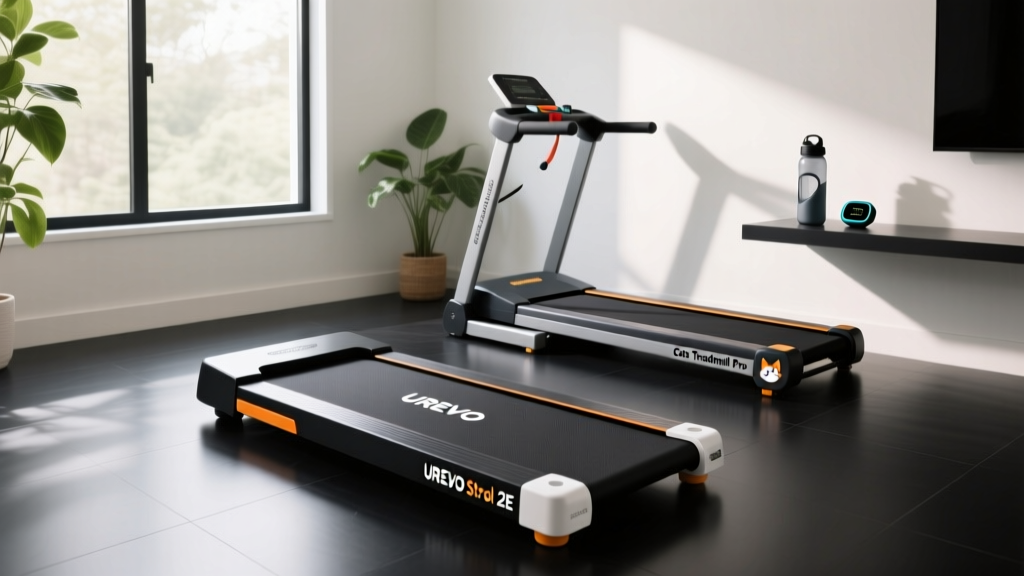
The UREVO Strol 2E remains a dominant force in the 2026 under-desk treadmill market. Priced around $279, it features a 2.5 HP peak brushless motor, a top speed of 3.8 MPH, and a 15.7-inch wide running belt. It is engineered specifically for human stride lengths, low-decibel operation (under 45 dB), and seamless app connectivity. However, its open-deck design lacks the side enclosures and safety tethers typical of animal-specific equipment.
The Pet Contender: Generic Motorized Pet Treadmill (Small Breed/Feline)
Dedicated pet treadmills (such as those from specialized canine and feline fitness brands) typically retail between $350 and $500. They feature a much shorter belt (usually 30 to 35 inches long), side "blinder" panels to keep the animal focused forward, and a specialized safety tether system. The belt material is often a heavier-duty rubberized compound designed to withstand claw traction without tearing or delaminating.
Head-to-Head Specification Matrix
| Feature | UREVO Strol 2E (Human) | Standard Pet Treadmill |
|---|---|---|
| Price Range | $259 - $299 | $350 - $500 |
| Belt Dimensions | 41.3" L x 15.7" W | 35" L x 12" W |
| Motor Type | 2.5 HP Peak Brushless | 1.5 HP Continuous |
| Speed Range | 0.5 - 3.8 MPH | 0.5 - 5.0 MPH |
| Side Enclosures | None (Open Deck) | Yes (Acrylic Blind Panels) |
| Belt Material | Multi-layer PVC | Heavy-duty Rubberized |
Deep Dive Review: UREVO Strol 2E Walking Pad
As a human walking pad, the UREVO Strol 2E is exceptional. The shock-absorption system utilizes six silicone dampeners that effectively reduce joint impact during 10,000-step daily goals. The brushless motor is remarkably quiet, allowing you to take conference calls while walking at 2.0 MPH. The foldable handrail is a welcome addition for 2026 models, providing stability for seniors or those transitioning from a seated desk.
However, when evaluating the Strol 2E through the lens of a cats treadmill, critical failure modes and edge cases emerge:
- Claw Puncture Risk: The multi-layer PVC belt is optimized for rubber-soled shoes. Feline claws, particularly from heavier indoor cats, can puncture the top PVC layer, causing the belt to fray and eventually jam the motor housing.
- Lack of Visual Blinders: Cats are highly visual and easily distracted by peripheral movement. Without side panels, a cat placed on a human walking pad will simply step off the side onto your hardwood floor within seconds.
- Auto-Stop Sensor Thresholds: Human walking pads often use weight-distribution sensors at the front and rear of the belt to auto-pause when the user steps off. A 10-pound cat does not generate enough localized PSI to trigger these sensors, meaning the belt will continue running even if the cat falls or steps to the edge, creating a severe friction-burn hazard.
Veterinary Insights on Feline Cardio
Before investing in any motorized equipment for your pet, it is crucial to understand feline exercise physiology. According to the Association for Pet Obesity Prevention, over 60% of indoor cats are classified as overweight or obese, a crisis that demands intervention. However, forced treadmill walking is rarely the recommended solution.
"Cats are not distance runners. Their musculoskeletal system is designed for short, explosive bursts of energy. Forcing a cat onto a continuous motorized belt can induce severe stress and musculoskeletal strain."
Experts at the Cornell University Feline Health Center emphasize that environmental enrichment—such as vertical climbing trees, motorized laser toys, and interactive wand play—mimics natural hunting behaviors and provides far superior cardiovascular and mental stimulation compared to a treadmill. Furthermore, the Humane Society notes that indoor cats require structured environmental enrichment to prevent behavioral and physical stagnation. If a treadmill is prescribed for specific rehabilitation purposes, it must be a specialized, low-speed, enclosed aquatic or dry pet treadmill operated under strict veterinary supervision.
The Final Verdict: Which Should You Buy?
Buy the UREVO Strol 2E If:
You are a human looking for a reliable, quiet, and compact walking pad for your home office. It is an outstanding piece of cardio equipment for humans, but it should never be used as a makeshift cats treadmill. The safety risks and potential for belt damage void the warranty and endanger your pet.
Buy a Dedicated Pet Exercise Wheel/Treadmill If:
You are looking to increase your indoor cat's daily movement. Instead of a motorized belt, we highly recommend a manual, 48-inch feline exercise wheel (often priced around $399). Because it is manually driven by the cat's own momentum, it allows for the natural sprint-and-stop intervals that feline physiology requires, while the enclosed circular track prevents falls and escapes.
⚠️ Safety Warning: Never leave a pet unattended on a motorized human walking pad. The lack of an emergency magnetic safety clip (which attaches to human clothing) means the machine will not stop if the animal trips or falls.Frequently Asked Questions
Can I train my cat to use my under-desk walking pad?
While some highly trained animals can be conditioned to walk on a belt, human walking pads lack the side enclosures and specialized belt textures required for safe animal use. The risk of claw damage to the PVC belt and friction burns to the animal is simply too high to justify the experiment.
What is the best alternative to a motorized cats treadmill?
A manual cat exercise wheel or a multi-level cat tree with integrated scratching posts and hanging toys. These provide the anaerobic burst exercise that cats naturally crave without the stress and danger of a motorized belt.
Does the UREVO Strol 2E require lubrication?
Yes. To maintain the 2.5 HP motor and prevent belt friction, UREVO recommends applying 100% silicone treadmill lubricant every 3 months or after every 30 miles of use. Note that allowing a cat on the belt will strip this lubrication much faster and introduce dander into the motor housing, leading to premature overheating.
How do I clean a pet treadmill belt safely?
Use a damp microfiber cloth with a mild, pet-safe enzymatic cleaner. Avoid harsh chemicals or bleach, as these can degrade the rubberized belt compound and leave toxic residues that may harm your cat's paws during their next sprint session.
More gear to consider
All reviews
NXSCI Treadmill Guide: Curved vs Motorized Step-by-Step

Treadmill vs Elliptical vs Bike vs Stair Climber: Home Guide
Air Bike vs Assault Bike vs Treadmill With Apple Watch Connection
Curved vs Motorized: Horizon Fitness 7.4 AT Treadmill Reviews

ProForm TLX Treadmill vs Under Desk Models: Office Layout Review