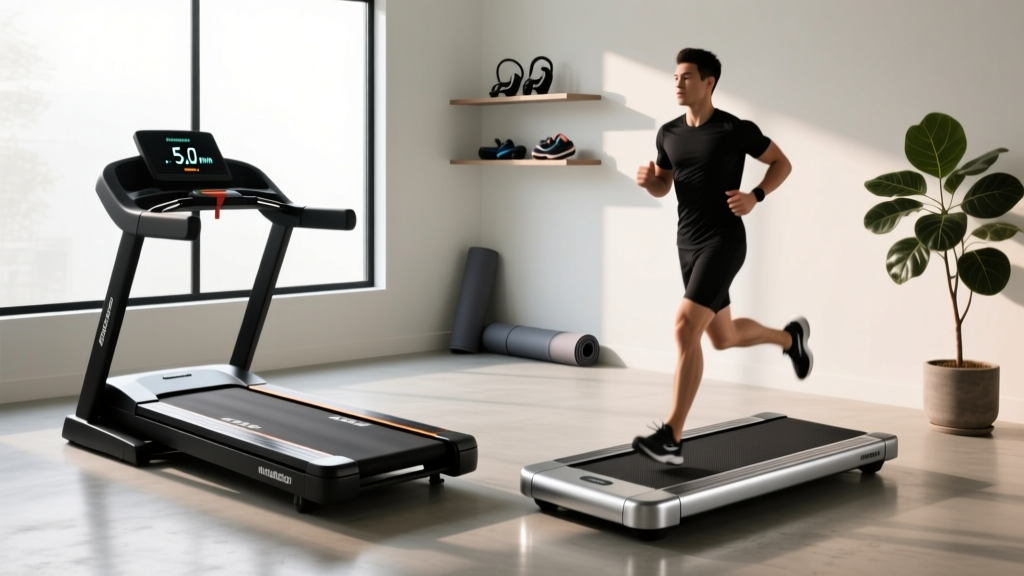
Walking Pad vs Treadmill: Finding a Good Speed for Treadmill Run
Compare walking pads and traditional treadmills. Learn what a good speed for treadmill run is, plus troubleshooting tips for belt slip and motor heat.

The Core Dilemma: Compact Walking Pads vs. Traditional Treadmills
The home fitness landscape in 2026 is heavily saturated with ultra-compact walking pads. Marketed aggressively for under-desk use and small apartments, these machines promise convenience. However, a growing number of consumers are attempting to use them for vigorous cardio, leading to a wave of biomechanical frustrations and mechanical failures. When you are trying to determine a good speed for treadmill run routines, the hardware limitations of a folding walking pad become glaringly obvious. This guide breaks down the critical differences between walking pads and standard treadmills, reviews top 2026 models, and provides a deep-dive troubleshooting matrix for the most common high-speed failures.
The Biomechanical Reality: What is a Good Speed for Treadmill Run?
Before comparing hardware, we must establish the physiological baseline. According to the Centers for Disease Control and Prevention (CDC), vigorous-intensity aerobic activity requires a significant elevation in heart rate. For most recreational runners, a good speed for treadmill run falls between 5.0 mph (a 12-minute mile) and 7.5 mph (an 8-minute mile).
⚠️ Biomechanical Warning: At 6.0 mph, the average adult's running stride length expands to roughly 4.5 to 5.5 feet. Most walking pads feature a belt length of only 40 to 43 inches. Attempting to run on a pad forces an unnatural, choppy cadence, drastically increasing the risk of shin splints, Achilles tendinopathy, and hip flexor strain.Therefore, if your target pace is above a 4.0 mph power walk, a traditional treadmill with a minimum 55-inch belt length is non-negotiable. The Mayo Clinic emphasizes that proper joint alignment and natural gait cycles are critical for preventing repetitive stress injuries during aerobic exercise.
2026 Hardware Comparison Matrix: Pads vs. Standard Models
To understand where your money is going, we reviewed four of the most popular cardio machines on the market this year. Notice how motor size and belt dimensions dictate the machine's true utility.
| Model | Category | Max Speed | Belt Size (L x W) | Motor (Peak HP) | 2026 Price |
|---|---|---|---|---|---|
| KingSmith WalkingPad X21 | Folding Pad | 7.4 mph | 42' x 17' | 2.5 HP | $599 |
| UREVO Strol 2E | Pad w/ Handrail | 7.6 mph | 40' x 15' | 2.25 HP | $459 |
| Sole F63 | Standard Treadmill | 12.0 mph | 60' x 20' | 3.0 CHP | $1,199 |
| Horizon Fitness 7.4 | Standard Treadmill | 12.0 mph | 60' x 22' | 3.0 CHP | $999 |
Expert Insight: Notice the motor specifications. Walking pads list 'Peak HP', which is the maximum output the motor can hit for a fraction of a second before overheating. Standard treadmills use 'CHP' (Continuous Horsepower), which is the power the motor can sustain indefinitely during a heavy run.
Common Mistakes When Transitioning to a Walking Pad
When users attempt to find a good speed for treadmill run routines on compact pads, they inevitably fall into several predictable traps:
- The 'Max Speed' Marketing Trap: Just because the KingSmith X21 can technically hit 7.4 mph does not mean it is safe or sustainable. Running at maximum capacity on a 15-inch wide belt leaves zero margin for lateral drift, increasing the likelihood of stepping off the belt and falling.
- Ignoring the Zero-Incline Limitation: Most walking pads lack an incline mechanism. Running on a completely flat surface alters the activation of your glutes and hamstrings compared to outdoor running. To compensate, physical therapists recommend adding a 1% incline to standard treadmills to simulate outdoor wind resistance; walking pads cannot offer this crucial joint-saving adjustment.
- Handrail Dependency: The UREVO Strol 2E includes a foldable handrail, but it is designed for balance during a 3.0 mph walk, not to anchor your body weight during a 6.0 mph run. Leaning into the handrail at high speeds ruins your posture and reduces core engagement.
Mechanical Troubleshooting Guide: Fixing High-Speed Failures
Pushing a compact walking pad beyond 4.5 mph puts immense stress on its lightweight components. If you are experiencing mechanical issues while trying to maintain your pace, follow this diagnostic flowchart.
Issue 1: Belt Slippage and Stuttering at High Speeds
The Symptom: When your foot strikes the belt at 6.0+ mph, the belt hesitates for a microsecond before catching up. This is incredibly dangerous and causes ankle sprains.
The Fix: This is a tension issue, not a motor issue. Locate the two hex-key bolts at the rear endcaps of the treadmill.
- Turn both the left and right bolts exactly one-quarter (1/4) turn clockwise.
- Run the machine at 3.0 mph and test the belt with your foot.
- If it still slips, repeat the 1/4 turn. Never exceed a full turn total, or you will stretch the belt and destroy the front roller bearings.
Issue 2: Motor Overheating and Thermal Shutoff
The Symptom: The machine abruptly stops after 15-20 minutes of running, and the console displays an 'E02' or 'Overheat' error code.
The Fix: Walking pads use small PWM (Pulse Width Modulation) controllers that generate massive heat when asked to sustain speeds over 5.0 mph.
- Lubrication: A dry belt increases friction, forcing the motor to draw excess amps. Lift the belt and apply exactly 15ml of 100% pure silicone treadmill lubricant in a zigzag pattern. Do not use WD-40 or petroleum-based oils, which will melt the belt backing.
- Cool Down Protocol: If thermal shutoff occurs, you must wait 45 minutes for the internal thermistor to reset. To prevent this, alternate running days with walking days to extend the lifespan of the brushless DC motor.
Issue 3: Speed Sensor Dropouts (Console Shows 0.0 MPH)
The Symptom: You are running, but the console drops to 0.0 mph and then the machine stops for safety.
The Fix: Walking pads rely on an optical sensor or magnetic reed switch near the front roller to count rotations. Dust and pet hair easily clog the optical eye. Unplug the machine, remove the front plastic motor shroud (usually 4 Phillips-head screws), and wipe the sensor lens with a microfiber cloth and isopropyl alcohol.
'The American Heart Association recommends at least 75 minutes of vigorous aerobic activity per week. If your primary goal is vigorous running, investing in a machine with a continuous-duty motor and a 60-inch deck is a non-negotiable requirement for both safety and cardiovascular efficacy.'
— Adapted from AHA Physical Activity Guidelines
Expert Verdict: Which Machine Actually Fits Your Routine?
The choice between a walking pad and a traditional treadmill ultimately boils down to your definition of a good speed for treadmill run. If your cardio routine consists of 2.0 to 3.5 mph walks while catching up on podcasts or working at a standing desk, a folding pad like the KingSmith X21 is an unparalleled space-saver.
However, if you are training for a 5K, executing HIIT intervals, or simply prefer a natural running gait at 6.0 mph or higher, walking pads will frustrate you and eventually break down under the mechanical load. For serious runners, the Sole F63 or Horizon 7.4 remain the gold standards in 2026, offering the belt real estate, continuous horsepower, and shock absorption required to keep your joints healthy and your stride uninterrupted.
More gear to consider
All reviews
Rowing Buying Guide & Technique: ProForm Carbon TLS Treadmill Setup

Assault Bike vs Air Bike & Concave Treadmill: 2026 Review

Ava Addams Treadmill Trend: Folding Treadmill Maintenance & Reviews

Rowing Buying Guide & Technique: Lubrication for Treadmill Belt Care

ProForm Treadmill Performance 400 Setup & Feature Comparison
