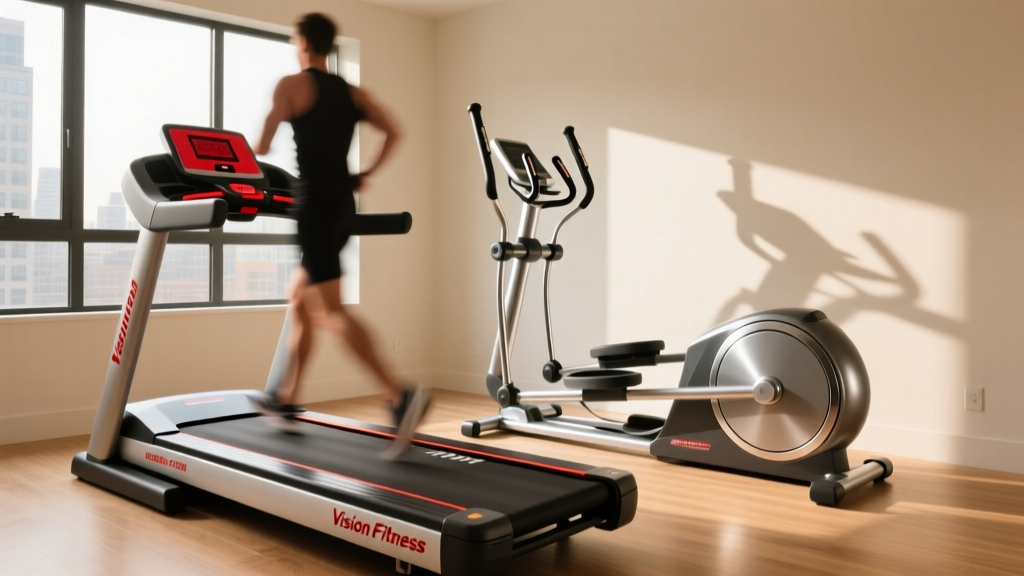
Vision Fitness T600 Treadmill vs Elliptical: Home Cardio Value
We break down the true cost of home cardio, comparing the Vision Fitness T600 treadmill against premium ellipticals to find the best long-term value.

The Upfront Capital: Benchmarking the Vision Fitness T600 Treadmill
When navigating the 'elliptical vs treadmill for home cardio' debate, most buyers fixate solely on the sticker price. However, true value analysis requires a granular look at long-term ownership costs, biomechanical return on investment (ROI), and spatial economics. To anchor this budget breakdown, we are using the Vision Fitness T600 treadmill as our premium treadmill benchmark. Renowned for its 4.0 HP continuous-duty motor, 20-inch by 60-inch running surface, and Variable Response Cushioning, the T600 represents the upper echelon of heavy-duty folding home treadmills.
On the other side of the aisle, we compare it against similarly tiered ellipticals, specifically the Sole E95 and the Schwinn 470. While the elliptical vs treadmill conversation often devolves into subjective preference, a strict financial and physiological audit reveals clear winners depending on your specific household constraints and fitness goals.
Initial Purchase Price Comparison
The premium home fitness market has seen price stabilization in 2026 following the supply chain anomalies of the early 2020s. Below is a snapshot of the upfront capital required for top-tier machines in both categories.
| Machine Type | Model Benchmark | Approx. 2026 Retail Price | Key Hardware Specs |
|---|---|---|---|
| Premium Treadmill | Vision Fitness T600 Treadmill | $2,899 - $3,199 | 4.0 HP Motor, 350 lb capacity, Folding Frame |
| Premium Elliptical | Sole E95 Elliptical | $1,999 - $2,299 | 20-inch Stride, 400 lb capacity, Heavy Flywheel |
| Mid-Tier Elliptical | Schwinn 470 Elliptical | $899 - $1,099 | 20-inch Stride, 300 lb capacity, Bluetooth |
Immediately, the Vision Fitness T600 treadmill commands a 30% to 40% premium over a high-end elliptical like the Sole E95. This price gap is primarily driven by the cost of the high-torque DC motor, the reinforced steel deck required to absorb repetitive impact, and the complex folding hinge mechanism.
The Hidden Ledger: Maintenance, Power, and Spatial Economics
The purchase price is merely the entry fee. The true budget breakdown must account for the hidden costs of operating and housing these machines over a 7-to-10-year lifespan.
Spatial Economics: Cost Per Square Foot
Treadmills require significantly more operational clearance. The Vision Fitness T600 measures roughly 83 inches long by 35 inches wide. However, safety guidelines mandate a minimum of 24 inches of clearance behind the machine to prevent severe injury in the event of a fall. This pushes the total required footprint to nearly 10 feet by 3 feet (30 square feet). Ellipticals, lacking a rear ejection hazard, typically require only their physical footprint (roughly 75 x 25 inches, or 13 square feet). In urban environments where real estate costs average $350 per square foot, dedicating an extra 17 square feet to a treadmill carries an implicit spatial cost of over $5,900.
Electrical and Mechanical Upkeep
Treadmills are power-hungry machines. The 4.0 HP motor on the Vision T600 can draw up to 12 to 15 amps under heavy load, necessitating a dedicated 120V/15A circuit to prevent tripping breakers. Ellipticals, which rely on magnetic resistance and user-generated momentum, draw less than 2 amps, allowing them to share a standard household circuit safely.
Mechanically, the friction inherent in treadmills creates a recurring maintenance ledger:
- Treadmill Belt Lubrication: Requires 100% silicone lubricant every 150 miles or 3 months (approx. $15 per year).
- Belt and Deck Replacement: Even with meticulous care, the phenolic deck and multi-ply belt on a premium treadmill will require replacement every 5 to 7 years. Parts and labor typically run between $250 and $400.
- Elliptical Pivot Bearings: Ellipticals operate on sealed bearings. While they require occasional rail cleaning, pivot bearings generally only need replacement after 10,000+ hours of use, costing roughly $45 to $80 for a full hardware kit.
Biomechanical ROI: Caloric Burn vs. Joint Preservation
Financial value is irrelevant if the machine causes injury or fails to deliver cardiovascular results. According to the American Heart Association, adults require at least 150 minutes of moderate-intensity or 75 minutes of vigorous aerobic activity per week to maintain optimal cardiovascular health. Both machines can fulfill this mandate, but their biomechanical pathways differ drastically.
A comprehensive review by the Mayo Clinic highlights that while treadmills offer superior weight-bearing benefits for bone density, ellipticals provide a distinct advantage in joint preservation. The Vision Fitness T600 treadmill features an advanced cushioning system that reduces impact by up to 30% compared to outdoor asphalt, but it cannot eliminate the ground reaction forces inherent to running. Ellipticals keep the foot planted, reducing ground reaction forces to near zero.
| Metric | Vision Fitness T600 Treadmill | Premium Cross-Trainer (Elliptical) |
|---|---|---|
| Caloric Expenditure (Vigorous) | 600 - 800 kcal / hour | 550 - 750 kcal / hour |
| Joint Impact (Ground Reaction) | Moderate to High (Running) | Negligible (Zero Impact) |
| Muscle Engagement | Lower Body (Calves, Quads, Glutes) | Full Body (Adds Lats, Biceps, Triceps) |
| Bone Density Benefit | High (Weight-Bearing) | Low (Non-Weight-Bearing) |
Depreciation Curves: Resale Value in 2026
Fitness equipment suffers from steep initial depreciation, akin to driving a new car off the lot. However, the secondary market treats treadmills and ellipticals differently. High-end treadmills like the Vision Fitness T600 hold their residual value remarkably well. Because the commercial-grade motor and robust frame have a verifiable lifespan of 10,000+ miles, a well-maintained T600 can recoup 40% to 50% of its purchase price on the secondary market after three years.
Ellipticals, conversely, suffer from a 'perceived fragility' stigma in the used market. Buyers are highly wary of worn-out pivot joints and squeaky rails, which are difficult to diagnose without a test drive. Consequently, a three-year-old premium elliptical typically recoups only 20% to 30% of its original value. When factoring in the cost of moving these 200-pound machines, many elliptical owners simply give them away or sell them for scrap value.
The Value Decision Framework
To determine which machine offers the best budget breakdown for your specific situation, apply this decision matrix:
- Choose the Vision Fitness T600 Treadmill if: You are training for outdoor running events, you prioritize bone-density loading, you have a dedicated 30+ square foot space with a dedicated electrical circuit, and you plan to resell the machine within 5 years to recoup capital.
- Choose a Premium Elliptical if: You are managing joint degradation (arthritis, prior meniscus tears), you live in a high-cost-per-square-foot apartment, you lack dedicated electrical circuits, and you view the machine as a 10-year 'buy it for life' sunk cost with no intention of reselling.
Expert Insight: The cheapest cardio machine is the one you actually use. If the impact of a treadmill causes shin splints that force you to abandon your routine for three weeks, the 'value' of that $3,000 investment drops to zero. Match the biomechanics to your physiology before matching the price tag to your wallet.
Ultimately, the Vision Fitness T600 treadmill represents a premium, high-performance asset that demands higher upfront and operational capital but rewards the user with superior athletic conditioning and stronger resale liquidity. Ellipticals remain the undisputed champions of low-impact, low-maintenance, and space-efficient daily movement.
More gear to consider
All reviews
Quiet Incline Treadmill for Beginners: Noise Guide 2026
Coin Operated Treadmill Comparison: Top Models & Features (2026)

Stair Climber vs Treadmill: How Do You Tighten a Treadmill Belt?

Beyond the ProForm Treadmill Weight Limit: Air Bike vs Assault Bike
ProForm XP 590s Treadmill vs Curved Manual: Cardio Showdown
