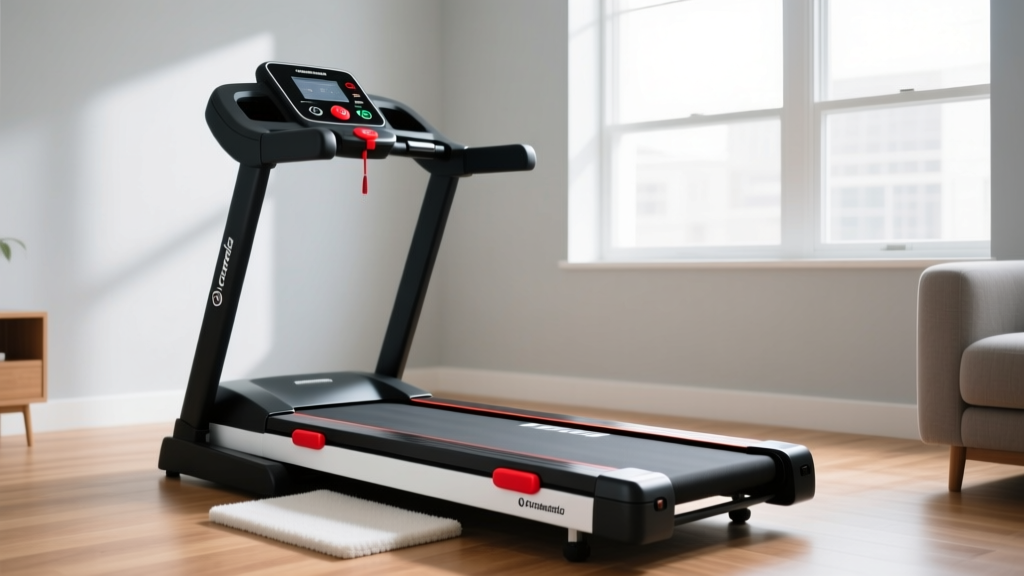
Under Desk Treadmill Review: Office Layout & Speed Chart
Optimize your home office with our under desk treadmill review. Explore space-saving layouts, clearance metrics, and a workflow-driven speed chart.

The Spatial Reality of the Active Workspace in 2026
As hybrid work models solidify in 2026, the home office has evolved from a temporary corner desk into a permanent, highly engineered environment. Integrating an under-desk treadmill is no longer just a fitness decision; it is a complex spatial planning challenge. Unlike traditional cardio machines that occupy a dedicated 'gym zone,' under-desk treadmills must seamlessly coexist with ergonomic furniture, cable routing systems, and daily workflow patterns.
According to the Centers for Disease Control and Prevention (CDC), integrating light physical activity into sedentary workdays is crucial for long-term cardiovascular health. However, simply sliding a treadmill beneath a desk without considering spatial dynamics leads to tripped breakers, snagged cables, and severe ergonomic strain. This review analyzes the top under-desk treadmills through the lens of space optimization, providing exact layout metrics and a workflow-driven treadmill speed chart to help you design a functional, safe, and active office footprint.
Mapping Your Workflow: The Under-Desk Treadmill Speed Chart
The most common failure mode for new treadmill desk users is attempting to type at 3.0 mph. Walking speed dictates not only your cognitive load capacity but also your required desk height, monitor stabilization, and spatial clearance. Below is a comprehensive treadmill speed chart mapped to specific office tasks and ergonomic requirements.
| Speed Zone (mph) | Primary Workflow Task | Desk Height Requirement | Spatial & Ergonomic Impact |
|---|---|---|---|
| 0.5 - 1.0 | Deep work, coding, precision mouse tasks | Standard standing height (approx. 41-43 inches) | Minimal vertical oscillation; standard monitor arms suffice. |
| 1.2 - 2.0 | Reading, casual emails, video calls (with stabilization) | Standard standing height + 1 inch | Moderate bounce; requires high-tension gas-spring monitor arms. |
| 2.2 - 3.0 | Audio-only meetings, brainstorming, dedicated walking | Extended height (approx. 45-48 inches) | High stride length; requires deeper desk (30'+) to prevent screen crowding. |
| 3.2 - 4.0 | Dedicated cardio breaks (no desk work) | N/A (Desk raised to maximum clearance) | Requires 24+ inches of rear clearance for safe mounting/dismounting. |
Top Under-Desk Treadmills for Compact Office Layouts
Not all treadmills are created equal when floor space is at a premium. We evaluated the top models based on their physical footprint, storage dimensions, and how they integrate into tight office layouts.
1. WalkingPad C2: The Ultra-Compact Folder
Price: ~$399 | Belt Size: 17.3' x 43.3' | Weight: 55 lbs
The WalkingPad C2 remains the gold standard for micro-apartments and multi-use rooms. Its 180-degree folding hinge allows it to slide under a sofa or stand vertically in a closet, measuring just 20.3 x 56.3 x 5 inches when folded.
- Space Advantage: Zero permanent footprint required. Ideal for bedrooms that double as offices.
- Layout Limitation: The narrow 17.3-inch belt width demands strict lateral discipline. At speeds above 2.0 mph, the lack of side rails increases the risk of stepping off the belt into desk legs.
2. LifeSpan TR1200-DT5: The Dedicated Zone Heavyweight
Price: ~$899 | Belt Size: 20' x 50' | Weight: 115 lbs
If your office layout features a permanent, dedicated standing desk zone, the LifeSpan TR1200-DT5 is the superior choice. It does not fold, and its 115-pound frame makes it difficult to move for daily vacuuming. However, the 20-inch wide belt and 50-inch length accommodate the longer strides required for the 2.5+ mph zones on our treadmill speed chart.
- Space Advantage: Integrated console and heavy-duty motor housing act as a physical barrier, preventing office chairs from rolling onto the belt.
- Layout Limitation: Requires a permanent 20' x 63' floor allocation, plus 18 inches of rear clearance, totaling roughly 6.5 square feet of dead space when not in use.
3. UREVO Strol 2E: The Hybrid 2-in-1 Compromise
Price: ~$259 | Belt Size: 16.5' x 40' | Weight: 63 lbs
The UREVO Strol 2E features a foldable handlebar, allowing it to function as both an under-desk walker and a standalone light jogging treadmill.
- Space Advantage: The folding handle reduces its visual profile when stored upright against a wall.
- Layout Limitation: When the handle is folded down for under-desk use, the control panel is obscured, forcing reliance on a remote control or smartphone app, which requires desk drawer space for storage.
Designing the Active Workspace: Clearance & Layout Metrics
Integrating a treadmill requires recalculating your office's spatial geometry. The Occupational Safety and Health Administration (OSHA) provides extensive guidelines on computer workstation ergonomics, emphasizing the need for unrestricted movement and safe egress. When adding a moving belt to this equation, specific clearance metrics must be met.
The 'Zone of Safety' Calculations
To prevent tripping and ensure proper airflow for the treadmill motor, your layout must adhere to the following minimum clearances:
- Rear Egress (Minimum 18 inches): You must have at least 18 inches of clear floor space behind the treadmill. This allows you to step backward off the belt safely without hitting a wall, filing cabinet, or bookshelf.
- Lateral Clearance (Minimum 12 inches per side): Treadmill belts can drift over time. If the belt is flush against a desk leg, friction will cause the motor to overheat and the belt to fray. Maintain a 12-inch buffer on the left and right sides.
- Vertical Clearance (Minimum 52 inches): When walking at 3.0 mph, your vertical head clearance increases. Ensure ceiling fans, low-hanging pendant lights, or sloped ceilings are at least 52 inches above the treadmill deck.
Cable Management and Power Routing
The most overlooked aspect of treadmill desk layout is cable management. A standard motorized treadmill requires a dedicated 120V outlet. In a compact office, power strips are often mounted to the underside of the desk. Critical Failure Mode: Routing the treadmill power cable up into an under-desk cable tray creates a severe snag hazard. If the treadmill shifts backward by even two inches, it will pull the power strip, potentially unplugging your PC or monitors.
The Solution: Route the treadmill power cable directly to a wall outlet or a floor-mounted surge protector. Use flat, low-profile cable raceways adhered to the baseboard rather than the desk legs. This decouples the treadmill's physical movement from your IT infrastructure.
Acoustic Spatial Planning and Flooring
Space optimization is not just visual; it is also acoustic. The Mayo Clinic notes that while reducing sedentary time is vital for metabolic health, the environmental stress of a noisy workspace can counteract the mental health benefits of an active office.
Under-desk treadmills generate low-frequency vibrations that transmit easily through hard floors. If your office is on a second floor or above a shared living space, spatial planning must include acoustic dampening.
- Hardwood/Laminate Floors: Require a high-density EVA foam or rubber treadmill mat (minimum 3/8-inch thick). This adds roughly 0.5 inches to the deck height, which must be accounted for in your ergonomic desk height calculations.
- Carpeted Floors: While carpet absorbs sound, the treadmill's rear transport wheels will sink into the pile, causing the deck to tilt forward. Use a rigid PVC slider board beneath the treadmill to distribute the weight evenly across the carpet fibers.
Monitor Stabilization in Active Layouts
When referencing the 1.2 to 2.0 mph zones on our treadmill speed chart, vertical oscillation becomes a significant factor. At 1.5 mph, the human body experiences approximately 1.2 inches of vertical bounce per step. If your monitor is resting on a standard desk stand, the screen will shake violently, causing eye strain and motion sickness.
Layout Integration: You must replace static monitor stands with heavy-duty, gas-spring monitor arms (such as the Ergotron LX or HX series). These arms feature adjustable tension screws that can be tightened to absorb the specific harmonic frequency generated by the treadmill motor and your walking stride. Mounting the arm directly to the desk edge via a C-clamp, rather than a grommet mount, provides better leverage and reduces lateral screen wobble.
Final Layout Verdict
Successfully integrating an under-desk treadmill requires treating it as a core piece of office architecture rather than an afterthought accessory. By utilizing the treadmill speed chart to align your physical tasks with appropriate walking zones, enforcing strict rear and lateral clearance metrics, and decoupling your cable management from the desk frame, you can create a highly optimized, space-efficient active workspace. Whether you choose the ultra-compact WalkingPad C2 for a multi-use room or the robust LifeSpan TR1200-DT5 for a dedicated executive office, precise spatial planning is the key to long-term adherence and ergonomic safety.
More gear to consider
All reviews
Is It Bad to Hold Onto the Treadmill While Walking in Small Spaces?

What's a Good Incline on a Treadmill? Folding Models & Care

Stair Climber vs Sole Treadmill F80 for Sale: 2026 Home Guide
Elliptical vs Life Fitness F1 Smart Folding Treadmill for Small Spaces
Rowing Machine Guide: Better Than a Stationary Bike or Treadmill?