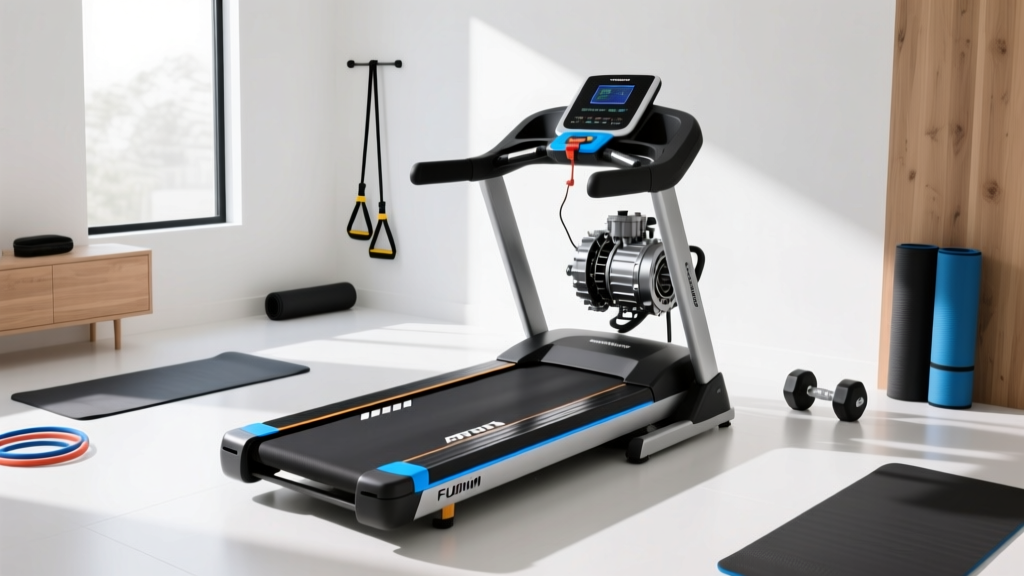
Treadmill Motor Guide: Are Umay Treadmills Powerful Enough?
Decode treadmill motor sizes and horsepower. We analyze Umay treadmills, CHP vs Peak HP, and exact motor requirements for your weight and workout.

The Horsepower Illusion: Why Treadmill Motor Specs Lie
When shopping for home cardio equipment, the motor is the beating heart of the machine. Yet, the fitness industry is notorious for obfuscating motor capabilities through misleading marketing jargon. If you have been researching budget-friendly walking pads and compact folders, you have likely encountered Umay treadmills. Known for their aggressive pricing and ultra-compact footprints, Umay models dominate the entry-level market. But how do their motors actually hold up under the laws of physics and electrical engineering?
To make an informed purchasing decision, you must look past the bolded numbers on the Amazon product page. This in-depth buying guide deconstructs treadmill motor sizes, explains the critical difference between Peak HP and Continuous Horsepower (CHP), and provides a rigorous analysis of where Umay treadmills fit into the broader equipment ecosystem.
Peak HP vs. CHP: The Marketing Trap Explained
The most common point of failure for first-time treadmill buyers is confusing Peak Horsepower (HP) with Continuous Horsepower (CHP). Understanding this distinction is non-negotiable if you want your machine to survive past its warranty period.
- Peak HP: This is the absolute maximum power the motor can draw for a fraction of a second before overheating or tripping a breaker. It is a marketing metric, not a performance metric.
- Continuous Horsepower (CHP): This measures the power the motor can sustain indefinitely during a normal workout without overheating. This is the only number that matters for real-world usage.
Treadmill Motor Tiers: Where Do Umay Treadmills Fit?
To contextualize the specs of Umay treadmills, we must compare them against the broader market. The table below breaks down the three primary motor tiers you will encounter in 2026, highlighting the stark differences in electrical components, cooling, and pricing.
| Brand Tier | Example Model | Advertised vs. Real Motor | Motor Type | Price Range |
|---|---|---|---|---|
| Budget / Compact | Umay Under Desk / Folding | 2.5 Peak HP (~1.0 CHP) | Brushed DC | $150 - $299 |
| Mid-Range Home | Sole F63 | 3.0 CHP (True Continuous) | Brushless DC (BLDC) | $999 - $1,299 |
| Commercial / Light Club | Life Fitness T5 | 4.0 HP AC Motor | Alternating Current (AC) | $7,000 - $9,000 |
Decoding Umay Treadmills: Motor Specs and Real-World Limits
Umay treadmills are engineered for a very specific use case: low-impact walking in space-constrained environments. Most Umay models, including their popular under-desk walking pads, utilize brushed Direct Current (DC) motors rated between 1.5 and 2.5 Peak HP. In real-world continuous draw, these translate to roughly 0.75 CHP to 1.25 CHP.
The Physics of the Umay Motor
Because these are brushed DC motors, they rely on physical carbon brushes that press against a commutator to deliver electrical current. This creates friction, heat, and eventual wear. When a 180-pound user attempts to jog at 6.0 mph on a 1.0 CHP Umay motor, the amperage draw spikes dramatically. The machine's Pulse Width Modulation (PWM) lower control board must work in overdrive to supply the necessary voltage.
⚠️ Thermal Cutoff Warning: If your Umay treadmill suddenly stops mid-stride and will not restart for 10 to 15 minutes, the PWM controller's thermal fuse has tripped, or the MOSFETs on the lower board have overheated. This is a hardware protection mechanism to prevent a literal electrical fire. It is a clear indicator that the motor is being asked to perform beyond its continuous duty cycle.According to equipment testing standards highlighted by Consumer Reports, budget treadmill motors are the number one point of failure for users who exceed the recommended weight limits or attempt high-speed running on compact decks.
How to Match Motor Size to Your Body Weight and Usage
Do not rely solely on the manufacturer's stated 'Max User Weight.' A machine might structurally support 240 pounds, but its motor may choke trying to move that mass. Use the following framework to determine the minimum CHP you actually need.
- The Walker (Under 4.0 mph): You need a minimum of 1.5 to 2.0 CHP. Umay treadmills are generally adequate for this tier, provided the user is under 180 pounds.
- The Jogger (4.0 to 6.0 mph): You need a minimum of 2.5 to 3.0 CHP. Umay models will struggle here, leading to belt hesitation and motor degradation.
- The Runner (6.0+ mph): You need a minimum of 3.0 to 4.0 CHP. You must look at mid-tier or commercial brands with heavy flywheels and brushless motors.
"Walking is one of the most accessible and effective forms of cardiovascular exercise, but the biomechanical force placed on a treadmill belt during the heel-strike phase requires a motor with enough low-end torque to prevent stuttering." — Adapted from Mayo Clinic fitness guidelines.
Warning Signs of an Undersized Treadmill Motor
If you already own a Umay treadmill or a similar budget model, monitor the machine for these specific failure modes that indicate the motor is undersized for your workload:
- Belt Hesitation (The 'Stutter'): When your foot strikes the deck, the belt momentarily slows down before the motor catches up. This means the motor lacks the low-end torque to overcome your body weight.
- Ozone or Burning Plastic Smells: This indicates the carbon brushes in the DC motor are arcing excessively, or the PWM board is overheating.
- High-Pitched Whining: A strained motor operating near its maximum amperage threshold will emit a distinct, high-frequency whine that differs from normal belt friction.
- Tripped Household Breakers: If your treadmill routinely trips the 15-amp or 20-amp circuit breaker in your home, the motor is drawing dangerous levels of surge current.
Expert Verdict: Should You Buy a Umay Treadmill?
Umay treadmills are not inherently 'bad' machines; rather, they are highly specialized tools that are frequently misused by consumers who misunderstand motor physics. If your goal is to accumulate 10,000 steps a day while working at a standing desk, or to do light, low-impact walking in a small apartment, a Umay treadmill offers exceptional value for its $200 price point. The 1.0 CHP equivalent is perfectly adequate for walking under 3.5 mph for users under 170 pounds.
However, if you intend to do interval training, jog, or if you weigh over 200 pounds, investing in a Umay treadmill is a false economy. The motor will inevitably overheat, the lower control board will fry, and you will be forced to upgrade within six months. For running and heavy jogging, bypass the budget tier entirely and invest in a 3.0 CHP brushless DC motor from a reputable mid-tier brand to ensure your equipment survives the biomechanical forces you subject it to.
More gear to consider
All reviews
Treadmill Making Noise? Budget Guide to Quiet Stationary Bikes

Setup Guide: LifeSpan Treadmill TR4000i vs Curved Manual Installation

The Backward Treadmill: Top Walking Pads Reviewed (2026)

Rowing Machine Setup vs Treadmill Belly Fat Workout

NordicTrack X24 Incline Treadmill vs Bowflex 22: 2026 Showdown
