Umay Treadmill Review: Elliptical vs Treadmill Space Layout
Compare ellipticals and treadmills for home cardio. This Umay treadmill review reveals space optimization, layout design, and clearance metrics.

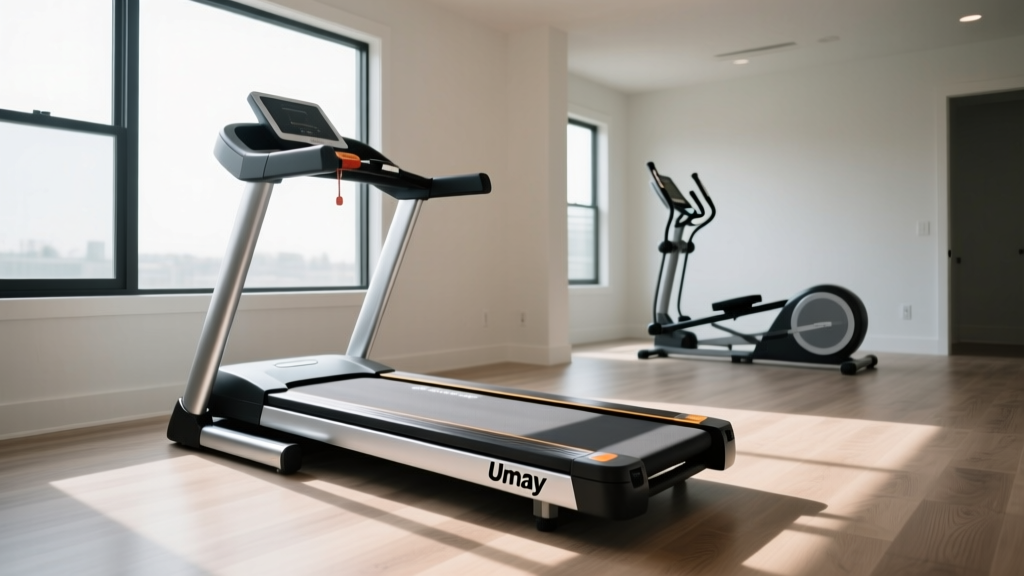
Designing a functional home gym in 2026 requires more than just picking the machine that burns the most calories; it demands a rigorous approach to spatial geometry and layout optimization. When deciding between an elliptical and a treadmill for home cardio, the physical footprint, ceiling clearance, and electrical requirements drastically alter your room's layout. To anchor this spatial comparison, we are utilizing a specific Umay treadmill review—focusing on their popular 2.5 HP ultra-compact folding model—as our benchmark for space-saving treadmill design against a standard mid-range elliptical.
According to the Centers for Disease Control and Prevention (CDC), adults need at least 150 minutes of moderate-intensity aerobic activity weekly. Achieving this at home means your equipment must integrate seamlessly into your living space without creating claustrophobic traffic bottlenecks or safety hazards. Let us break down the exact measurements, failure modes, and layout frameworks you need to make the right choice for your floor plan.
The Spatial Showdown: Active vs. Stored Footprints
The most common mistake home gym builders make is measuring only the machine's static footprint. True space optimization requires calculating the active clearance zone—the total volume of space required while the machine is in motion, including user stride, arm swing, and emergency dismount areas.
| Metric | Umay 2.5HP Folding Treadmill | Mid-Range Elliptical (e.g., Sole E25) |
|---|---|---|
| Active Length | 53 inches | 70 inches |
| Active Width | 24 inches | 24 inches |
| Peak Machine Height | 45 inches (console) | 71 inches (rear drive) |
| Stored Thickness | 9 inches (folded flat) | N/A (Static footprint) |
| Average Price (2026) | $189 - $229 | $899 - $1,199 |
| Power Draw Under Load | 12 - 15 Amps | 1 - 2 Amps |
Umay Treadmill Review: A Space-Saver’s Benchmark
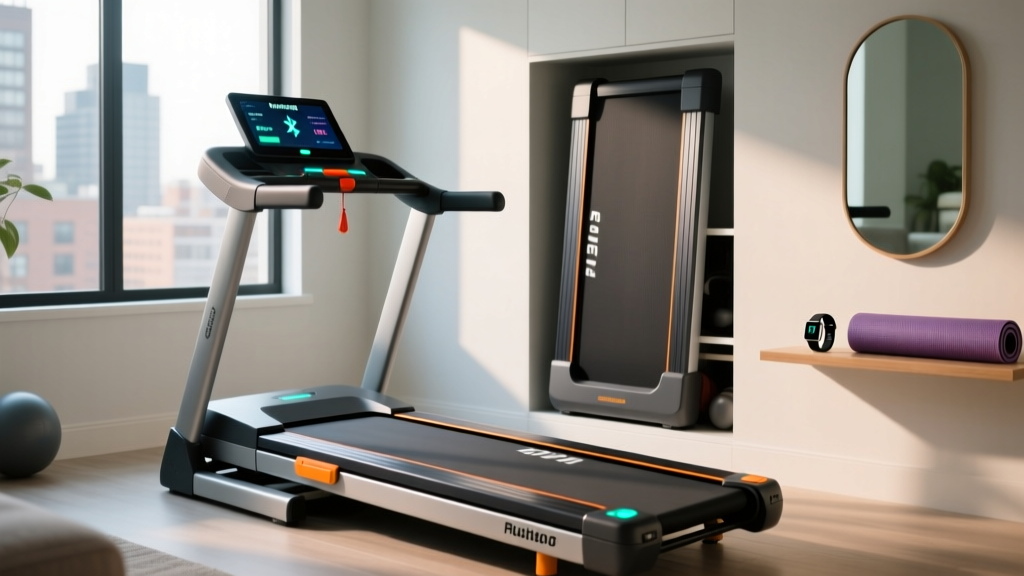
To understand how modern treadmills can adapt to tight layouts, we look at the Umay 2.5 HP Folding Treadmill. Priced aggressively between $189 and $229, this model is engineered specifically for small apartments and multi-use guest rooms. When folded, the deck locks into a vertical position, reducing the depth to just 9 inches. This allows it to slide into a closet or rest flush against a wall, effectively reducing its daily spatial footprint to near zero.
Real-World Layout & Biomechanical Limitations
While the Umay excels in spatial efficiency, its compact design introduces specific biomechanical constraints. The running deck measures 43 inches long by 16 inches wide. For context, a standard commercial treadmill deck is 20 inches wide. This 4-inch reduction means users must maintain strict forward-and-back linear movement; lateral drifting will result in foot strikes on the side rails.
Expert Warning: The hydraulic folding hinge on budget compact treadmills like the Umay is a known wear point. If folded and unfolded daily, the hinge will begin to squeak and resist lowering after 6 to 8 months. Apply a few drops of white lithium grease to the pivot joints bi-annually to prevent metal-on-metal degradation and maintain smooth spatial transitions.Ceiling Height & The Headroom Rule
When placing cardio equipment in basements, attics, or rooms with vaulted ceilings, vertical clearance is just as critical as floor space. The American Council on Exercise (ACE) frequently highlights safety hazards related to improper overhead clearance in home setups.
- The Elliptical Factor: Elliptical pedals sit between 10 and 14 inches off the ground. At the peak of the stride, your head is elevated significantly higher than your standing height. Rule of Thumb: Ceiling height must be at least User Height + 15 inches.
- The Treadmill Factor: Treadmill decks typically sit 5 to 7 inches off the ground. Because you are running or walking in a natural posture, your vertical profile remains relatively static. Rule of Thumb: Ceiling height must be at least User Height + 8 inches.
If you are 6 feet tall (72 inches) and have an 8-foot ceiling (96 inches), an elliptical leaves you with only 9 inches of overhead clearance at peak stride—a recipe for a skinned knuckle or a ceiling fan collision. The Umay treadmill, conversely, offers a much safer margin in low-clearance environments.
Designing the 2026 Compact Home Gym Layout
Choosing the machine is only half the battle; integrating it into your home's electrical and structural layout requires precise planning. Follow this step-by-step framework to finalize your room design.
Step 1: Audit the Breaker Panel
Treadmills with 2.0 HP or higher motors draw significant current, especially during incline adjustments or heavy user acceleration. The Umay 2.5 HP model can spike to 15 amps under peak load. If your treadmill shares a 15-amp circuit with a space heater, window AC unit, or even a high-draw television, you will trip the breaker mid-stride. Ellipticals, utilizing magnetic resistance, draw less than 2 amps and can safely share standard household circuits.
Step 2: Map the Safety Eject Zone
Never push a treadmill flush against a wall. The American Heart Association (AHA) emphasizes the importance of safe exercise environments to prevent fall-related injuries. You must leave a minimum of 24 inches of clear space behind the rear roller of any treadmill. If a user falls and the magnetic safety key disengages, the belt will coast to a stop; without a rear buffer zone, the user's momentum will eject them directly into the drywall or baseboard.
Step 3: Select the Proper Dampening Mat
Impact noise travels through floor joists as low-frequency vibration. Treadmill heel-strikes generate immense acoustic transfer, while ellipticals generate virtually zero impact noise. If placing a treadmill on a second-floor room or over a finished basement, you must use a high-density mat.
Mat Selection Guide:
- Ellipticals: A standard 1/8-inch PVC equipment mat is sufficient to protect hardwood from sweat and minor scratches.
- Treadmills (Compact/Umay): Requires a minimum 3/8-inch thick vulcanized rubber mat to absorb heel-strike resonance.
- Treadmills (Heavy Commercial): Requires 1/2-inch or 3/4-inch horse stall mats for true acoustic decoupling.
Final Verdict: Matching Machine to Room Geometry
The decision between an elliptical and a treadmill ultimately comes down to your room's specific dimensional constraints and your structural layout. If you have a dedicated room with high ceilings, ample square footage, and a desire for zero-impact, full-body engagement, a mid-range elliptical is the superior biomechanical choice. However, if you are optimizing a multi-use space, a low-clearance attic, or a bedroom where the equipment must disappear after use, the spatial efficiency highlighted in our Umay treadmill review makes a compact, folding treadmill the undisputed champion of layout design.
Frequently Asked Questions
Can I store the Umay folding treadmill under my bed?
While the Umay folds down to roughly 9 inches thick, its overall length when folded horizontally is still around 50 inches. It will easily slide under standard king or queen beds with at least 10 inches of floor clearance, but it will not fit under most low-profile platform beds or twin-size frames.
Do ellipticals require a dedicated electrical circuit?
No. Because ellipticals use electromagnetic resistance systems rather than high-torque drive motors, their power draw is minimal (usually under 2 amps). You can safely plug an elliptical into a shared bedroom or living room outlet without risking a tripped breaker, making them highly versatile for rooms where electrical upgrades are not feasible.
More gear to consider
All reviews
Treadmill for Beginners: Belt Care & Space-Saving Layout Guide

Rowing Machine Setup & Technique: Upgrading Your Lose Weight on Treadmill Plan

Beyond the ProForm Treadmill 520 ZN: 2026 Compact Cardio Trends

Can You Hit an 8 Minute Mile Pace on Treadmill Walking Pads? (2026)
Folding Treadmills for Small Spaces: Treadmill Trails App Review
