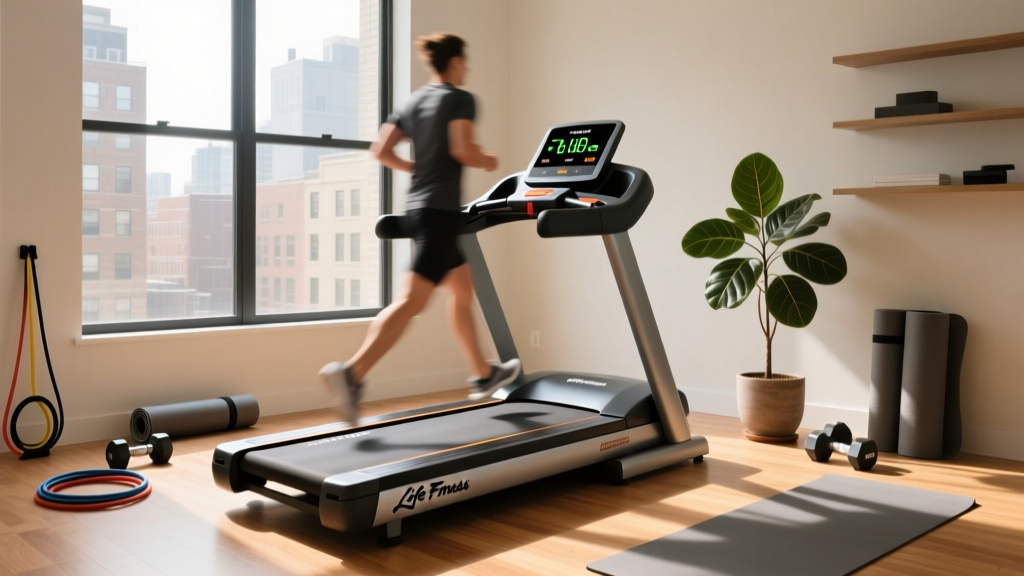
Managing Treadmill Weight in Compact Home Gym Layouts
Discover how managing treadmill weight and choosing compact portable cardio equipment can optimize your small home gym layout for maximum efficiency.

The Physics of Small Spaces: Why Treadmill Weight Dictates Layouts
When designing a home gym in a micro-apartment or a multi-use guest room, spatial footprint is usually the primary concern. However, interior designers and structural engineers know that treadmill weight and dynamic load distribution are equally critical. A standard motorized treadmill, such as the NordicTrack T Series 6.5S, carries a static weight of roughly 130 pounds. While this might seem manageable, the true challenge emerges during use.
Running generates a peak ground reaction force of up to 2.5 times your body weight. A 180-pound runner on a 130-pound treadmill creates a momentary dynamic load exceeding 580 pounds. Because this force is concentrated through four small rubber feet (typically totaling less than 10 square inches of contact area), the point-load pressure can spike to over 58 PSI (pounds per square inch). In upstairs apartments or older homes with residential floor joists rated for 40 PSF (pounds per square foot) distributed loads, this concentrated treadmill weight can cause structural sagging, annoying squeaks, and severe noise transfer to neighbors below.
⚠️ Structural Warning: Never place heavy, motorized treadmills in the center of a room on an upper floor. Always position heavy cardio equipment directly over load-bearing walls or perpendicular to floor joists to distribute the dynamic impact.Compact Portable Cardio Alternatives: Escaping the Heavy Footprint
To optimize layouts in tight spaces, the 2026 fitness market has heavily pivoted toward compact, portable cardio equipment that minimizes both spatial dominance and floor-loading risks. According to Wirecutter's comprehensive treadmill and walking pad reviews, the rise of under-desk treadmills and smart folding equipment has revolutionized small-space fitness. Here are the top portable alternatives that solve the weight and space dilemma.
1. Smart Walking Pads (The Ultra-Lightweight Solution)
Walking pads strip away the heavy motor, console, and handrails of traditional treadmills. The KingSmith WalkingPad R2 is a prime example. Weighing just 55 pounds, it features a 180-degree folding hinge that reduces its storage footprint to roughly 17.3 x 61 x 5 inches. You can slide it under a sofa or stand it vertically in a closet. Because it is designed for walking (up to 7.5 mph), the dynamic impact force is a fraction of running, making it perfectly safe for second-story apartment layouts.
2. Vertical-Folding Smart Rowers
Rowing machines offer a full-body cardio workout but traditionally require 8 to 9 feet of linear clearance. Modern smart rowers, like the Echelon Smart Rower (priced around $549), solve this with a vertical folding mechanism. Weighing 102 pounds, it folds up to a 22 x 22-inch footprint. The weight is distributed over a wider base rail, drastically reducing the PSI exerted on your flooring compared to a treadmill's concentrated feet.
3. Compact Air Bikes and Steppers
For high-intensity interval training (HIIT) without the heavy footprint, compact air bikes like the Assault AirBike Classic (weighing 98 pounds) offer a 48 x 26-inch footprint. While the point-load is still notable, the lack of repetitive downward striking (unlike running) means the dynamic load remains relatively stable, protecting your subfloor.
Equipment Comparison: Weight, Footprint, and Floor Pressure
When planning your layout, use this matrix to compare how different cardio machines impact your available space and floor integrity.
| Equipment Model | Static Weight | Active Footprint | Storage Footprint | Est. 2026 Price |
|---|---|---|---|---|
| NordicTrack T 6.5S (Traditional) | 130 lbs | 29" x 73" | 29" x 73" (No fold) | $499 |
| KingSmith WalkingPad R2 | 55 lbs | 28" x 57" | 17" x 61" (Folded) | $459 |
| Echelon Smart Rower | 102 lbs | 22" x 86" | 22" x 22" (Vertical) | $549 |
| Bowflex Max Trainer M6 | 148 lbs | 30" x 49" | 30" x 49" (No fold) | $1,699 |
Strategic Layout Design: The 'Deployment Triangle'
According to space-planning guidelines highlighted by the American Council on Exercise (ACE), a functional home gym requires specific clearances for safety and ventilation. When integrating portable cardio into a small room, utilize the Deployment Triangle framework:
- Zone 1: The Hidden Storage Node. This is where your folded equipment lives. For a walking pad, this requires a 6-inch vertical gap under a bed or a 18 x 62-inch slice of closet floor. Ensure this zone is within 5 steps of your deployment area to reduce friction.
- Zone 2: The Active Clearance Envelope. Never push cardio equipment flush against a wall. You need a minimum of 20 inches of lateral clearance on both sides for arm swing and emergency dismounts. For vertical climbers or steppers, ensure an 84-inch ceiling clearance to avoid head strikes at peak extension.
- Zone 3: The Anchor Point. This is where you deploy the machine. In a multi-use room, this area should be anchored by a high-density equipment mat to visually define the space and protect the floor.
Pro Layout Tip: If your room is under 150 square feet, avoid equipment that requires 'swing-out' assembly. Machines that fold vertically or slide under furniture preserve your room's traffic flow, which is critical for maintaining a sense of spaciousness in micro-apartments.
Mitigating Point Loads and Noise Transfer
If your layout absolutely requires a heavier machine, or if you are placing a compact stepper on an upper floor, you must manage the floor pressure. The Mayo Clinic's home fitness guidelines emphasize the importance of a safe, stable environment to prevent joint strain and equipment shifting.
The Subfloor Sandwich Method
Do not rely on cheap PVC puzzle mats. To properly distribute treadmill weight and dynamic impact, create a 'subfloor sandwich':
- Base Layer: A 1/2-inch thick sheet of plywood (cut to the exact active footprint of your machine plus 10 inches on all sides). This spreads the point load across multiple floor joists.
- Dampening Layer: A 3/8-inch thick vulcanized rubber mat (such as Pro Source Fit horse stall mats). This absorbs high-frequency vibrations and prevents the plywood from scratching your hardwood or laminate.
- Result: This setup reduces peak PSI by up to 70%, effectively eliminating structural squeaks and neighbor complaints.
Frequently Asked Questions
Can I put a walking pad on carpet?
Yes, but thick pile carpets can trap heat around the walking pad's motor housing, leading to thermal shutdowns. If your layout dictates carpet placement, use a rigid plastic chair mat underneath the walking pad to ensure proper airflow and prevent the belt from tracking off-center due to uneven compression.
How do I hide a folding rower in a living room?
Vertical-folding rowers like the Echelon or Hydrow models can be disguised using a tension-rod curtain setup or a folding Japanese room divider. Because their folded footprint is roughly 2 square feet, they can easily be tucked into a corner or behind a large potted plant, maintaining the aesthetic flow of your living space.
Does treadmill weight affect the motor's lifespan?
Indirectly. Heavier treadmills usually feature larger, continuous-duty motors (2.5 CHP or higher) which handle user weight more efficiently. Ultra-lightweight portable treadmills often use smaller DC motors. If a 220-pound user regularly runs on a walking pad rated for 180 pounds, the motor will overheat and degrade rapidly. Always buy portable equipment with a maximum user weight rating at least 20% higher than your actual weight.
More gear to consider
All reviews
Best Self Paced Treadmill for Small Spaces: 2026 Folding Review
Are Treadmills Good for Weight Loss? Why Belt Maintenance Matters
How Many Calories Burned on Treadmill vs Bikes: Space Layout Guide

Horizon Advantage Treadmill vs Under Desk Treadmills: Office Value

How to Take Apart a ProForm Treadmill: 2026 Under-Desk Office Reviews