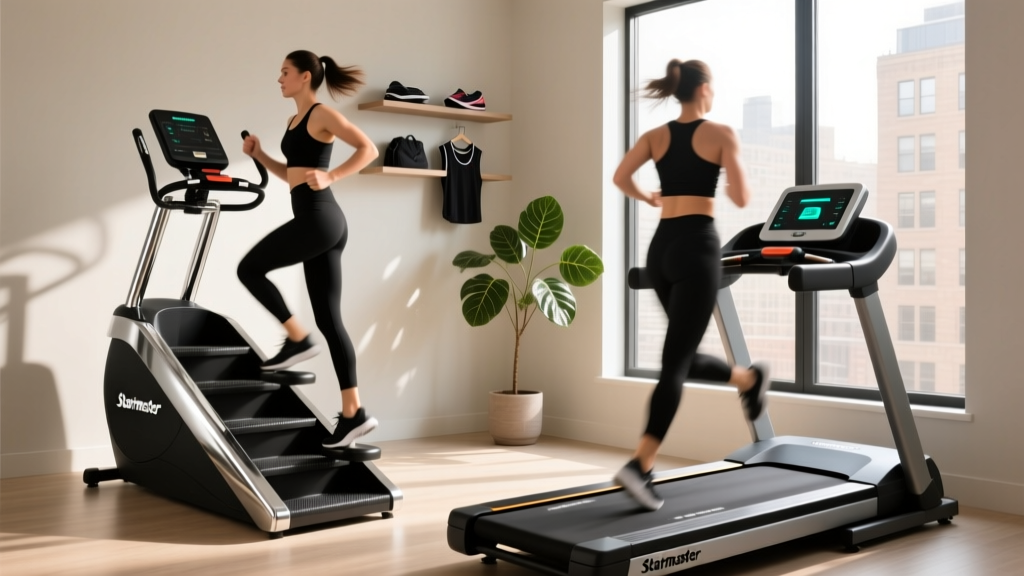
What Burns More Calories: StairMaster or Treadmill? 2026 Buying Guide
Discover what burns more calories: StairMaster or treadmill. Our 2026 buying guide compares features, MET values, and top incline treadmills for fat loss.

The Ultimate Cardio Debate: StairMaster vs. Treadmill
If you are outfitting a home gym or trying to optimize your commercial gym routine, you have likely asked the classic fitness question: what burns more calories stairmaster or treadmill? The answer is not a simple binary. It depends entirely on how you manipulate the machine's variables—specifically speed, incline, and resistance.
While the StairMaster (and generic stepmills) forces a high baseline of energy expenditure by fighting gravity with every step, a modern treadmill offers a vastly wider spectrum of calorie-burning potential. In this 2026 in-depth buying guide, we break down the exact metabolic math, compare the biomechanics, and provide a comprehensive feature comparison matrix to help you choose the right treadmill for maximum caloric output.
The Short Answer
At a moderate, steady-state pace without holding the handrails, a StairMaster burns roughly 15% to 20% more calories than walking on a flat treadmill. However, if you utilize high-incline treadmill walking (12% to 15%) or running, the treadmill will match or exceed the StairMaster's calorie burn while offering superior biomechanical variety and lower impact on the patellar tendon.
The Calorie Burn Showdown: Decoding MET Values
To accurately compare these machines, exercise physiologists use METs (Metabolic Equivalent of Task). One MET is the energy you expend sitting still. According to data referenced by Harvard Health Publishing, here is how the two machines stack up for a 185-pound (84 kg) individual over 30 minutes:
- Stair Step Machine (Moderate Effort): ~9.0 METs (Burns ~335 calories)
- Treadmill Walking (3.5 mph, Flat): ~4.3 METs (Burns ~160 calories)
- Treadmill Running (6.0 mph, Flat): ~9.8 METs (Burns ~365 calories)
- Treadmill Walking (3.0 mph, 15% Incline): ~9.5 METs (Burns ~350 calories)
The data reveals a critical buying insight: if you hate running but want maximum calorie burn, you must buy a treadmill with a high maximum incline. A treadmill capped at a 10% incline will struggle to compete with a stepmill for non-runners.
Expert Warning: The moment you grip the handrails on a StairMaster and lean back, you offload up to 20% of your body weight, artificially inflating your console's calorie readout while drastically reducing actual metabolic expenditure. Treadmills encourage better natural arm swing and core engagement during incline walks.
2026 Treadmill Feature Comparison Matrix
If your goal is to rival the StairMaster's calorie burn without the joint impact of running, you need a treadmill engineered for steep inclines and sustained heavy loads. Below is a comparison of the top 2026 treadmills optimized for high-calorie-burn incline training.
| Model (2026 Editions) | Motor (CHP) | Incline / Decline | Belt Dimensions | Estimated Price |
|---|---|---|---|---|
| NordicTrack Commercial 1750 | 3.5 CHP | -3% to 15% | 22" x 60" | $1,999 |
| Sole F85 | 4.0 CHP | 0% to 15% | 22" x 60" | $1,999 |
| Horizon 7.4 AT | 3.5 CHP | 0% to 15% | 22" x 60" | $1,299 |
| ProForm Pro 9000 | 3.6 CHP | -3% to 12% | 22" x 60" | $1,599 |
| Echelon Stride-S (Folding) | 1.25 CHP | 0% to 10% | 20" x 55" | $1,099 |
Critical Treadmill Specs for High-Intensity Incline Training
When shopping for a treadmill specifically to maximize calorie burn, ignore the flashy touchscreen sizes and focus on the mechanical chassis. Here is what you must look for in 2026:
1. Continuous Horsepower (CHP) vs. Peak Horsepower
Marketing materials often boast about "Peak HP," which only measures the motor's maximum output for a few seconds. For sustained 45-minute incline walks (the treadmill equivalent of a StairMaster session), you need a high Continuous Horsepower (CHP) rating. Walking at a 15% incline puts massive torque on the motor. Minimum requirement: 3.5 CHP. If you weigh over 220 lbs, upgrade to a 4.0 CHP motor (like the Sole F85) to prevent the belt from stuttering or the motor from overheating.
2. The Necessity of Decline Mechanics
Why do top-tier models like the NordicTrack 1750 offer a -3% decline? While incline targets the glutes and calves for high calorie burn, decline training introduces eccentric muscle loading. According to the Mayo Clinic, varying your aerobic exercise prevents plateauing and reduces overuse injuries. Decline walking strengthens the quadriceps and patellar tendons, ensuring your legs can handle the high volume required for daily calorie-burning sessions.
3. Belt Ply and Shock Absorption
High-incline walking generates immense downward shear force on the rear of the belt. Look for a 4-ply belt rather than a standard 2-ply. Furthermore, advanced cushioning systems (like Sole's Cushion Flex or NordicTrack's FlexSelect) allow you to turn off the shock absorption for a firmer, road-like push-off, which actually increases muscle recruitment and marginally boosts calorie expenditure compared to a mushy, overly soft deck.
How to Structure a Treadmill Workout to Beat the StairMaster
You do not need to run to out-burn a stepmill. By utilizing the "Incline Interval Protocol," you can spike your heart rate into Zone 4 (anaerobic threshold) while keeping impact low.
The 15% Incline Calorie Crusher (30 Minutes)
- 0-5 Min: 3.0 mph at 5% incline (Warm-up)
- 5-10 Min: 3.2 mph at 10% incline (Zone 2 Cardio)
- 10-20 Min: Alternate 1 min at 15% incline (3.0 mph) with 1 min at 8% incline (3.5 mph). Do not hold the handrails.
- 20-25 Min: 3.0 mph at -2% decline (Eccentric quad flush)
- 25-30 Min: 2.5 mph at 5% incline (Cool down)
The Verdict: Which Machine Should You Buy?
So, what burns more calories: StairMaster or treadmill? The StairMaster wins for foolproof, zero-setup calorie burn. You step on, you climb, you burn. However, for a home gym in 2026, the treadmill is the vastly superior investment.
A high-quality incline treadmill allows you to replicate the StairMaster's metabolic demand via steep inclines, while also offering the ability to run, sprint, walk with a stroller, or do eccentric decline training. The versatility, combined with interactive coaching platforms like iFIT and JRNY that automatically adjust your incline to match global hiking trails, ensures higher long-term adherence—which is the ultimate driver of lifelong calorie expenditure.
Frequently Asked Questions
Is the 12-3-30 treadmill workout enough to replace the StairMaster?
The viral 12-3-30 workout (12% incline, 3 mph, for 30 minutes) burns roughly the same amount of calories as a moderate-paced StairMaster session. However, to continue progressing, you will eventually need a treadmill that exceeds 12% incline, which is why we recommend models that reach at least 15%.
Does holding the handrails on a treadmill ruin the calorie burn?
Yes. Holding the handrails while walking at a high incline shifts your center of gravity backward, reducing the workload on your glutes and hamstrings by up to 25%. To get the true MET value and calorie burn advertised by the machine, you must pump your arms and support your own body weight.
Which machine is better for bad knees?
While both are low-impact compared to outdoor running, a treadmill set to a moderate incline (5% to 8%) is generally friendlier to the knees than a StairMaster. The repetitive deep knee flexion required on a stepmill can aggravate patellofemoral pain syndrome, whereas incline walking keeps the knee joint in a safer, more stable range of motion.
More gear to consider
All reviews
NordicTrack T6.5 Treadmill Setup & Motor Horsepower Guide

Folding Treadmill Review: Small Spaces & Redwood City Outlet Value

Horizon Evolve Treadmill vs Concept2 Rower: 2026 Guide
How to Use a Treadmill to Lose Weight: 2026 Feature Guide

Treadmill Buying Guide: Compare Features & Precor Treadmill Lubricant
