
How Much Is a Good Treadmill vs. Home Stair Climber?
Discover how much is a good treadmill compared to a home stair climber. We break down 2026 pricing, spatial needs, and biomechanics to guide your buy.

The Real Cost: How Much Is a Good Treadmill vs. Stair Climber?
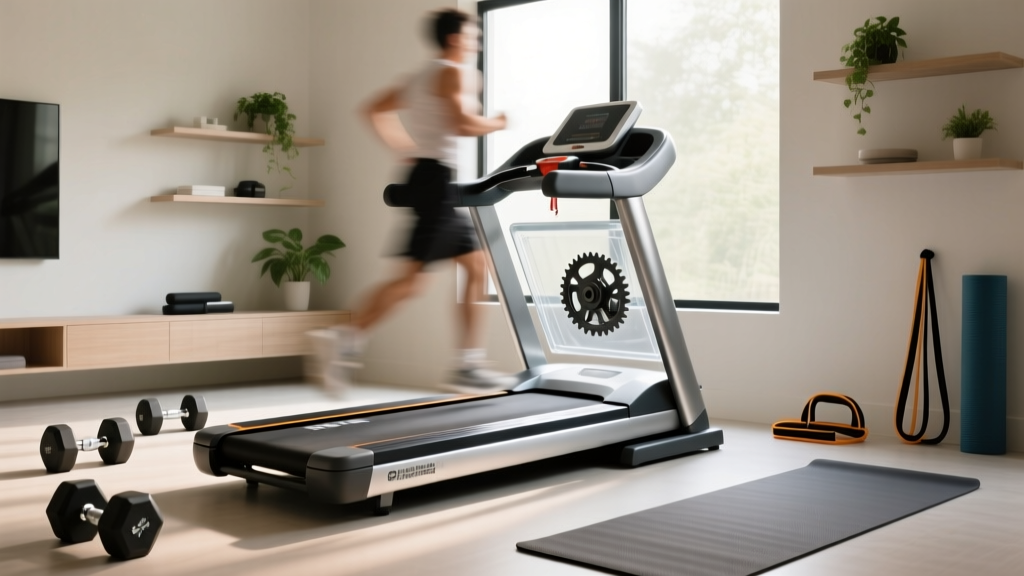
When outfitting a home gym, the most common question we receive is, how much is a good treadmill? In 2026, a high-quality, motorized treadmill with a 3.0 CHP motor, advanced shock absorption, and interactive programming typically costs between $1,200 and $2,500. Models like the Sole F80 ($1,199) or the NordicTrack Commercial 1750 ($2,299) set the benchmark for reliable home running. But what if your fitness goals demand higher glute activation, lower joint impact, and a smaller physical footprint? This is where the home stair climber enters the conversation.
While treadmills dominate the cardio market, stair climbers offer a uniquely intense, low-impact cardiovascular workout that targets the posterior chain in ways a flat belt cannot. However, the pricing architecture, spatial requirements, and mechanical maintenance of stair climbers differ vastly from treadmills. This in-depth guide deconstructs the home stair climber market, compares it directly to treadmill ownership, and provides the exact data you need to make a capital investment in your health.
Quick Budget Verdict
Treadmill: Expect to spend $1,200 - $2,500 for a durable, motorized home model.
StepMill (Rotating Stairs): Expect to spend $3,500 - $5,500 for commercial-grade home units.
Pedal Climber: Expect to spend $1,500 - $2,500 for hybrid resistance climbers.
Mini-Stepper: Expect to spend $60 - $150 for basic hydraulic models.
Deconstructing the Home Stair Climber Market
The term "stair climber" is often misused to describe three entirely different categories of equipment. Understanding these distinctions is critical before evaluating cost and utility.
1. The StepMill (Rotating Staircase)
This is the gold standard, popularized by the StairMaster Gauntlet. It features a literal revolving staircase that forces you to lift your body weight against gravity with every step. Because the mechanism requires a heavy-duty alternator, a robust drive chain, and a massive steel frame, these are the most expensive cardio machines on the market. The StairMaster SM5000 Club Series retails for approximately $4,299, while the premium SM9000 pushes past $5,500. They are built for 20+ years of daily abuse, but their price point and sheer weight (often exceeding 350 lbs) make them a major commitment.
2. Pedal Climbers & Hybrid Trainers
Instead of actual stairs, these machines use two independent pedals connected to a magnetic or electromagnetic resistance flywheel. They mimic the motion of climbing without the extreme vertical rise. The Bowflex Max Trainer M9 (retailing around $2,299) is a prime example, combining stair-climbing pedal motion with upper-body ergometer arms. These are significantly cheaper than StepMills, quieter, and require less vertical clearance, making them the most popular "stair climber" choice for modern home gyms.
3. Mini-Steppers (Hydraulic)
These compact, floor-level devices use hydraulic cylinders to provide resistance. Brands like Sunny Health & Fitness offer models with resistance bands for $70 to $120. While excellent for light physical therapy or adding movement to a standing desk, they lack the cardiovascular ceiling and biomechanical range of motion required for serious athletic conditioning.
Head-to-Head Matrix: Treadmill vs. Stair Climber
To visualize how a premium treadmill stacks up against the two main types of premium stair climbers, review the comparison matrix below.
| Feature | Motorized Treadmill (e.g., Sole F80) | StepMill (e.g., StairMaster SM5000) | Pedal Climber (e.g., Bowflex M9) |
|---|---|---|---|
| Average Cost | $1,199 - $2,299 | $4,299 - $5,500 | $1,800 - $2,499 |
| Footprint (L x W) | 82" x 35" | 74" x 36" | 49" x 30" |
| Ceiling Req. | 8'0" (8'6" on max incline) | 8'6" to 9'0" minimum | 7'6" minimum |
| Joint Impact | Moderate to High (Running) | Low (No eccentric striking) | Very Low |
| Noise Level | 65 - 75 dB (Motor + Footfalls) | 55 - 65 dB (Mechanical whir) | 40 - 50 dB (Near silent) |
The Spatial Reality: Calculating Ceiling Clearance
The most frequent point of failure when buying a home stair climber is ignoring ceiling height. Unlike a treadmill where your head remains at a relatively static elevation, a StepMill requires you to continuously step upward.
The Clearance Formula: Take the tallest user in your household and add 16 inches. If the primary user is 6'0" (72 inches), you need a minimum of 88 inches (7'4") of clearance just to avoid brushing the ceiling. However, because the handrails on a StepMill sit higher than your head, and to prevent psychological claustrophobia, we mandate a minimum ceiling height of 8'6" for StepMills. If your home gym is in a basement with drop ceilings or HVAC ductwork, a Pedal Climber or Treadmill is likely your only viable option.
Biomechanics and Caloric Expenditure
Why pay a premium for a stair climber? The answer lies in metabolic demand and joint preservation. According to data published by Harvard Health Publishing, a 155-pound person burns approximately 216 calories in 30 minutes on a general stair stepper, compared to 108 calories walking at a moderate pace on a treadmill. To match the caloric output of a stair climber on a treadmill, you must either run at a 6 MPH pace (burning ~360 calories) or utilize a 15% maximum incline at a brisk walk.
"Stair climbing eliminates the eccentric 'braking' force associated with heel-striking on a treadmill belt. Because you are purely engaging in concentric muscle contractions (pushing up against gravity), the shear force on the patellofemoral joint is drastically reduced, making it an ideal modality for aging athletes or those recovering from lower-back compression issues."
Furthermore, the American Heart Association recommends at least 150 minutes of moderate-intensity aerobic activity per week. Stair climbers achieve target heart rate zones (Zone 2 and Zone 3) much faster than walking on a flat treadmill, allowing users to condense their cardiovascular requirements into highly efficient 20-to-30-minute sessions.
Hidden Costs: Maintenance and Electrical Draw
When calculating how much a good treadmill or stair climber truly costs, you must factor in long-term maintenance. Treadmills require regular silicone belt lubrication (roughly $15 annually) and eventual belt/deck replacements ($150–$300 every 3 to 5 years depending on mileage).
StepMills, conversely, have fewer wearable surface areas but contain complex internal drivetrains. The alternator and drive chain on a commercial StepMill are designed for thousands of hours of use, but if the internal battery or alternator fails out of warranty, replacement parts and technician labor can exceed $500. Pedal climbers like the Bowflex Max series require almost zero mechanical maintenance, though their proprietary digital screens and electronic resistance servos are vulnerable to power surges, making a dedicated $30 surge protector a mandatory accessory.
Final Decision Framework for Your Home Gym
- Choose the Treadmill if: You are training for outdoor road races, you prefer variable pacing (sprinting to walking), and you have a dedicated room with standard 8-foot ceilings and ample floor length.
- Choose the StepMill if: You have a budget exceeding $4,000, ceilings over 8'6", and you prioritize maximum glute/quad hypertrophy and low-impact Zone 3 cardio without the spatial footprint of a full treadmill deck.
- Choose the Pedal Climber if: You are working with a $2,000 budget, possess limited square footage (e.g., an apartment or small den), and want a full-body, high-heart-rate interval machine that operates quietly.
Ultimately, answering the question of how much is a good treadmill is only the first step in home gym curation. By evaluating your spatial constraints, joint health, and specific metabolic goals, you can confidently select the cardio machine that will deliver decades of reliable performance.
More gear to consider
All reviews
Is a Treadmill Easier Than Running Outside? Curved vs Motorized

Stair Climber vs NordicTrack T6.7i Treadmill: Home Use Guide

Treadmill Belt Maintenance vs Fitness Tracker Elliptical Costs

Stair Climber vs. Underwater Treadmill for Dog Rehab: Home Guide
Cardio Noise Comparison: Fixing a Treadmill in Spanish or English
