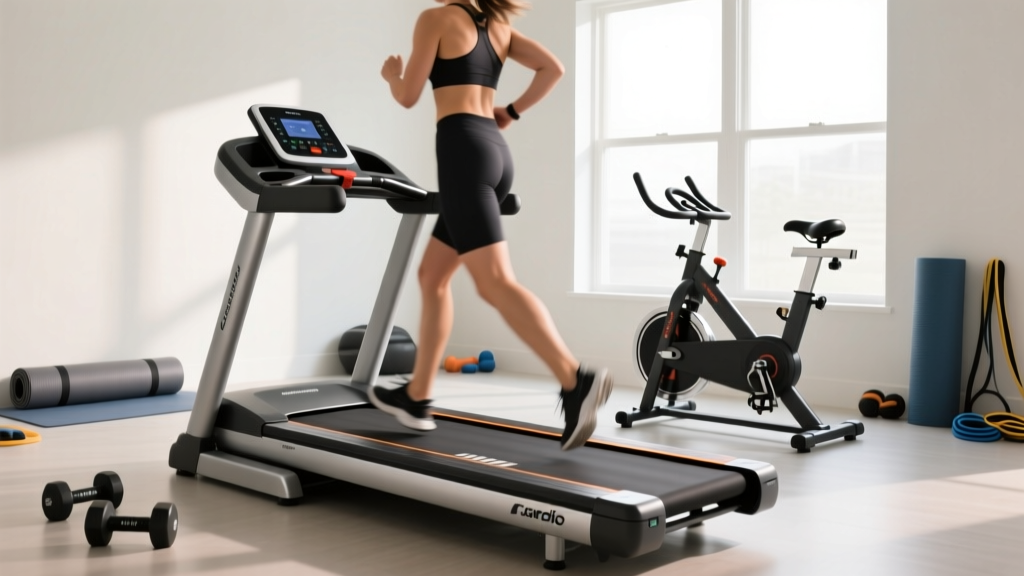
Why Does My Treadmill Stop When I Step On It? Bike Value Guide
Discover why your treadmill stops when you step on it, repair costs, and a value analysis of upright, recumbent, and spin bikes as alternatives.

The Dreaded Treadmill Stall: Why It Stops When You Step On It
You press start, the belt begins to move, but the moment your full body weight transfers onto the deck, the motor groans and the belt abruptly halts. If you are searching for answers to why does my treadmill stop when i step on it, you are experiencing the most common mechanical failure in home cardio equipment. According to reliability data from Consumer Reports, treadmills consistently rank highest for repair needs among home fitness machines due to the immense friction and high-impact forces involved.
Before you abandon your workout or spend hundreds on a technician, it is crucial to understand the exact mechanical failure points causing this stall under load.
⚠️ Diagnostic Warning: Never test the motor with the hood off while the machine is plugged in. Always unplug the treadmill before inspecting the drive belt or motor control board.The 3 Primary Culprits of Treadmill Stalling
- 1. Loose or Glazed Drive Belt (60% of cases): The ribbed belt connecting the motor pulley to the front roller loses tension over time. When unweighted, the motor can turn the pulley. When you step on it, the friction demand exceeds the belt's grip, causing it to slip silently or squeak while the belt stops.
- 2. Dry Walking Belt / Deck Friction (25% of cases): If the walking belt lacks 100% silicone lubrication, the friction between the belt and the wooden deck spikes. The motor draws excessive amperage to overcome this drag, triggering the thermal overload switch or causing the Motor Control Board (MCB) to cut power to prevent a fire.
- 3. Failing Motor Control Board Capacitor (15% of cases): The MCB regulates voltage to the motor. If the main capacitor is degrading, it cannot deliver the initial torque required to move the belt with a 150+ lb load on it, resulting in an immediate stall.
Repair vs. Replace: The 2026 Budget Breakdown
Is it worth fixing your treadmill, or should you pivot to a lower-maintenance cardio alternative? Let us break down the average out-of-warranty repair costs for a standard mid-tier treadmill (e.g., NordicTrack T Series or ProForm Performance) in 2026.
| Repair Component | Part Cost | Labor / Total | DIY Difficulty |
|---|---|---|---|
| Drive Belt Replacement | $25 - $45 | $120 - $160 | Easy (30 mins) |
| Walking Belt & Deck | $80 - $150 | $250 - $350 | Moderate (1.5 hrs) |
| Motor Control Board | $150 - $300 | $300 - $450 | Moderate (45 mins) |
| Drive Motor Replacement | $250 - $500 | $450 - $700 | Hard (2 hrs) |
If your treadmill is over five years old and requires an MCB or motor replacement, the repair cost often exceeds 50% of the machine's depreciated value. This is the exact financial threshold where pivoting to a stationary bike becomes the superior long-term investment.
The Pivot: Why Stationary Bikes Offer Better Long-Term Value
Unlike treadmills, stationary bikes do not rely on high-friction decks, heavy impact loading, or massive continuous-duty horsepower motors. The best modern bikes utilize magnetic resistance and poly-groove belt drives, virtually eliminating the mechanical wear-and-tear that plagues treadmills. If you are reallocating your $400 repair budget toward a new cardio machine, here is a deep-dive value analysis of the three main stationary bike types: Upright, Recumbent, and Spin.
1. Upright Bikes: The Budget-Friendly Traditionalist
Upright bikes mimic the geometry of a standard outdoor road bike but feature a step-through frame and a wider, cushioned saddle. They use a lightweight flywheel (usually 8 to 15 lbs) paired with an electronic servo-motor that moves a magnet closer to or further from the flywheel to create resistance.
Value Proposition & Top 2026 Models
- Entry-Level ($300 - $500): The Schwinn 130 remains a benchmark for budget value, offering a reliable magnetic drive and basic Bluetooth connectivity to third-party apps like Zwift.
- Premium ($600 - $900): The Schwinn 170 Upright adds a heavier flywheel for smoother inertia, dual-track LCD displays, and 29 preset workout programs.
Expert Insight: Upright bikes are ideal for users who want a compact footprint (roughly 4 sq. ft.) and traditional cardio without the premium price tag of interactive smart bikes. However, they require the user to support their own upper body weight, which can lead to lower back fatigue during sessions exceeding 45 minutes.
2. Recumbent Bikes: The Ergonomic & Joint-Friendly Investment
Recumbent bikes feature a bucket-style seat with a full mesh backrest and pedals positioned in front of the body rather than underneath. This design completely removes the load from the lumbar spine and drastically reduces the impact on the knees and hips.
According to physical activity guidelines from the Centers for Disease Control and Prevention (CDC), low-impact aerobic activities are critical for aging adults or those recovering from joint injuries. Recumbent bikes perfectly fulfill this medical necessity while providing rigorous cardiovascular conditioning.
Value Proposition & Top 2026 Models
- Mid-Tier ($500 - $800): The Nautilus R618 offers a 25-lb flywheel (heavy for a recumbent, ensuring incredibly smooth pedaling) and a highly adjustable sliding seat rail.
- Commercial/Premium ($1,000 - $1,800): The Sole Fitness R92 is built with a heavy-gauge steel frame, a 40-lb flywheel, and a 10-year frame warranty. It is virtually indestructible for home use.
3. Spin Bikes (Indoor Cycles): The High-Intensity Powerhouse
Spin bikes are designed to replicate the exact biomechanics of outdoor cycling. They feature a heavy, perimeter-weighted steel or aluminum flywheel (30 to 50 lbs) and a direct-drive or belt-drive system. They demand higher cardiovascular output and are the preferred choice for High-Intensity Interval Training (HIIT).
The American Heart Association (AHA) recommends at least 75 minutes of vigorous-intensity aerobic activity per week for optimal cardiovascular health. Spin bikes are uniquely engineered to sustain this vigorous intensity safely at home.
Value Proposition & Top 2026 Models
- Mid-Tier ($700 - $1,200): The Schwinn IC4 (also sold as the Bowflex VeloCore in some markets) dominates this space with a magnetic resistance system, dual-sided pedals (SPD and toe cages), and native integration with Peloton and Zwift without requiring a proprietary ecosystem lock-in.
- Premium/Commercial ($1,800 - $2,500): The Keiser M3i is the gold standard. It uses an aerospace-grade aluminum frame, a rear-mounted flywheel to protect against sweat corrosion, and a Gates poly-groove belt drive that requires zero maintenance for its entire lifespan.
2026 Price-to-Lifespan Matrix: Which Bike Wins?
When evaluating the true cost of ownership, you must factor in the initial purchase price, expected lifespan, and annual maintenance. Here is how the three types compare in 2026.
| Bike Type | Average Cost | Expected Lifespan | Maintenance Cost/Year | Best For |
|---|---|---|---|---|
| Upright | $450 | 5 - 8 Years | $10 (Batteries/Wipes) | Budget buyers, small spaces |
| Recumbent | $850 | 8 - 12 Years | $15 (Lubricate rails) | Joint pain, rehab, seniors |
| Spin / Indoor | $1,100 | 10 - 15+ Years | $0 (Belt drives) | HIIT, athletes, app users |
Hidden Costs: Subscriptions and Drivetrains
When budgeting for your new cardio machine, beware of the 'hardware trap.' Many premium spin bikes (like the Peloton Bike+ at $2,495) require a mandatory proprietary app subscription to access live classes and detailed metrics, costing an additional $44 per month ($528 per year).
The Value Alternative: Purchase a hardware-agnostic bike like the Schwinn IC4 or the Echelon EX3. These bikes offer native Bluetooth FTMS (Fitness Machine Service) protocols, allowing you to connect to third-party apps like Zwift ($19.99/mo) or even free open-source alternatives like MyHomeFit, drastically reducing your 5-year total cost of ownership.
Final Verdict: Fix the Treadmill or Buy a Bike?
If your treadmill stops when you step on it, check the drive belt tension and lubricate the deck first. If those $30 fixes do not resolve the issue, you are likely facing a $300+ electronic failure. At that price point, reallocating your budget toward a Spin Bike (for high-intensity value) or a Recumbent Bike (for long-term joint health) is the smartest financial and physiological decision you can make in 2026. Bikes simply do not suffer from the catastrophic friction failures that doom aging treadmills, ensuring your cardio routine remains uninterrupted for the next decade.
More gear to consider
All reviews
Sprinting Intervals on Treadmill: Beginner Guide & Noise Levels

T101 Horizon Treadmill Review: Motor HP & Sizing Guide
FreeMotion 890 Treadmill Motor Guide & Installation Setup

MC 2100 Treadmill Repair vs Walking Pad: 2026 Review

Letter of Medical Necessity for Treadmill: 2026 Under Desk Reviews
