What Size Treadmill Do I Need? Space Layout and Belt Care
Discover what size treadmill you need for your home gym layout, plus expert belt maintenance and lubrication tips for compact and folding models.

When designing a home gym, the most common question we encounter is, "What size treadmill do I need?" Most buyers focus purely on the spatial footprint: measuring ceiling height for incline clearance, calculating the square footage of the room, and deciding between a full-sized rig or a folding model. However, from a space optimization and mechanical longevity perspective, the size and class of treadmill you choose to fit your layout directly dictates its internal mechanics—specifically, its belt maintenance and lubrication requirements.
In 2026, the market is flooded with ultra-compact walking pads and low-profile folding treadmills designed specifically for space-constrained apartments and multi-use rooms. While these space-saving designs solve your layout dilemmas, they introduce a hidden mechanical trade-off: smaller rollers and tighter deck clearances that drastically alter friction dynamics. If you optimize your space by choosing a compact treadmill, you must adapt your maintenance routine to prevent catastrophic motor failure.
The Space vs. Mechanics Trade-Off: Sizing Your Footprint
Before diving into lubrication protocols, we must establish the baseline dimensions for your space optimization plan. According to guidelines on home exercise equipment safety from the Mayo Clinic, you must account not just for the machine's static footprint, but for the user's safety fall zone and maintenance clearance.
- Full-Size Commercial Rigs (e.g., NordicTrack Commercial 1750, Sole F85): Require a footprint of roughly 80" L x 35" W. Ideal for dedicated garage gyms or large basements with 8-foot ceilings.
- Standard Folding Models (e.g., Horizon 7.0 AT): Operate on a 70" L x 30" W footprint and fold down to roughly 40" L x 30" W x 65" H. Perfect for guest rooms or finished basements.
- Compact Walking Pads (e.g., KingSmith WalkingPad X21): Require as little as 55" L x 22" W and slide under beds or sofas. The ultimate solution for studio apartments.
The "Compact Penalty": Roller Diameter and Friction Heat
Here is the non-obvious engineering reality that most space-optimization guides ignore: belt speed is linear, but roller RPM is inversely proportional to roller diameter.
A full-sized treadmill utilizes front and rear rollers measuring 2.5 to 3.0 inches in diameter. To move the belt at 6.0 MPH, these large rollers spin at a relatively relaxed RPM. Conversely, to maintain a low-profile deck that can slide under a couch, compact walking pads and ultra-thin folding treadmills use rollers measuring between 1.0 and 1.5 inches. To achieve that same 6.0 MPH belt speed, these tiny rollers must spin at double or triple the RPM.
This hyper-rotation generates exponential friction heat between the PVC belt and the phenolic resin deck. If a compact treadmill is not meticulously lubricated, the localized heat will melt the belt backing, delaminate the deck, and cause the drive motor to overwork, eventually frying the Lower Control Board (LCB)—a replacement part that typically costs between $180 and $350.
Treadmill Class Maintenance Matrix
| Treadmill Class | Typical Roller Size | Lubrication Frequency | Optimal Amp Draw (No Load) | Silicone Volume per Side |
|---|---|---|---|---|
| Full-Size / Commercial | 2.5" - 3.0" | Every 150 miles / 6 months | 3.0 - 5.0 Amps | 15 ml |
| Standard Folding Home | 1.8" - 2.2" | Every 90 miles / 4 months | 4.0 - 6.0 Amps | 10 ml |
| Compact / Walking Pad | 1.0" - 1.5" | Every 40 miles / 8 weeks | 5.0 - 8.0 Amps | 5 - 8 ml |
Layout Design: Creating the "Maintenance Halo"
When asking "what size treadmill do I need," you must also ask, "how will I service it?" A major failure in home gym layout design is pushing a folding treadmill flush against a wall or wedging it into a tight corner.
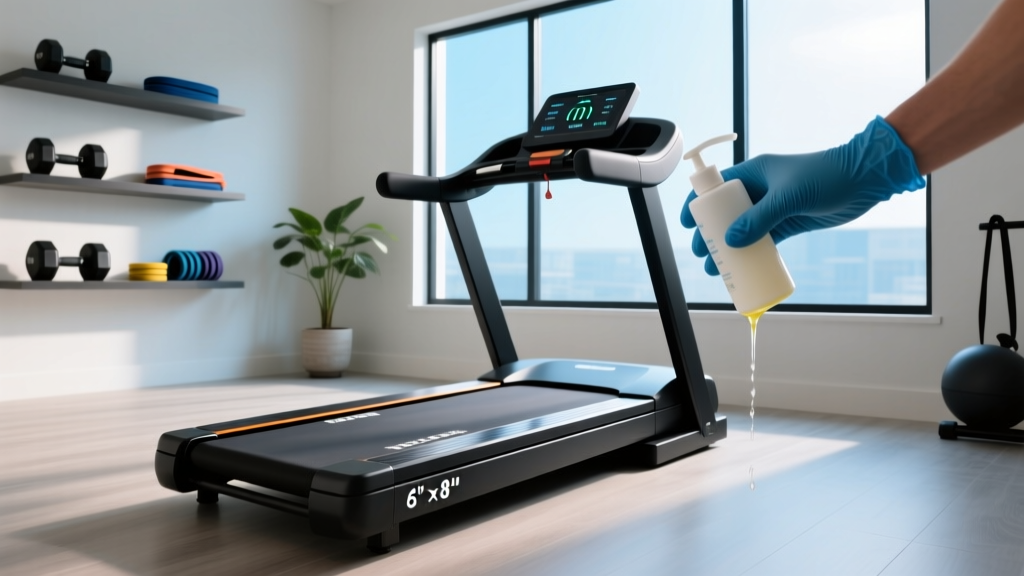
To properly maintain and lubricate a treadmill belt, you need access to both sides of the deck to adjust the tension bolts and apply silicone. We recommend designing your space with a 24-inch Maintenance Halo on at least one side and the rear of the machine. If your space optimization strategy requires the treadmill to be flush against a wall when in use, ensure the machine is on heavy-duty, lockable caster mats so it can be easily pulled out for the 15-minute monthly maintenance routine.
Critical Warning: Never use WD-40, silicone spray from a hardware store, or petroleum-based lubricants on your treadmill belt. These contain solvents that will dissolve the PVC backing of the belt and destroy the deck wax. You must use 100% pure liquid silicone specifically formulated for fitness equipment, which typically costs $12 to $18 per bottle.
Step-by-Step Belt Lubrication for Space-Constrained Setups
If you have opted for a compact or folding treadmill to save space, follow this exact protocol to mitigate the high-RPM friction penalty.
- Release the Tension: Using a 3/16" or 1/4" Allen wrench (check your specific model's manual), turn the left and right rear roller bolts counter-clockwise by exactly one full rotation. This loosens the belt enough to slide your hand underneath.
- Check the Deck Wear: Run your hand under the belt. If the phenolic deck feels rough, like sandpaper, the friction coating has worn off. A worn deck cannot be lubricated; it must be replaced (or flipped, if it is a reversible double-sided deck).
- Apply the Silicone: Squeeze the applicator tube of 100% liquid silicone about halfway between the center and the edge of the deck. Apply a zigzag pattern covering about 12 inches of the deck length. Repeat on the opposite side. Note: Walking pads require less volume (5-8ml) to prevent silicone from slinging off the edges due to the narrow 16-inch belt width.
- Re-Tension the Belt: Tighten the rear bolts clockwise by the exact same amount you loosened them.
- The Lift Test: Reach under the center of the belt and pull upward. You should be able to lift the belt exactly 2 to 3 inches off the deck. If it lifts higher, it is too loose and will slip during heavy foot strikes; if lower, it is choking the drive motor.
- Distribute the Lube: Turn the machine on to 3.0 MPH and walk on it for 3 minutes, deliberately stepping on the left and right edges to spread the silicone evenly across the deck surface.
Diagnosing Friction Damage: The Amp-Draw Test
Because compact treadmills are often pushed to their mechanical limits, visual inspection is not enough. You must monitor the electrical load. According to equipment diagnostics data cited by Consumer Reports fitness equipment guides, a treadmill's electrical draw is the most accurate indicator of deck health.
For a precise diagnostic, plug your treadmill into a standard digital watt meter or use a clamp multimeter on the internal motor wires (if you are certified to open the motor hood).
Expert Diagnostic Framework:- 3.0 - 6.0 Amps (No Load, 3 MPH): Belt is properly lubricated. Deck is healthy.
- 8.0 - 12.0 Amps: High friction. Belt requires immediate lubrication. Continued use will trigger the thermal safety shutoff.
- 14.0+ Amps: Critical failure zone. The deck is likely warped or the belt backing has melted. The lower control board is at imminent risk of capacitor blowout. Stop use immediately.
2026 Innovations: Auto-Lubrication in Smart Treadmills
If your space optimization plan involves a premium folding treadmill, look for models featuring integrated auto-lubrication reservoirs. In 2026, several mid-to-high-tier compact treadmills feature a small silicone cartridge located under the front motor hood. These systems use a micro-pump tied to the machine's internal odometer, automatically dispensing 2ml of silicone every 30 miles. While this drastically reduces manual maintenance, you still must verify the reservoir levels every 6 months and manually check the belt tension, as the auto-lube systems do not compensate for belt stretch over time.
Final Verdict on Sizing and Upkeep
Answering "what size treadmill do I need" is a balancing act between your available square footage and your willingness to perform mechanical upkeep. If you have the space for a full-sized machine with 2.5-inch rollers, you will enjoy a more forgiving maintenance schedule and a cooler-running deck. However, if your layout demands a compact folding model or an under-desk walking pad, you can absolutely protect your investment—provided you respect the compact penalty, adhere to a strict 40-to-90-mile lubrication cycle, and design your room with a 24-inch maintenance halo to ensure you can actually reach the machine when it needs care.
More gear to consider
All reviews
Walking Pad vs Horizon CST 3.5 Treadmill: Mistakes & Fixes
ProForm T35 Treadmill & Stationary Bike Types: Space Layout

Rowing Machine vs Incline Exercise Treadmill: 2026 Showdown

Can Under Desk Treadmills Handle Treadmill Sprint Workouts? Review

ProForm 390PI Treadmill vs Stationary Bikes: Budget Value Analysis
