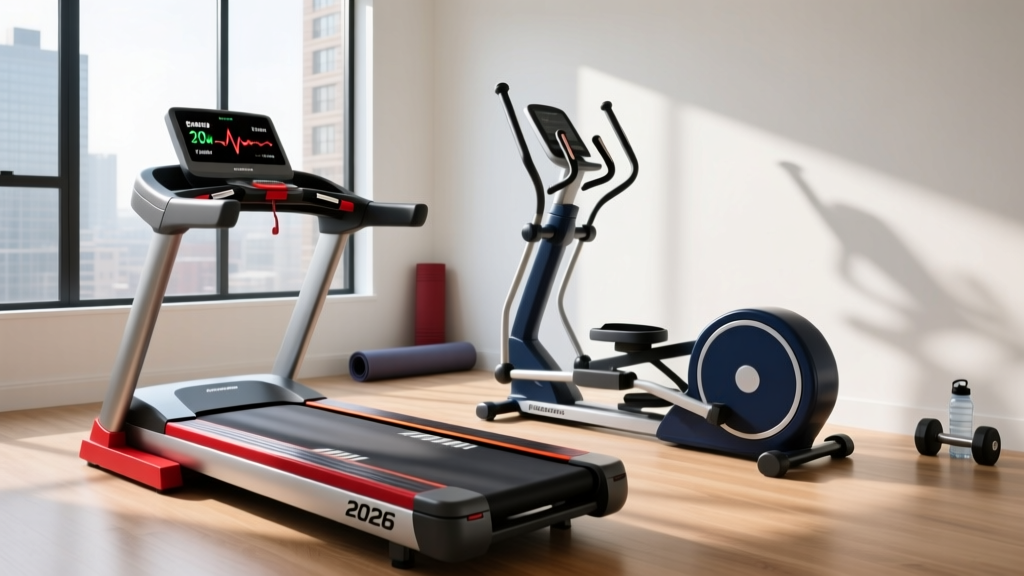
Decoding the 2026 Treadmill Receipt: Elliptical vs Treadmill Trends
Analyze the 2026 home cardio market. We decode the true treadmill receipt vs elliptical costs, examining TCO, biomechanics, and smart-tech trends.

The 2026 Home Cardio Market: Beyond the Sticker Price
The home fitness equipment market has undergone a radical transformation since the pandemic-era buying frenzy. As we navigate 2026, supply chain bottlenecks have fully resolved, manufacturing has shifted heavily toward integrated AI coaching, and consumer purchasing behavior has matured. Today’s buyers are no longer just looking at the upfront MSRP; they are auditing the long-term financial and physiological return on investment. When conducting a market analysis of home cardio, the concept of the treadmill receipt has evolved from a simple proof of purchase into a complex ledger representing the Total Cost of Ownership (TCO), ongoing software subscriptions, maintenance liabilities, and biomechanical ROI.
For consumers and market analysts alike, comparing the treadmill sector against the elliptical market reveals fascinating divergences in hardware depreciation, software monetization, and user retention. While treadmills continue to dominate overall market volume due to the universal familiarity of walking and running, ellipticals are capturing a growing share of the premium demographic seeking low-impact, high-yield cardiovascular conditioning. To understand where the industry is heading, we must look past the marketing gloss and dissect what your equipment receipt actually represents over a five-year lifecycle.
Anatomy of the Treadmill Receipt vs. Elliptical Invoice
A detailed breakdown of a premium treadmill receipt versus an elliptical invoice highlights a shift in how manufacturers generate revenue. In 2026, the hardware is often subsidized or priced at a narrow margin to drive adoption of proprietary digital ecosystems. Let us compare the five-year TCO of two category leaders: a high-end folding treadmill (e.g., Sole F80 or NordicTrack Commercial 1750 equivalent) and a premium compact elliptical (e.g., Bowflex Max M9 or NordicTrack FS14i equivalent).
| Cost Category (5-Year Projection) | Premium Treadmill (e.g., Sole F80 Class) | Premium Elliptical (e.g., Bowflex Max M9 Class) |
|---|---|---|
| Base MSRP (2026 Average) | $1,999 - $2,499 | $2,299 - $2,799 |
| Delivery & Assembly | $250 (Threshold delivery + 2-person setup) | $150 (Standard freight + 1-person setup) |
| Mandatory/Incentivized Subscriptions | $2,340 ($39/mo for 60 months) | $2,940 ($49/mo for 60 months) |
| Routine Maintenance | $120 (Silicone belt lube, deck inspection) | $40 (Pivot arm lithium grease, sensor cleaning) |
| Out-of-Warranty Repair Risk | High (Motor brush/control board: $450+) | Low (Magnetic resistance flywheel: $150) |
| Estimated 5-Year Resale Value | $400 - $600 (20% retention) | $700 - $900 (30% retention) |
| Total 5-Year Cost of Ownership | $4,259 - $5,059 | $4,739 - $5,639 |
As the data illustrates, the initial treadmill receipt might appear lower than the elliptical invoice, but the long-term maintenance and depreciation profiles differ significantly. Treadmills endure high-impact mechanical stress, leading to a higher likelihood of out-of-warranty control board or motor failures. Ellipticals, utilizing frictionless magnetic resistance and sealed flywheel bearings, generally incur lower mechanical repair costs but often command higher monthly subscription fees for their specialized HIIT programming.
Biomechanical ROI: What Are You Actually Paying For?
From a physiological standpoint, the financial receipt is only half the equation; the biomechanical ROI dictates user longevity and adherence. According to the Mayo Clinic, the primary differentiator between these two machines is joint loading and ground reaction forces (GRF).
Expert Insight: Ground Reaction Forces
When running on a treadmill, the body absorbs ground reaction forces equivalent to 2.5 to 3 times your body weight with every footstrike. For a 180 lb individual, this translates to over 500 lbs of force per step. Conversely, ellipticals maintain continuous foot contact with the pedals, reducing joint impact to near zero while still elevating the heart rate into the target cardiovascular zone outlined by the American Heart Association.
Failure Modes and Edge Cases
Market analysis shows that treadmill abandonment rates spike in year two, often correlated with the onset of plantar fasciitis, shin splints, or lumbar strain in users over the age of 40. The elliptical market capitalizes on this by marketing 'active recovery' and 'joint preservation.' However, ellipticals present their own biomechanical edge cases: users with limited hip flexor mobility or pre-existing lower back issues often experience lumbar fatigue on ellipticals due to the fixed, repetitive hip-flexion angle and the tendency to lean heavily on the static handlebars, which disengages the core.
The Subscription Trap: Software Line Items
The most significant trend in the 2026 fitness equipment market is the aggressive pivot toward Software-as-a-Service (SaaS) models. The modern treadmill receipt is no longer just a one-time hardware transaction; it is a gateway to a recurring billing cycle. Brands like NordicTrack (iFIT) and Bowflex (JRNY) have engineered their hardware to heavily restrict manual functionality if the subscription lapses.
- Treadmill Software Integration: Subscriptions offer global route mapping, automatic incline/decline adjustments, and live coaching. The hardware relies on the software to adjust the 3.5 CHP motor and 15% incline gradient in real-time.
- Elliptical Software Integration: Elliptical subscriptions focus on adaptive resistance. The software reads your heart rate via Bluetooth chest straps or optical sensors and dynamically adjusts the magnetic resistance to keep you in specific VO2 max or fat-burn zones.
Market watchdogs and consumer advocates, including Consumer Reports, have increasingly highlighted the frustration of 'bricked' features when users refuse to pay the $40-$50 monthly fees. When evaluating your purchase, you must calculate whether the digital ecosystem justifies a $2,400+ five-year software expenditure, or if a 'dumb' machine with a higher upfront cost but zero mandatory subscriptions (like certain Sole or Spirit models) better aligns with your financial strategy.
Depreciation and the Secondary Market
An often-overlooked aspect of the home cardio market is the secondary resale value. Treadmills suffer from severe depreciation. A $2,500 treadmill purchased in 2024 will likely fetch no more than $500 on the secondary market in 2026. This is driven by three factors:
- Logistical Friction: Moving a 250 lb treadmill requires professional disassembly and freight, which deters second-hand buyers.
- Wear and Tear Visibility: Treadmill belts show visible fraying, and decks develop permanent grooves, making used units look heavily degraded.
- Non-Transferable Warranties: Most premium brands void the motor and parts warranty if the machine is not purchased from an authorized dealer by the original owner.
Ellipticals, particularly compact or folding models, retain approximately 10% to 15% more of their original value. They lack the high-friction wear points of a treadmill belt, meaning a three-year-old elliptical often looks and functions identically to a new one, provided the pivot bearings have been maintained.
Strategic Decision Framework: Aligning Receipt with Physiology
To synthesize this market analysis into an actionable purchasing framework, buyers should categorize themselves into one of three distinct profiles:
Profile A: The Performance Runner (Choose Treadmill)
If your goal is marathon prep, sprint interval training, or improving running economy, the biomechanical specificity of a treadmill is non-negotiable. You must budget for the higher maintenance costs and accept the steep depreciation curve. Look for models with a minimum 4.0 CHP motor and a 60-inch belt length to accommodate full stride extension without hitting the front motor housing.
Profile B: The Longevity & Joint-Preservation Seeker (Choose Elliptical)
If you are over 40, recovering from lower-extremity orthopedic surgery, or suffer from rheumatoid arthritis, the elliptical is the superior investment. The higher initial MSRP and subscription costs are offset by the elimination of physical therapy 'receipts' associated with high-impact treadmill running. Prioritize models with adjustable stride lengths (18 to 24 inches) to prevent knee hyperextension.
Profile C: The Budget-Conscious Generalist (Choose the 'Dumb' Treadmill)
If you want to avoid the SaaS subscription trap entirely, the market still offers commercial-grade, non-connected treadmills. By sacrificing the HD touchscreen and auto-incline routing, you can secure a machine with a lifetime frame and motor warranty for under $1,500, fundamentally altering the long-term math of your treadmill receipt.
Final Market Outlook
As we move through 2026, the home cardio market is bifurcating into ultra-premium, AI-driven ecosystems and rugged, subscription-free commercial clones. Whether you are signing a receipt for a smart treadmill or a magnetic elliptical, the key to a successful investment lies in matching the machine's biomechanical reality with your physiological needs, while keeping a sharp eye on the hidden, compounding costs of software and maintenance.
More gear to consider
All reviews
Motor Comparison & How to Fix Motor in Treadmill That's Belt is Stuck

Treadmill Training Program for Half Marathon: Walking Pad vs Standard

Redefining the Treadmill Meaning: Expert Belt Maintenance Guide
2026 Rowing Machine Buying Guide: Beat the 45-Minute Treadmill
Under Desk Treadmill Review vs Average Treadmill Size: 2026 Trends
