Stationary Bike Types: Budgeting to Improve Treadmill Times (2026)
Discover how upright, recumbent, and spin bikes impact your treadmill times. Our 2026 budget breakdown reveals the best value cardio cross-training.

The Cross-Training ROI: How Biking Impacts Treadmill Times
Shaving seconds off your 5K or sustaining a faster pace for a half-marathon requires more than just logging endless miles on a motorized belt. Pounding the deck daily inevitably leads to joint fatigue, shin splints, and plateaued performance. To break through these barriers and consistently improve your treadmill times, strategic cross-training is non-negotiable. But when you are outfitting a home gym on a budget, which stationary bike type offers the highest return on investment (ROI) for runners?
In this 2026 budget breakdown and value analysis, we dissect the three primary stationary bike types—spin (indoor cycles), upright, and recumbent. We will evaluate their biomechanical benefits for runners, exact pricing tiers, hidden ownership costs, and specific model recommendations to help you allocate your fitness budget wisely.
Expert Insight: According to the American Heart Association, diversifying your aerobic activities reduces overuse injuries while maintaining cardiovascular conditioning. Cycling provides the exact low-impact, high-output aerobic stimulus runners need without the repetitive ground-reaction forces that degrade cartilage over time.Spin Bikes (Indoor Cycles): The Speed & Interval Specialist
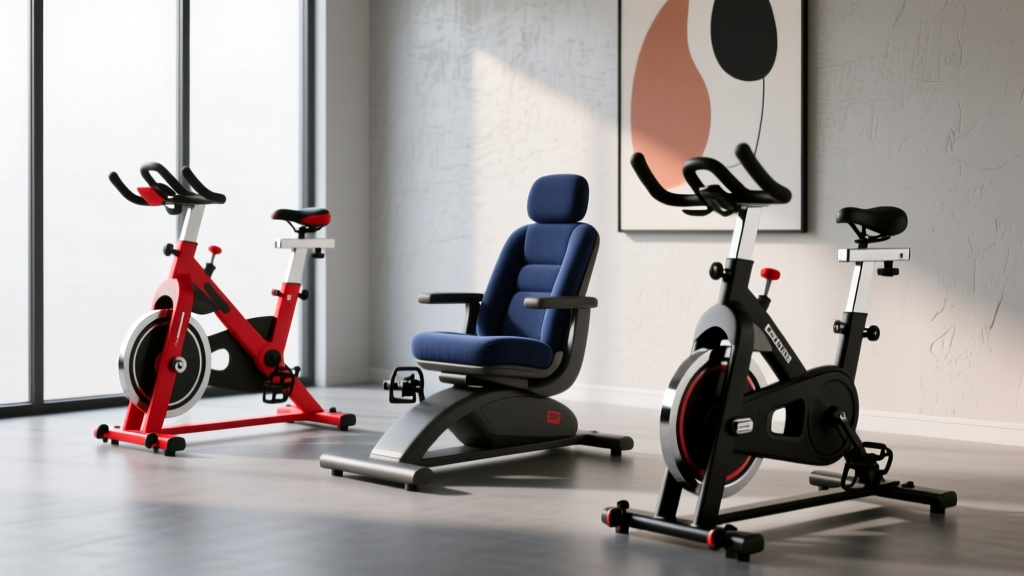
Spin bikes are engineered to mimic the geometry and biomechanics of outdoor road cycling. They feature a heavy flywheel (often 30-45 lbs), a forward-leaning aggressive posture, and a narrow Q-factor (the distance between the pedals).
Why It Improves Treadmill Times
Spin bikes are the undisputed champions of High-Intensity Interval Training (HIIT) and VO2 max development. The ability to rapidly transition from seated climbs to out-of-the-saddle sprints builds explosive power in the glutes and hamstrings. This translates directly to a more powerful push-off phase on the treadmill, improving your sprint finishes and uphill treadmill times.
2026 Budget & Value Analysis
- Entry-Level ($500 - $800): The Schwinn IC4 ($799) remains a massive value winner. It features a 40-lb perimeter-weighted flywheel, dual-sided pedals (SPD and toe cages), and native Bluetooth connectivity to Zwift and Peloton. It requires zero monthly subscription fees to operate, making its long-term ROI exceptional.
- Premium Tier ($1,500 - $2,500): The Keiser M3i ($2,295) uses a lightweight rear flywheel with eddy-current magnetic resistance. While the upfront cost is high, its virtually silent operation and zero-maintenance belt drive mean you will never spend a dime on brake pad replacements or belt tensioning.
- The Ecosystem Trap: The Peloton Bike+ ($2,495) offers an incredible screen and auto-follow resistance, but the mandatory $44/month All-Access membership adds $528 to your annual operating cost. Over three years, the true cost of ownership exceeds $4,000.
Upright Bikes: The Endurance & Posture Builder
Upright bikes feature a more relaxed, vertical seating position with a wider, plush saddle and higher handlebars. The pedals are positioned slightly in front of the rider, and the flywheels are generally enclosed and lighter than those on spin bikes.
Why It Improves Treadmill Times
Upright bikes are your Zone 2 training workhorses. According to OrthoInfo by the American Academy of Orthopaedic Surgeons, indoor cycling is highly effective for building aerobic capacity while sparing the joints. Spending 60 to 90 minutes on an upright bike at a conversational pace builds mitochondrial density and capillary networks. This enhanced aerobic base allows you to clear lactate more efficiently, delaying the 'burn' and helping you sustain faster treadmill times over long distances.
2026 Budget & Value Analysis
- Entry-Level ($400 - $700): Budget upright bikes often use friction resistance (felt pads) which degrades over time. Avoid these if you want long-term value. Instead, look for entry-level magnetic resistance models like the ProForm Studio Bike ($999), which often goes on sale for around $799.
- Premium Tier ($1,200 - $1,800): The Sole B94 ($1,499) is a commercial-grade upright bike built like a tank. It features a heavy 48-lb flywheel for incredibly smooth inertia and a 10-year frame warranty. For runners logging heavy mileage who need a reliable recovery tool, the B94's durability justifies its premium price tag.
Recumbent Bikes: Active Recovery & Injury Prevention
Recumbent bikes place the rider in a reclined position with a full backrest and pedals extending out in front. This completely removes the load from the lumbar spine, wrists, and neck.
Why It Improves Treadmill Times
You cannot set personal records if you are sidelined by plantar fasciitis or IT band syndrome. Recumbent bikes are the ultimate active recovery tools. The open hip angle reduces hip flexor strain—a common culprit in runner's knee—while the seated position promotes blood flow to flush metabolic waste (lactic acid) from the legs. By accelerating recovery between hard treadmill sessions, recumbent bikes ensure your workout consistency remains unbroken.
2026 Budget & Value Analysis
- Entry-Level ($500 - $800): The Schwinn 270 ($699) is the gold standard for budget recumbents. It offers 25 levels of magnetic resistance and a ventilated lumbar-supporting seat. Its low step-through design is perfect for fatigued legs post-long-run.
- Premium Tier ($1,500 - $3,000): High-end models like the Horizon Comfort R ($1,199) or commercial NuStep recumbent steppers offer advanced biomechanical tracking. However, for pure running cross-training, spending over $1,500 on a recumbent bike yields diminishing returns compared to investing that capital into a high-quality treadmill or spin bike.
2026 Budget Breakdown & Value Matrix
| Bike Type | Sweet Spot Price | Best Treadmill Goal | Annual Maintenance Cost | Overall Value Rating |
|---|---|---|---|---|
| Spin Bike | $799 - $1,200 | Speed, VO2 Max, 5K PRs | $0 - $150 (Cleats/Pedals) | ★★★★★ (Highest ROI) |
| Upright Bike | $999 - $1,499 | Endurance, Half-Marathon Base | $50 (Lubrication/Belts) | ★★★★☆ |
| Recumbent Bike | $699 - $1,199 | Injury Prevention, Active Recovery | $0 - $50 | ★★★☆☆ (Niche Use) |
Hidden Costs & Mechanical Failure Modes to Watch
When budgeting for a stationary bike to supplement your running, the sticker price is only half the equation. As a domain expert, I advise buyers to look out for these specific edge cases and hidden costs in 2026:
- Magnetic Resistance Calibration Drift: Cheaper magnetic resistance bikes (under $400) use manual cable tension to move the magnet closer to the flywheel. Over 6-12 months, these cables stretch, causing 'Level 10' on the console to feel like 'Level 4'. Always opt for electronic servo-motor magnetic resistance found in bikes priced $700 and above.
- Pedal Threading & Q-Factor Mismatches: Runners often have highly specific gait mechanics. Spin bikes with an ultra-narrow Q-factor (under 150mm) can cause knee valgus (inward collapsing) if you are used to the wider deck of a treadmill. Budget for aftermarket pedals or shims ($40-$80) to align your knees properly.
- Software Obsolescence: Bikes with built-in proprietary touchscreens (like older NordicTrack or ProForm models) often suffer from software bloat and hardware lag within three years. Mayo Clinic fitness guidelines emphasize consistency; if your bike's screen freezes, you skip the workout. Value-focused buyers should choose bikes with device holders and BYOD (Bring Your Own Device) tablet mounts instead of integrated screens.
"The smartest runners don't just buy equipment; they buy specific physiological adaptations. A $799 spin bike that allows you to execute 4x4-minute VO2 max intervals twice a week will do more for your 10K treadmill times than a $3,000 smart-bike that you only use for casual pedaling while watching TV."
Final Verdict: Which Bike Yields the Best Value for Runners?
If your primary goal is to aggressively lower your treadmill times and maximize your home gym budget, the Spin Bike (Indoor Cycle) in the $700–$900 range is the undisputed winner. Models like the Schwinn IC4 provide the mechanical resistance necessary for high-wattage interval training, directly translating to improved running economy and speed.
However, if you are a high-volume marathoner prone to lower back pain or joint inflammation, reallocating your budget toward a premium Recumbent Bike is a strategic investment in longevity. Ultimately, the best value is found not in the most expensive machine, but in the one that perfectly targets your specific physiological weak points, keeping you healthy, consistent, and consistently setting new personal records on the treadmill.
More gear to consider
All reviews
Rowing Machine Buying Guide & TR150 Treadmill Setup

Home Stair Climber Fixes & The Wooden Treadmill Without Electricity

The Treadmill Guide to TweeklyNutrition Machine Care
Elliptical vs Treadmill: ProForm ProShox 2 Treadmill & 2026 Market Trends
Intermix Acoustics 2.0 Treadmill Noise Comparison
