Treadmill Motor Size Guide: Why Lubricating Treadmill Belt Matters
Learn how treadmill motor size (CHP vs HP) impacts performance and why lubricating treadmill belt surfaces prevents costly motor burnout and strain.

Replacing a burnt-out treadmill motor is one of the most expensive repairs in home fitness equipment, often costing between $400 and $800 for parts and labor in 2026. Yet, the vast majority of premature motor failures are not caused by manufacturing defects or electrical surges. They are caused by excessive friction. Understanding the relationship between your machine's horsepower and the critical task of lubricating treadmill belt surfaces is the key to protecting your investment.
This comprehensive treadmill motor size and horsepower guide doubles as a troubleshooting manual. We will decode motor specifications, explain how friction destroys undersized motors, and provide an actionable, step-by-step framework for diagnosing and resolving motor strain before it results in catastrophic failure.
⚠️ Maintenance Warning: According to the Consumer Reports Treadmill Buying Guide, failing to perform routine deck maintenance is the number one reason manufacturers deny warranty claims on fried lower control boards and seized drive motors.Decoding Treadmill Motor Size: HP vs. CHP
Before troubleshooting motor strain, you must understand what your motor is actually rated to handle. In the modern fitness equipment market, marketing jargon often obscures true mechanical capability. The American Council on Exercise (ACE) consistently advises consumers to look past peak horsepower and focus on continuous duty ratings.
Peak HP vs. Continuous Duty Horsepower (CHP)
- Peak HP: The maximum power the motor can generate for a fraction of a second under zero load. This is a marketing metric and largely irrelevant for real-world troubleshooting.
- Continuous Duty HP (CHP): The power the motor can sustain indefinitely during a heavy workout without overheating. This is the only number that matters when sizing a motor and calculating thermal limits.
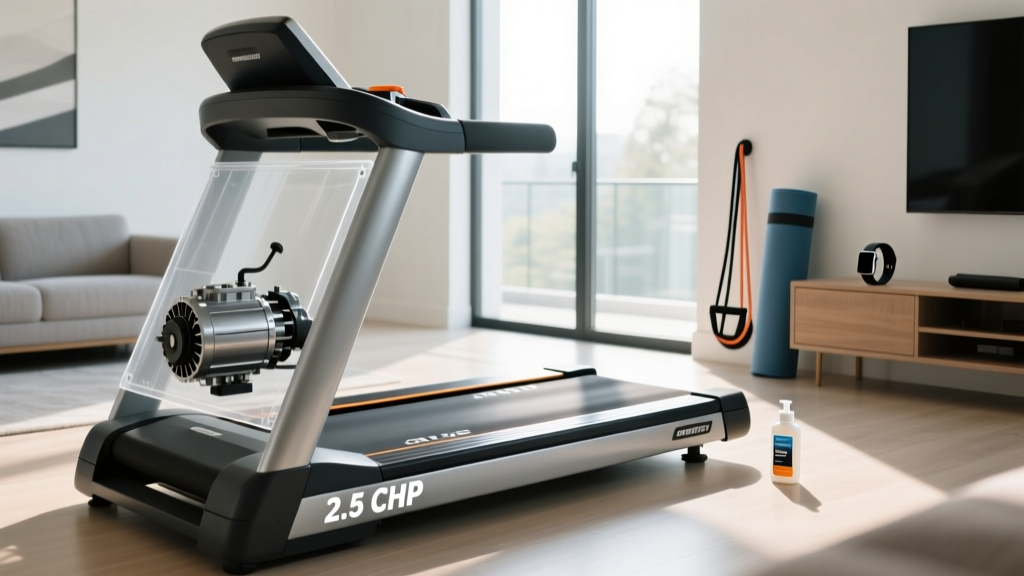
Modern 2026 treadmill models predominantly use Brushless DC (BLDC) motors, which run cooler and quieter than older brushed alternatives. However, even a high-efficiency BLDC motor will fail if the physical resistance of the deck exceeds its CHP rating.
| Primary Activity | User Weight (Under 200 lbs) | User Weight (200 - 250 lbs) | User Weight (Over 250 lbs) |
|---|---|---|---|
| Walking / Light Jogging | 2.0 CHP | 2.5 CHP | 3.0 CHP |
| Frequent Running | 2.75 CHP | 3.25 CHP | 3.75 CHP |
| Sprinting / Incline HIIT | 3.5 CHP | 4.0 CHP | 4.25+ CHP |
The Friction Factor: How Dry Belts Destroy Motors
When you step onto a treadmill, your body weight presses the belt into the wooden deck. If the deck lacks proper lubrication, the coefficient of friction skyrockets. The motor must draw more electrical current (amperage) to overcome this physical resistance and maintain your target speed.
If a 3.0 CHP motor is rated for a maximum continuous draw of 12 amps, a severely dry belt can force the motor to pull 16 to 18 amps. This excessive amp draw generates intense heat inside the motor windings, eventually melting the insulation, tripping the thermal breaker, or sending a voltage spike back to the lower control board, frying the MOSFETs.
Diagnostic Amp Draw Testing
Before assuming your motor is dead, you must test the amp draw. You will need a digital clamp multimeter.
- Remove the front motor hood.
- Clamp the multimeter around the red wire connecting the lower control board to the drive motor.
- Turn the treadmill on and walk at 3.0 MPH without holding the handrails.
- Record the amperage, then increase the speed to 6.0 MPH and record again.
| Belt Condition | Walking (3 MPH) | Running (6 MPH) | Action Required |
|---|---|---|---|
| Optimal | 2.0 - 4.0 Amps | 5.0 - 8.0 Amps | None. System is healthy. |
| Moderate Friction | 4.5 - 7.0 Amps | 9.0 - 12.0 Amps | Lubricate immediately. |
| Critical / Deck Damage | 8.0+ Amps | 14.0+ Amps | Inspect deck for grooves; replace belt/deck. |
Step-by-Step: Lubricating Treadmill Belt Assemblies
If your amp draw test indicates moderate friction, lubricating treadmill belt mechanisms is your immediate next step. Doing this correctly requires the right materials and technique.
"The single most common mistake homeowners make is using aerosol WD-40 or petroleum-based silicone sprays. Petroleum breaks down the PVC and rubber compounds in the belt, causing it to stretch, delaminate, and ultimately snap. Always use 100% pure liquid silicone."
The 10-Minute Lubrication Protocol
- Step 1: Loosen the Belt. Use an Allen wrench to turn the rear roller tension bolts counter-clockwise (usually 3 to 4 full turns) until you can easily lift the center of the belt 2 to 3 inches off the deck.
- Step 2: Apply the Silicone. Squeeze exactly 1 ounce (approx. 30 ml) of 100% liquid silicone lubricant in a zig-zag pattern directly onto the wooden deck beneath the belt. Focus on the center third of the deck, where 80% of foot traffic occurs.
- Step 3: Re-tension. Tighten the rear bolts clockwise by the exact same number of turns you loosened them to maintain tracking alignment.
- Step 4: Distribute. Turn the treadmill on to 3.0 MPH and let it run empty for 5 minutes. The rotation will evenly distribute the silicone across the entire deck surface.
- Step 5: Re-test Amp Draw. Use your clamp meter again. You should see a drop of 2 to 5 amps, confirming the motor is no longer straining.
Common Troubleshooting Mistakes to Avoid
Even experienced DIYers make critical errors when addressing treadmill motor strain. Avoid these pitfalls to save your machine:
❌ Mistake 1: Over-tightening the belt to stop slipping.If a belt slips, it is usually due to a loose front drive roller, not the rear tension bolts. Over-tightening the rear bolts crushes the deck bearings and artificially spikes motor amp draw, mimicking the symptoms of a dry belt. ❌ Mistake 2: Lubricating a grooved deck.
If you run your hand under the belt and feel deep physical grooves worn into the phenolic coating of the wooden deck, lubricating treadmill belt surfaces will not fix the issue. The friction is caused by physical abrasion, not a lack of fluid. The deck must be flipped (if reversible) or replaced. ❌ Mistake 3: Ignoring the drive belt.
Treadmills have two belts. The walking belt is what you run on; the drive belt connects the motor to the front roller. If the drive belt is frayed or loose, the motor will rev high without moving the deck, causing you to mistakenly think the walking belt is the issue.
Cost Analysis: Maintenance vs. Motor Replacement
Understanding the financial impact of neglecting motor maintenance highlights why a $15 bottle of silicone is the best insurance policy for your cardio equipment.
| Service / Part | Estimated Cost (2026) | Frequency |
|---|---|---|
| 100% Silicone Lubricant (1 oz) | $12 - $18 | Every 130 miles / 3 months |
| Replacement Walking Belt | $150 - $250 | Every 5 - 8 years |
| Replacement Deck Board | $180 - $300 | As needed (if grooved) |
| Replacement Drive Motor + Labor | $450 - $850 | Premature failure due to friction |
Frequently Asked Questions
Can I use a silicone spray aerosol instead of liquid?
No. Aerosol sprays contain propellants and solvents that can degrade the rubber backing of the walking belt. Furthermore, aerosols tend to coat the sides of the belt and the rollers, which can cause severe tracking issues and belt slipping. Always use a squeeze bottle of 100% liquid silicone applied directly to the deck.
How do I know if my treadmill has a self-lubricating deck?
Some premium 2026 models feature infused decks or wax-impregnated belts that claim to be "maintenance-free." However, independent teardowns show that even these systems eventually dry out after 3 to 5 years of heavy use. Check your specific owner's manual; if the manufacturer explicitly forbids aftermarket silicone, rely on their warranty, but monitor your amp draw annually.
Does a heavier user require more frequent lubrication?
Yes. A 275 lb runner generates significantly more downward force and heat than a 150 lb walker. The increased pressure forces the silicone out toward the edges of the deck faster. Heavy users should inspect and lubricate their decks every 100 miles or roughly every 6 to 8 weeks, rather than the standard 130-mile interval.
Final Verdict
Your treadmill's motor size and CHP rating dictate its theoretical limits, but physical maintenance dictates its actual lifespan. Sizing your motor correctly for your body weight and running style is only the first step. By routinely monitoring amp draw and properly lubricating treadmill belt decks with pure liquid silicone, you eliminate the friction that causes 90% of all premature motor and control board failures. Protect your investment, respect the physics of friction, and your machine will deliver years of reliable performance.
More gear to consider
All reviews
Sole F80 Treadmill Belt Maintenance: Expert Lubrication Guide

Compact Incline Treadmill Walking: Maintenance & Longevity Guide
Walking Pad Review: Belt Care & NordicTrack Treadmill Belt Lubricant
Treadmill Motor Guide: How Many Minutes on Treadmill to Lose Weight

Elliptical vs Treadmill Maintenance & Treadmill Brands to Avoid