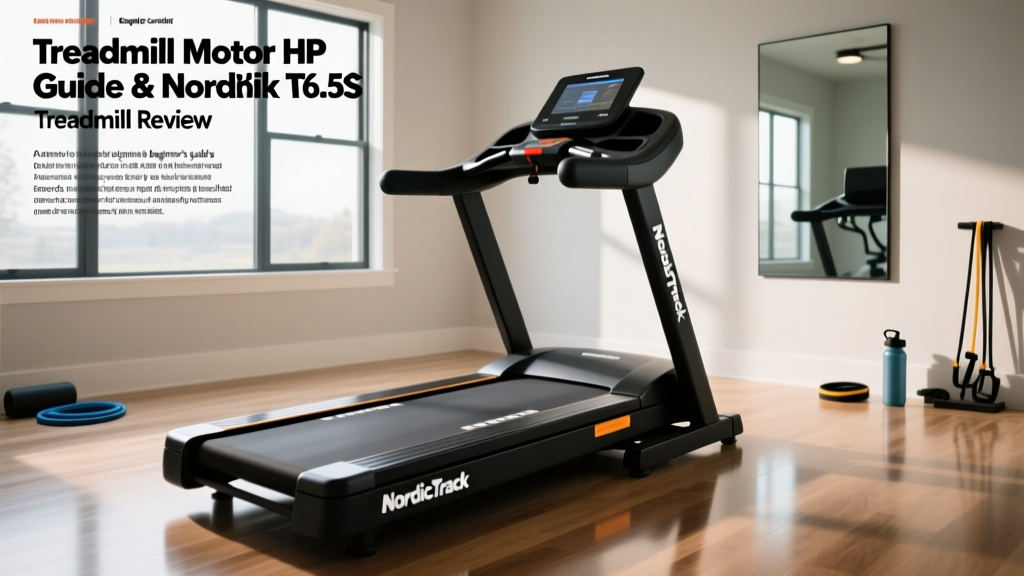
Treadmill Motor HP Guide & NordicTrack T6.5S Treadmill Review
Master treadmill motor sizing with our beginner guide. Includes a real-world NordicTrack T6.5S treadmill review to illustrate budget CHP performance.

Stepping into the world of home cardio equipment can feel like learning a new language. When you are shopping for your first walking or running machine, you are immediately bombarded with acronyms, technical jargon, and conflicting advice. Among the most critical—and most frequently misunderstood—specifications is the motor size. Choosing the wrong motor doesn't just mean a sluggish workout; it can lead to premature mechanical failure, voided warranties, and a frustrating waste of your hard-earned money.
In this beginner-friendly, step-by-step guide, we will demystify treadmill motor sizing, continuous horsepower (CHP), and torque. To ground these concepts in reality, we will use a classic entry-level machine as our baseline case study: the NordicTrack T6.5S treadmill. By the end of this guide, you will know exactly how to match a motor to your biomechanics and whether a budget-friendly 2.6 CHP motor is right for your home gym in 2026.
Step 1: Decoding the Horsepower Illusion
The biggest trap for beginners is looking at the "Peak Horsepower" number slapped on the side of a treadmill console. Marketing departments love peak HP because it looks impressive on paper. However, peak horsepower only measures the maximum output the motor can achieve for a fraction of a second before it likely overheats or trips a breaker.
Pro Tip: Always Look for CHPWhen evaluating any cardio machine, ignore Peak HP and look exclusively for Continuous Horsepower (CHP) or Continuous Duty Horsepower. CHP measures the power the motor can sustain continuously throughout an entire 60-minute workout without overheating. According to equipment testing standards highlighted by Consumer Reports, a treadmill's CHP rating is the only reliable metric for predicting long-term durability and performance under load.
DC vs. AC Motors: What is the Difference?
Residential treadmills almost exclusively use Direct Current (DC) motors. DC motors are quieter, smaller, and provide a smoother start-up phase than Alternating Current (AC) motors. AC motors are typically reserved for commercial gym equipment (like the Life Fitness Integrity Series) because they can run 24/7 without rest, but they are incredibly loud and heavy for home use. When reading a NordicTrack T6.5S treadmill review or evaluating any home model, you can safely assume it houses a DC motor.
Step 2: Matching Motor Size to Your Biomechanics
How much continuous horsepower do you actually need? The answer depends on two primary variables: your body weight and your top workout speed. Every time your foot strikes the deck, you create a momentary spike in resistance. A heavier user or a faster runner generates exponentially more resistance, forcing the motor to draw more amps to maintain belt speed.
| Primary Activity | User Weight (Under 200 lbs) | User Weight (200 - 250 lbs) | User Weight (Over 250 lbs) |
|---|---|---|---|
| Walking (Under 4 mph) | 2.0 CHP Minimum | 2.25 CHP Minimum | 2.5 CHP Minimum |
| Jogging (4 - 6 mph) | 2.5 CHP Minimum | 2.75 CHP Minimum | 3.0 CHP Minimum |
| Running (Over 6 mph) | 3.0 CHP Minimum | 3.25 CHP Minimum | 3.5 to 4.0 CHP |
If you consistently push a motor beyond its continuous rating, the internal windings will overheat. The treadmill's logic board will detect the excessive amp draw and trigger a thermal shutdown to prevent a fire, leaving you stranded on the belt mid-stride.
Step 3: Real-World Case Study & NordicTrack T6.5S Treadmill Review
To see how these rules apply in the real world, let us examine a staple of the budget fitness market. The NordicTrack T6.5S has long been a popular entry-level choice, often hovering around the $499 to $599 price point depending on seasonal sales and refurbished availability in 2026. It serves as the perfect specimen for understanding the limits and capabilities of a budget motor.
The 2.6 CHP Motor: Capabilities and Limits
The NordicTrack T6.5S is equipped with a 2.6 Continuous Horsepower (CHP) motor. Based on our chart above, this motor is perfectly sized for:
- Walkers of almost any weight (up to the machine's 300 lb capacity).
- Light joggers who weigh under 200 lbs.
However, if a 240 lb user attempts to do high-intensity interval training (HIIT) with sprinting at 10 mph on this machine, the 2.6 CHP motor will struggle. You will likely notice "belt hesitation"—a momentary stutter where the belt slows down upon foot strike because the motor cannot spin the flywheel fast enough to compensate for the sudden load.
Supporting Specs: Belt Size and Incline
A motor does not work in isolation; it must move the belt. The T6.5S features a 20-inch by 55-inch tread belt. This is a crucial detail for beginners: a smaller belt requires less torque to turn than a massive 22x60 commercial belt. NordicTrack pairs the 2.6 CHP motor with this compact belt size intentionally, allowing the motor to perform adequately without being overtaxed by excessive friction. The machine also offers a 0 to 10% motorized incline. Be aware that running at a 10% incline increases the amp draw on a 2.6 CHP motor significantly. If you plan to do steep hill climbs, you must keep your speed under 4 mph to prevent thermal overload.
Warning: The 300 lb Weight Capacity RealityWhile the T6.5S advertises a 300 lb user weight capacity, operating any 2.6 CHP treadmill at maximum capacity will drastically shorten the motor's lifespan. For users consistently near the 280-300 lb mark, upgrading to a 3.0+ CHP model (like the Horizon 7.4 or NordicTrack T Series 10) is highly recommended to avoid burning out the motor control board within the first year.
Step 4: Spotting Motor Strain and Failure Modes
As a beginner, you need to know how to listen to your machine. Treadmills will give you audible and physical warnings before the motor completely fails. According to cardiovascular equipment maintenance guidelines, maintaining a steady target heart rate during exercise is vital, but you should also be monitoring the "health" of your equipment. The American Heart Association emphasizes consistent, uninterrupted aerobic sessions; a stuttering treadmill ruins that consistency and poses a fall risk.
Watch out for these three red flags:
- The "Whining" Sound: A high-pitched whine that grows louder as you increase speed usually indicates that the motor bearings are drying out or the drive belt is misaligned, forcing the motor to work harder.
- Thermal Shut-offs: If your treadmill abruptly stops after 30 to 40 minutes of use and the console displays an error code (or simply resets), the motor has overheated. This is a clear sign the CHP rating is too low for your specific weight and speed combination.
- Footfall Hesitation: As mentioned earlier, if the belt stutters exactly when your foot strikes the deck, the motor is maxing out its torque output. This is a major safety hazard.
Step 5: Step-by-Step Motor Preservation Maintenance
You can extend the life of a budget 2.6 CHP motor like the one in the NordicTrack T6.5S by reducing the friction it has to overcome. Friction is the enemy of DC motors. Here is your step-by-step maintenance routine:
1. The 100% Silicone Lubrication Rule
Never use WD-40, petroleum jelly, or household oils on a treadmill belt. These substances will degrade the cotton underside of the belt and ruin the deck. Purchase a 100% silicone liquid treadmill lubricant.
- Frequency: Every 150 miles or every 3 months.
- Application: Loosen the rear roller bolts by exactly two turns on each side. Lift the belt, apply a zig-zag pattern of about 1 oz of silicone directly onto the wooden deck, and re-tighten the bolts.
2. Belt Tension and Alignment Check
If the belt is too tight, it creates immense drag on the motor shaft. You should be able to lift the edge of the belt about 2 to 3 inches off the deck in the center. If it is tighter than that, loosen the rear roller adjustment bolts. Additionally, ensure the belt is centered; a belt rubbing against the side plastic rails creates friction that drains horsepower and causes the motor to overheat.
3. Keep the Motor Hood Clean
Dust and pet hair are insulators. When they build up inside the motor hood, they trap heat. Every six months, unplug the machine, remove the plastic front hood cover (usually held by 4 to 6 Phillips-head screws), and use a vacuum with a brush attachment to gently clean the motor fins and the logic board.
Frequently Asked Questions (FAQ)
Is a 2.6 CHP motor good for running?
A 2.6 CHP motor is adequate for light jogging (under 6 mph) for users weighing less than 200 lbs. For sustained running, sprinting, or for heavier users, a 2.6 CHP motor will experience excessive wear and tear. Runners should look for a minimum of 3.0 CHP to ensure the motor operates efficiently without overheating.
How long does a budget treadmill motor last?
With proper maintenance (regular silicone lubrication and belt alignment) and usage within its weight and speed limits, a quality 2.6 CHP DC motor like the one in the NordicTrack T6.5S can last between 5 to 7 years. Neglecting deck lubrication can cause the motor to burn out in as little as 12 to 18 months due to excessive amp draw.
Can I upgrade the motor on my treadmill later?
Technically, yes, but it is rarely cost-effective. Upgrading a motor requires matching the voltage, physical mounting brackets, and the flywheel teeth count, and often requires replacing the lower control board to handle the new amp draw. It is almost always more economical to sell the budget frame and invest in a higher-CHP model from the start.
Final Verdict: Is the NordicTrack T6.5S Right for You?
Understanding treadmill motors is about matching the machine's engineering to your physical reality. The NordicTrack T6.5S remains a highly capable, budget-friendly walking and light-jogging machine, provided you respect the limits of its 2.6 CHP motor. If you are a casual walker, a senior focusing on daily step goals, or a lighter user looking for an affordable way to maintain cardiovascular health at home, the T6.5S is a smart, space-saving investment. However, if you are training for a 10K, weigh over 220 lbs, or plan to do steep incline intervals, use this guide as your stepping stone to explore 3.0+ CHP models that can handle the rigorous demands of your fitness journey.
More gear to consider
All reviews
How Much Does a NordicTrack Treadmill Weigh vs Rowing Machines?

Motor Setup for Good Interval Training on Treadmill: Install Guide
Quiet Incline Treadmill for Beginners: Noise Guide 2026
Compact Folding Treadmill Review: NordicTrack Treadmill Manuals Online

Cardio Machine Noise Comparison & Treadmill Belt Tension Adjustment
