Treadmill Motor HP Guide: NordicTrack Series 8 Treadmill & Beyond
Discover how treadmill motor size impacts performance. We analyze the NordicTrack Series 8 treadmill HP and compare continuous duty ratings for 2026 buyers.

The Heart of the Machine: Decoding Treadmill Horsepower
When investing in home cardio equipment, the motor is the single most critical component dictating longevity, performance, and noise levels. Yet, the fitness industry is rife with misleading marketing jargon. As of 2026, manufacturers still frequently highlight 'Peak Horsepower' to inflate perceived value, leaving buyers confused when their budget machines overheat during a simple 5K run. According to Consumer Reports, understanding the distinction between peak output and continuous duty is the first line of defense against purchasing a treadmill that will fail within its first year.
This in-depth guide breaks down the physics of treadmill motors, explores the real-world implications of continuous horsepower (CHP), and uses the highly popular NordicTrack Series 8 treadmill as a baseline case study to help you determine exactly how much motor power you actually need.
The Horsepower Illusion: Peak HP vs. Continuous Duty (CHP)
Before evaluating any specific model, you must understand the two metrics used to measure treadmill motors:
- Peak Horsepower (HP): This is the absolute maximum power the motor can draw for a fraction of a second before the internal thermal cutoff trips. It is a largely useless metric for everyday use and is primarily used in marketing materials for entry-level machines.
- Continuous Horsepower (CHP): This measures the power the motor can sustain indefinitely during a standard workout without overheating. This is the only number that matters.
A treadmill advertised with a '4.0 Peak HP' motor might only possess a 2.0 CHP motor. If a 220-pound user attempts to run at 7.0 mph on a 2.0 CHP motor, the machine will strain, the belt will stutter, and the Pulse Width Modulation (PWM) controller will eventually fail due to excessive heat buildup.
Case Study: Analyzing the NordicTrack Series 8 Treadmill Motor
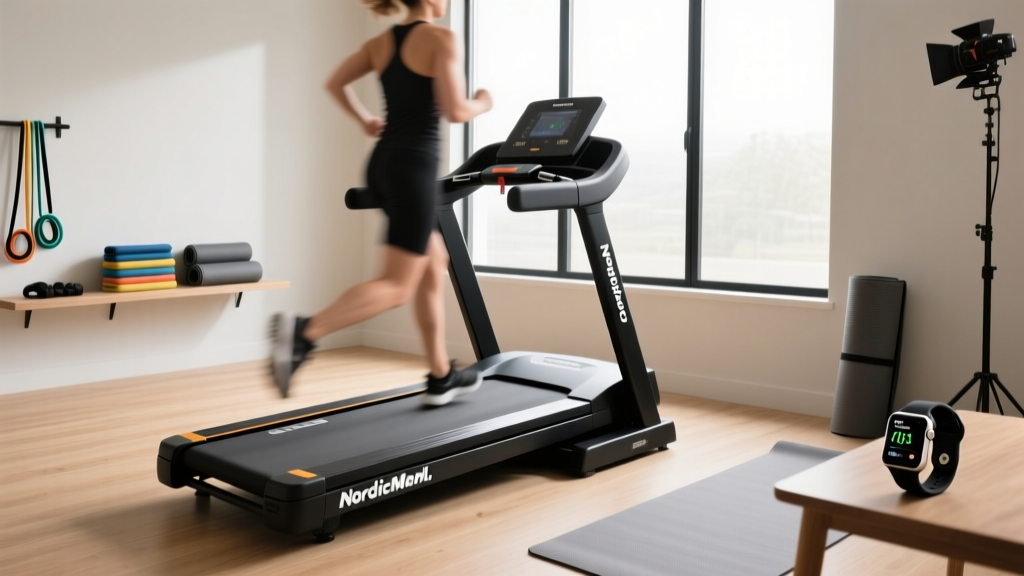
To understand how motor sizing applies to real-world home gyms, let us examine the NordicTrack Series 8 treadmill. Positioned as an entry-to-mid-range compact option, it is a staple in apartments and smaller home gyms. As of early 2026, the Series 8 typically retails between $499 and $599 and is equipped with a 2.6 CHP motor.
NordicTrack Series 8 Treadmill: Quick Specs
- Motor: 2.6 Continuous Horsepower (CHP)
- Belt Dimensions: 18' x 55'
- Max Speed: 10 MPH
- Weight Capacity: 300 lbs
- Primary Use Case: Walking, power walking, and light jogging
Is 2.6 CHP Enough?
The 2.6 CHP motor in the NordicTrack Series 8 treadmill is perfectly calibrated for its physical footprint. Because it features a narrower 18-inch belt and a shorter 55-inch deck, the overall friction and rotational mass are lower than those of commercial-grade machines. For a user weighing under 180 pounds, the 2.6 CHP motor will handle walking at 3.5 mph and jogging at 5.5 mph with minimal thermal strain.
However, the edge case arises with heavier users or those attempting high-intensity interval training (HIIT). If a 250-pound user attempts to sprint at 9.0 mph, the 2.6 CHP motor will draw maximum amperage from the PWM controller to maintain belt speed against the increased downward force. Over time, this specific failure mode degrades the motor's internal windings and the drive belt.
Motor Size vs. User Weight: The Hidden Strain Factor
Motor requirements are not static; they scale dynamically with user weight and belt friction. The American Heart Association recommends at least 150 minutes of moderate-intensity aerobic activity per week. To sustain this on a treadmill without mechanical stuttering, your motor must have a sufficient CHP buffer.
Below is a practical decision framework for matching your body weight to the minimum required Continuous Horsepower.
| User Weight | Minimum CHP (Walking) | Minimum CHP (Running) | Recommended Machine Tier |
|---|---|---|---|
| Under 150 lbs | 2.0 CHP | 2.5 CHP | Compact / Entry-Level (e.g., NordicTrack Series 8) |
| 150 - 200 lbs | 2.5 CHP | 3.0 CHP | Mid-Range Home (e.g., Horizon 7.4) |
| 200 - 250 lbs | 3.0 CHP | 3.5 CHP | Premium Home (e.g., Sole F80) |
| 250+ lbs | 3.5 CHP | 4.0+ CHP | Light Commercial / High-End |
The Friction Factor: Why Motors Burn Out
A treadmill motor does not operate in a vacuum. Its primary adversary is deck friction. When the belt is not properly lubricated with 100% silicone treadmill oil, the coefficient of friction between the belt and the wooden/MDF deck increases exponentially.
Expert Insight: A dry belt can increase the amperage draw on a 2.6 CHP motor by up to 40%. This is the number one reason entry-level treadmill motors fail within the first 18 months. Always perform the 'slip test' under the belt every 90 days.
If you are using the NordicTrack Series 8 treadmill in a dry climate or a room with low humidity, the deck will absorb moisture from the belt lubricant faster, requiring more frequent maintenance to protect the 2.6 CHP motor from thermal overload.
2026 Comparison Matrix: Entry-Level vs. Premium Motors
To contextualize the NordicTrack Series 8, we must compare its motor architecture against the broader market. Below is a structural comparison of popular home treadmills, highlighting how motor size correlates with belt dimensions, price, and warranty coverage.
| Model | Motor (CHP) | Belt Size | Est. Price (2026) | Motor Warranty |
|---|---|---|---|---|
| NordicTrack Series 8 | 2.6 CHP | 18' x 55' | $549 | 1 Year |
| Horizon Fitness 7.4 | 2.75 CHP | 20' x 55' | $799 | Lifetime |
| Sole Fitness F80 | 3.5 CHP | 22' x 60' | $999 | Lifetime |
| NordicTrack Commercial 1750 | 3.5 CHP | 22' x 60' | $1,599 | Lifetime |
Decoding the Matrix
Notice the relationship between the motor and the belt size. The NordicTrack Series 8 treadmill pairs a 2.6 CHP motor with a compact 18x55 belt. This is a mathematically sound pairing. However, if a manufacturer pairs a 2.5 CHP motor with a massive 22x60 belt, the motor will struggle to turn the heavier rollers and wider belt surface, leading to premature failure. Always evaluate the motor in proportion to the deck size.
Thermal Overload and Failure Modes
Modern DC treadmill motors, like the one found in the NordicTrack Series 8, are equipped with internal thermal cutoff switches. When the internal temperature exceeds roughly 212°F (100°C), the switch trips, and the treadmill abruptly stops to prevent a fire hazard.
Common Edge Cases that Trigger Thermal Cutoffs:
- Unlevel Floors: If the treadmill is placed on an uneven surface, the belt tracks to one side, rubbing against the side rail and creating immense drag.
- Carpet Placement: Placing a treadmill directly on thick carpet restricts airflow to the motor compartment. Always use a high-density EVA foam equipment mat to ensure proper ventilation and dust prevention.
- Static Buildup: In winter months, low humidity causes static shocks that can arc across the PWM controller board, permanently damaging the motor's control logic.
Final Verdict: Sizing Your Treadmill Motor
Choosing the right motor size is an exercise in matching your biomechanics to machine engineering. The NordicTrack Series 8 treadmill remains a highly capable, space-efficient choice for walkers and light joggers under 180 pounds, thanks to its appropriately sized 2.6 CHP motor and compact deck. It delivers excellent value for its price point without overpromising on commercial-grade metrics.
However, if your household includes multiple users over 200 pounds, or if you plan to run at speeds exceeding 8.0 mph for durations longer than 30 minutes, you must step up to a 3.0 to 3.5 CHP motor paired with a minimum 20x55 belt. By prioritizing Continuous Horsepower over Peak HP marketing gimmicks, and maintaining strict belt lubrication schedules, you can ensure your cardio equipment survives well beyond its warranty period.
Frequently Asked Questions (FAQ)
Can I upgrade the motor on my NordicTrack Series 8 treadmill later?
No. Treadmill motors are matched to specific PWM controller boards, belt roller diameters, and chassis mounts. Attempting to install a larger 3.5 CHP motor into a compact frame designed for a 2.6 CHP motor will result in voltage mismatches and physical mounting failures.
Does a higher CHP motor consume more electricity?
Not necessarily. A 3.5 CHP motor running at 40% capacity to move a 200-pound runner will actually draw less electricity and run cooler than a 2.0 CHP motor running at 95% capacity to perform the exact same task. Oversizing your motor slightly can improve long-term energy efficiency and component lifespan.
How often should I lubricate the belt to protect the motor?
For standard home use, apply 100% silicone treadmill lubricant every 130 miles or every three months, whichever comes first. If you notice the belt hesitating when you plant your foot, or if the motor housing feels excessively hot to the touch after a 20-minute walk, immediate lubrication is required.
More gear to consider
All reviews
Best Folding Treadmills for a Treadmill and Dumbbell Workout in 2026

Assault Runner Pro Treadmill vs Walking Pads: Review & Mistakes

Best Ergonomic Treadmill for Under-Desk Office Layouts (2026)

NordicTrack Commercial 2450 Treadmill: Setup & Feature Comparison

ProForm Crosswalk 405e Treadmill & Compact Cardio Picks