When Was the Treadmill Invented? Treadmill vs. Rower History & Guide
Discover when was the treadmill invented, compare its history to the rowing machine, and explore our deep-dive 2026 rowing machine buying guide.

The Historical Head-to-Head: Origins of Cardio Giants
When researching home gym equipment, a common trivia question arises: when was the treadmill invented? While many assume the treadmill is a modern 20th-century fitness staple, its origins are surprisingly grim. The first iteration of the 'tread-wheel' was invented in 1818 by English engineer Sir William Cubitt as a penal device to crush grain and pump water, utilizing prisoner labor. It wasn't until 1952 that Dr. Robert Bruce invented the modern motorized medical treadmill for cardiac stress testing, paving the way for the commercial fitness boom of the 1980s. For a deeper look into this fascinating evolution, PBS Newshour provides an excellent historical breakdown of the machine's dark past.
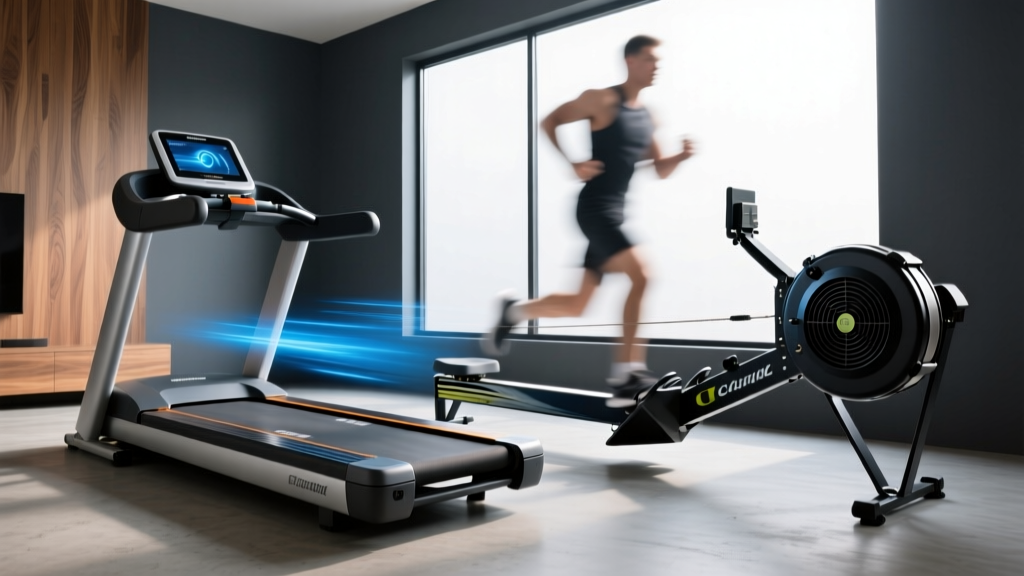
In stark contrast, the rowing machine was born purely from athletic competition and physical conditioning. The first patent for an indoor rowing machine was issued to W.B. Curtis in 1872, designed to help oarsmen train during harsh winters. Today, the head-to-head battle between the modern treadmill and the indoor rower (ergometer) remains one of the most hotly debated topics in cardiovascular training. Which machine deserves the prime real estate in your home gym?
'The treadmill simulates natural human locomotion, but the rowing machine demands a synchronized, full-body kinetic chain that no other cardio equipment can replicate.' — Biomechanics Research Institute
Biomechanics & Caloric Burn: Treadmill vs. Rowing Machine
To make an informed buying decision, we must look past marketing and examine the physiological demands of both machines. According to the British Heart Foundation, indoor rowing is one of the most efficient cardiovascular workouts available, engaging approximately 86% of the body's musculature per stroke. Treadmills primarily target the lower body and core, engaging roughly 70% of the musculature depending on incline settings.
| Feature | Motorized Treadmill (e.g., NordicTrack 1750) | Indoor Rower (e.g., Concept2 RowErg) |
|---|---|---|
| Joint Impact | High (2-3x body weight on knees/ankles) | Zero-Impact (Seated, smooth glide) |
| Muscle Engagement | Lower-body dominant (Calves, Quads, Glutes) | Full-body (Legs, Core, Back, Arms) |
| Avg Caloric Burn (155lb user, 30 mins) | ~280 - 350 kcal (depending on incline/speed) | ~250 - 320 kcal (depending on drag/wattage) |
| Space Footprint | ~70 x 30 inches (Heavy, difficult to move) | ~96 x 24 inches (Separates in half for storage) |
| 2026 Avg Price Range | $1,500 - $3,500 | $600 - $1,500 |
The Ultimate 2026 Rowing Machine Buying Guide
If the zero-impact, full-body benefits of the rower have won you over, navigating the 2026 market requires understanding the three primary resistance types: Air, Magnetic, and Water. Below is our head-to-head comparison of the top contenders this year.
1. The Gold Standard: Concept2 RowErg (Air Resistance)
Price: $995 | Monitor: PM5 with Bluetooth | Drag Factor: Adjustable 1-10 damper
The Concept2 RowErg remains the undisputed king of competitive and home rowing. Its air resistance provides an infinitely variable workload—the harder you pull, the more resistance it generates. The PM5 monitor is universally recognized for its accuracy, making it the only machine where global leaderboard times are considered valid. Edge Case Warning: The chain requires occasional oiling (every 40 hours of use), and the internal bungee return cord typically needs a $15 replacement every 3 to 4 years.
2. The Premium Immersive Experience: Hydrow Apollo (Electromagnetic)
Price: $1,495 | Monitor: 22-inch Touchscreen | Drag Factor: Software-controlled
Hydrow utilizes a patented electromagnetic drag mechanism that mimics the feel of water without the maintenance of a water tank. It is heavily integrated with live and on-demand coaching. Failure Mode: Unlike the mechanical simplicity of the Concept2, the Hydrow requires a constant Wi-Fi connection and power outlet. If your internet drops or the proprietary screen fails out of warranty, the machine's functionality is severely limited.
3. The Budget Air Alternative: Titan Fitness Air Rower
Price: $599 | Monitor: Basic LCD | Drag Factor: Air-only (No damper)
For home gyms on a strict budget, Titan offers a robust chain-and-belt hybrid drive system. It lacks the refined data tracking of a PM5 and the handle return mechanism is slightly harsher at high stroke rates, but the structural frame is virtually indestructible and rated for 500 lbs.
Mastering the Rowing Technique: The 4-Phase Stroke
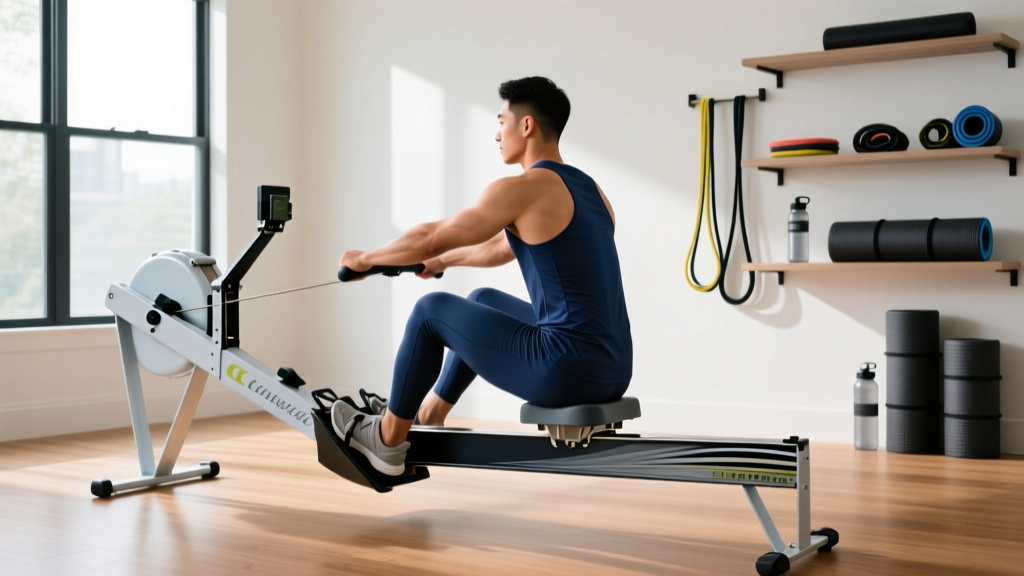
Buying the machine is only 10% of the battle; rowing with improper form is a fast track to lumbar strain. The Concept2 Technique Guide emphasizes that the rowing stroke is a continuous loop divided into four distinct phases. Power distribution should be roughly 60% legs, 30% core swing, and 10% arms.
- The Catch: Shins are vertical (or as close as ankle mobility allows), torso is hinged forward at 11 o'clock, and arms are fully extended. Shoulders should be relaxed, not shrugged.
- The Drive: Initiate the movement by pushing explosively with the legs. The arms remain completely straight until the handle passes the knees. Once the legs are nearly fully extended, hinge the torso back to 1 o'clock, then finally pull the handle to the lower sternum.
- The Finish: Legs are fully extended, torso is slightly leaned back, and the handle rests lightly against the lower ribs. Elbows are drawn past the torso.
- The Recovery: The exact reverse of the drive. Extend the arms first, hinge the torso forward past the knees, and finally bend the knees to slide back to the catch. The recovery should take twice as long as the drive (a 1:2 ratio).
Target Stroke Rates (spm) for 2026 Training Protocols
- Steady State (UT2): 18-22 spm (Focus on power per stroke and aerobic base building)
- Threshold (UT1): 24-28 spm (Lactate threshold work, balancing power and speed)
- Sprint/Intervals: 30-36+ spm (Maximum cardiovascular output, lower drag factor recommended)
Common Maintenance Edge Cases & Troubleshooting
Cardio machines are investments, and neglecting maintenance leads to costly repairs. Here are the most common failure modes we see in home gyms:
- Chain Slap & Stretching: On air rowers, a dry chain will stretch and 'slap' against the housing. Apply 3-in-One oil or purified mineral oil to a paper towel and pull the chain through it every 50 hours.
- Water Tank Algae (Water Rowers Only): If you opt for a water rower (like the WaterRower Natural), you must drop a chlorine tablet into the tank every 6 months. Failure to do so will result in algae buildup that degrades the polycarbonate tank and ruins the impeller bearings.
- Monitor Battery Drain: If using D-cell batteries for your PM5 monitor, remove them if you plan to leave the machine unused for more than a month to prevent acid leakage from destroying the motherboard.
Final Verdict: Which Cardio Giant Wins?
If your primary goal is marathon training, bone-density improvement through weight-bearing impact, or walking-pad convenience, the treadmill remains unmatched. However, if you are seeking maximum caloric efficiency, zero-impact joint preservation, and a machine that builds functional posterior-chain strength, the rowing machine is the superior choice. For most home gym owners in 2026, the Concept2 RowErg offers the best intersection of durability, resale value, and biomechanical excellence, proving that sometimes the oldest fitness inventions are still the best.
More gear to consider
All reviews
Manual vs Motorized: Troubleshooting the NordicTrack X32i Treadmill

Under Desk Treadmill Value: Treadmill Walking Workouts for Weight Loss

What to Look for When Buying a Treadmill for Under-Desk Office Use

ProForm XP Trainer 580 Treadmill Motor Guide: Horsepower Explained

How Many Steps is 2 Miles on a Treadmill? Motor HP Guide