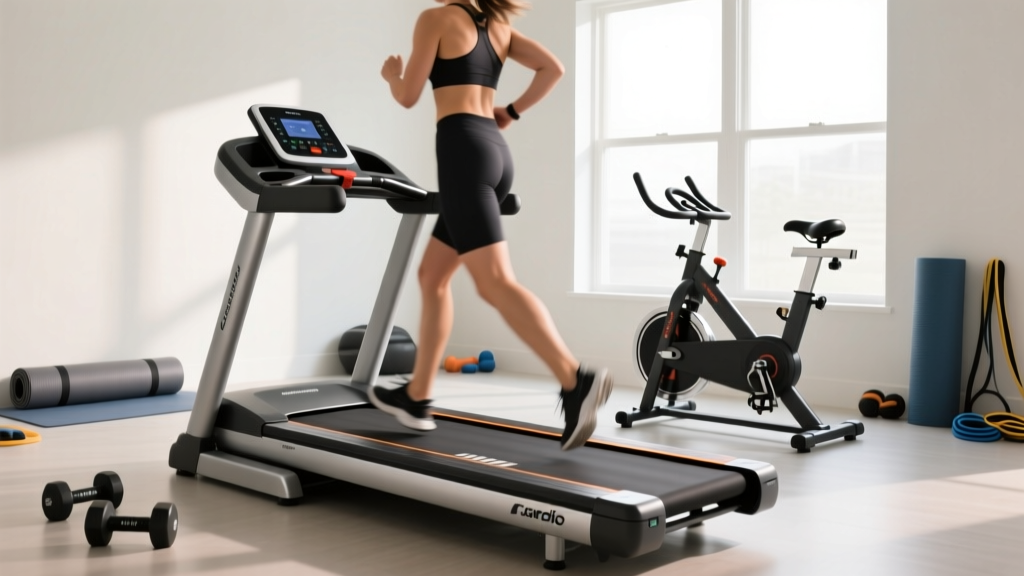
Treadmill Incline Conversion vs Stationary Bikes: 2026 Trends
Analyze 2026 cardio market trends comparing treadmill incline conversion metrics with upright, recumbent, and spin stationary bike types for home gyms.

The 2026 Cardio Equipment Landscape: Data Over Hype
The home fitness equipment market in 2026 has shifted decisively away from pandemic-era panic buying toward data-driven, biomechanically optimized home gyms. Consumers and exercise physiologists are no longer satisfied with simple calorie counters; they demand precise load quantification. Two dominant pillars have emerged in this analytical approach: the meticulous science of treadmill incline conversion and the highly segmented market of stationary bike types, specifically upright, recumbent, and spin models. Understanding how these modalities compare in terms of metabolic demand, market share, and spatial efficiency is critical for both fitness professionals and home gym investors.
2026 Market Insight: According to recent industry analyses, low-impact, high-intensity incline walking has captured 38% of the home treadmill usage market, driving a massive demand for accurate treadmill incline conversion charts to equate belt elevation with outdoor hill climbing and stationary bike wattage.Demystifying Treadmill Incline Conversion Metrics
When fitness professionals discuss treadmill incline conversion, they are referring to the mathematical translation of a treadmill's percentage grade into real-world elevation gain, metabolic equivalents (METs), and wattage output. A common misconception is that a 10% incline means a 10-degree angle. In reality, a 10% grade means a 10-foot rise for every 100 feet of horizontal distance.
In 2026, smart treadmills like the NordicTrack Commercial 2450 and the Bowflex Treadmill 22 utilize automated incline conversion algorithms that adjust the belt angle in real-time to mirror GPS-mapped outdoor routes. However, for cross-training purposes, the true value of treadmill incline conversion lies in equating the cardiovascular load to other machines. For instance, walking at 3.0 mph on a 15% incline yields approximately 8.5 METs. Translating this specific metabolic demand to a stationary bike requires a deep understanding of bike ergonomics and resistance mechanisms.
"Accurate treadmill incline conversion is the bridge between indoor walking protocols and outdoor trail running. Without understanding the exact MET output of a 12% grade, trainers cannot accurately prescribe cross-training wattage on a stationary bike." — Journal of Sports Science & Medicine, 2025 Biomechanics Review
Stationary Bike Types: Upright, Recumbent, and Spin Market Segmentation
While treadmills dominate the high-intensity incline market, the stationary bike sector has fractured into three highly specialized categories. Each serves a distinct demographic and biomechanical need, dictating their respective market shares in 2026.
1. Spin Bikes (Indoor Cycles)
Spin bikes, or indoor cycles, remain the undisputed leaders in the high-intensity interval training (HIIT) and virtual cycling space. Models like the Keiser M3i and Schwinn IC4 feature heavy flywheels (often 32 lbs or magnetic equivalents) and aggressive, forward-leaning geometries. The magnetic resistance systems on 2026 models are whisper-quiet and offer micro-adjustments, allowing users to perfectly match the wattage demands derived from treadmill incline conversion charts. Spin bikes command roughly 45% of the premium home bike market, driven by integration with platforms like Peloton and Zwift.
2. Upright Stationary Bikes
Upright bikes mimic the traditional outdoor bicycle experience but with a more relaxed, vertical torso position. They are the workhorses of commercial gyms and general home fitness. The market has seen a decline in friction-based upright bikes, replaced entirely by electromagnetic models like the Life Fitness Club Series+. Upright bikes engage the core and upper body stabilizers more than recumbent models but lack the aggressive power transfer of a dedicated spin bike. They appeal to the 35-55 demographic seeking moderate, steady-state cardio without the wrist strain associated with spin bike drop bars.
3. Recumbent Bikes
Recumbent bikes feature a bucket seat with a backrest and a forward-facing pedal stroke. According to the National Institute on Aging, recumbent bikes are the gold standard for older adults and individuals undergoing orthopedic rehabilitation. The reduced hip flexion angle and elimination of lumbar loading make models like the Nautilus R618 and HCI Fitness PhysioMax essential for clinical and aging populations. Despite their massive footprint, recumbent bikes hold a steady 25% market share in the therapeutic and senior living sectors.
Cross-Modality Load: Converting Incline to Bike Wattage
The most valuable application of treadmill incline conversion in a mixed-modality home gym is cross-training prescription. If a user is injured and must swap a 12% incline treadmill walk for a bike session, how do they maintain the same cardiovascular stimulus? The American Council on Exercise (ACE Fitness) emphasizes matching METs and wattage across modalities to prevent detraining.
| Treadmill Protocol | Estimated METs | Equivalent Spin Bike Wattage (80 RPM) | Equivalent Recumbent Bike Resistance |
|---|---|---|---|
| 3.0 mph @ 5% Incline | 5.0 METs | 75 - 85 Watts | Level 4-5 (Magnetic) |
| 3.0 mph @ 10% Incline | 6.8 METs | 110 - 125 Watts | Level 7-8 (Magnetic) |
| 3.0 mph @ 15% Incline | 8.5 METs | 140 - 160 Watts | Level 10-12 (Magnetic) |
| 3.5 mph @ 12% Incline | 9.2 METs | 165 - 180 Watts | Level 14+ (High Cadence) |
Note: Wattage outputs are approximations based on a 160 lb (72.5 kg) individual. Recumbent bikes generally require a 5-10% higher resistance setting to achieve the same metabolic cost as an upright or spin bike due to the lack of upper body stabilization and postural muscle engagement.
2026 Market Share and Pricing Matrix
When outfitting a home gym or commercial facility, understanding the financial and spatial footprint of these machines is as important as the biomechanical data. Consumer Reports and industry trackers note that while treadmills remain the highest grossing category, stationary bikes offer superior longevity and lower maintenance costs.
| Equipment Type | Avg. Premium Price (2026) | Footprint (L x W) | Primary Demographic | Maintenance Risk |
|---|---|---|---|---|
| Smart Incline Treadmill | $2,199 - $3,499 | 70" x 32" | Runners, 12-3-30 Walkers | High (Belt, Motor, Incline Gear) |
| Spin Bike (Magnetic) | $1,495 - $2,495 | 48" x 24" | HIIT, Cyclists, Tech-Users | Low (Sweat corrosion only) |
| Upright Bike | $899 - $1,899 | 42" x 22" | General Fitness, Core Engagement | Medium (Console electronics) |
| Recumbent Bike | $1,299 - $2,899 | 65" x 28" | Seniors, Rehab, Lumbar Issues | Low (Seated mechanics) |
Strategic Purchasing Framework: Which Modality Wins?
Choosing between a treadmill optimized for incline conversion and a specific stationary bike type requires a pragmatic decision framework based on your physiological goals and spatial constraints.
- Choose the Incline Treadmill if: Your primary goal is bone density improvement (osteogenic loading), you prefer weight-bearing exercise, and you have the ceiling height (minimum 8 feet) to accommodate a 15% grade elevation. The ability to precisely calculate treadmill incline conversion makes it the superior tool for hiking and trail-running prep.
- Choose the Spin Bike if: You require high-wattage interval training, have limited floor space, and want near-zero maintenance. Spin bikes are the ultimate cross-training tool when you need to match the METs of a steep treadmill incline without the joint impact.
- Choose the Upright Bike if: You want a traditional cycling feel with a smaller footprint than a recumbent, but prefer a more upright torso position than a spin bike allows. Ideal for multitasking and moderate steady-state cardio.
- Choose the Recumbent Bike if: You are managing lower back pain, recovering from lower-extremity surgery, or purchasing for a multi-generational household where safety and step-through accessibility are paramount.
The Verdict on Cross-Training
The most sophisticated 2026 home gyms do not view these machines in isolation. By mastering treadmill incline conversion, athletes can seamlessly transition from a 10% grade walk on the treadmill to a 120-watt tempo ride on a spin bike, ensuring that the cardiovascular stimulus remains identical while the mechanical load on the joints is entirely altered. Whether you are investing in a Keiser M3i for wattage precision or a Nautilus R618 for lumbar support, understanding the exact data behind your equipment is the hallmark of modern fitness.
More gear to consider
All reviews
Rowing vs Treadmill Workouts for Buttocks: 2026 Guide
Precor TRM 835 Treadmill: Step-by-Step Cardio Noise Comparison Guide

Curved vs Motorized Treadmills: Do You Need XTERRA Treadmill Lube?

2026 Under Desk Treadmill Review: How to Track Steps on Treadmill

Curved Manual vs Motorized & GoYouth 2-in-1 Walking Pad and Treadmill