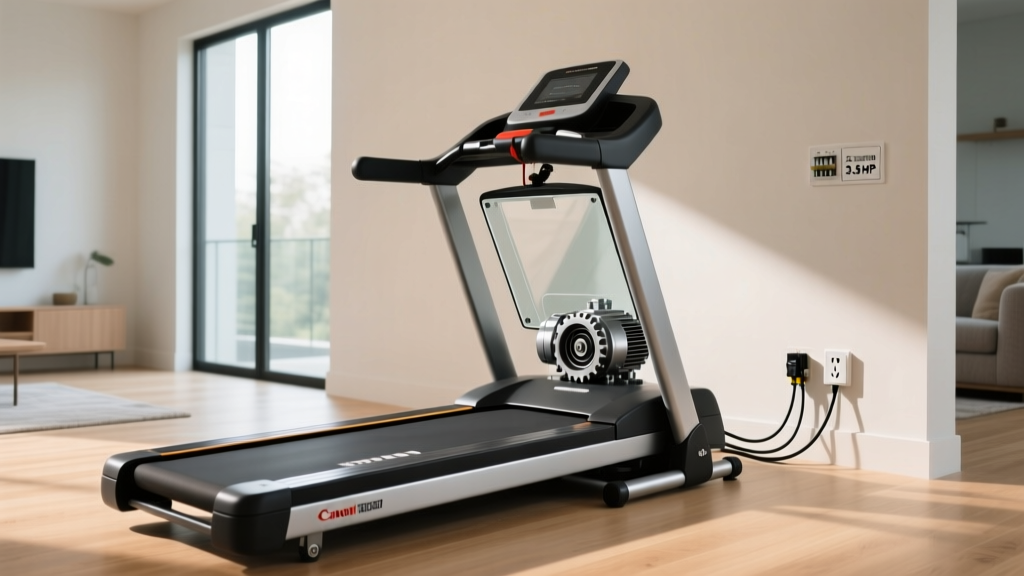
Treadmill Hill Walking Workout Setup: Motor Size & Installation Guide
Master your treadmill hill walking workout setup. This guide covers motor size selection, electrical installation, and calibration for steep inclines.

The Hidden Bottleneck of Incline Training: Motor Thermal Throttling
When fitness enthusiasts plan a rigorous treadmill hill walking workout, they often obsess over the machine's maximum incline percentage, deck cushioning, or interactive programming. However, as a fitness equipment technician, I can tell you that the true point of failure on steep inclines isn't the frame or the belt—it is the drive motor and its Pulse Width Modulation (PWM) controller. Simulating a 15% to 40% grade requires immense continuous torque. If your treadmill's motor is undersized, the PWM controller will overheat, leading to thermal throttling, sudden speed drops, or catastrophic board failure.
This complete setup and installation walkthrough bridges the gap between selecting the right horsepower and physically installing the machine to handle the extreme electrical and mechanical loads of incline training. According to Consumer Reports' treadmill buying guidelines, understanding Continuous Horsepower (CHP) is the single most critical factor in ensuring longevity for home gym equipment.
Quick Terminology: Peak HP vs. CHP
Peak Horsepower (HP): The maximum output the motor can hit for a few seconds before overheating. Often used in cheap marketing.
Continuous Horsepower (CHP): The power the motor can sustain indefinitely under load. This is the only metric that matters for a sustained treadmill hill walking workout.
Motor Size Matrix: Matching CHP to Your Incline Goals
Not all hill walking routines are created equal. A gentle 5% grade for recovery walking requires vastly different mechanical support than a 20%+ 'mountain climbing' simulation. Below is the technical matrix I use when prescribing treadmill setups for home clients in 2026.
| Motor Size (CHP) | Max User Weight | Ideal Incline Range | Best Use Case |
|---|---|---|---|
| 2.5 CHP | Up to 180 lbs | 0% - 10% | Light walking, flat jogging, budget setups. |
| 3.0 CHP | Up to 250 lbs | 0% - 15% | Standard hill walking, moderate interval training. |
| 3.5 - 4.0 CHP | Up to 350 lbs | 0% - 20% | Steep incline walking, heavy users, daily use. |
| 4.0+ CHP (Commercial) | Up to 400 lbs | 0% - 40% | Extreme 'mountain' simulations (e.g., NordicTrack X32i). |
Phase 1: Pre-Installation & Electrical Requirements
The most common installation failure for high-incline treadmills isn't mechanical; it's electrical. When a 4.0 CHP motor pushes a 200 lb user up a 20% grade, the amperage draw can spike to 15-18 amps. If your treadmill shares a standard 15-amp bedroom circuit with a space heater or air conditioner, the breaker will trip mid-workout.
The Dedicated Circuit Mandate
According to safety guidelines outlined by the Electrical Safety Foundation International (ESFI), high-draw fitness equipment requires specialized wiring. For any treadmill featuring a 3.5 CHP motor or higher, or any machine capable of exceeding a 15% incline, you must install a dedicated 20-amp circuit.
- Wire Gauge: 12-gauge copper wire (not 14-gauge).
- Breaker: 20-Amp single-pole breaker.
- Outlet: NEMA 5-20R receptacle (features a T-shaped neutral slot).
- Surge Protection: Do NOT use cheap power strips. Use a dedicated 15-joule minimum surge suppressor rated for high-amperage appliances, or plug directly into the wall.
Phase 2: Physical Assembly and Belt Tensioning
Once the electrical foundation is secure, physical assembly begins. High-incline walking places immense friction on the walking belt. If the belt is too tight, it will choke the drive motor and fry the PWM board. If it's too loose, it will slip when the deck tilts upward, causing dangerous stuttering.
The 3-Inch Deflection Test
Follow this exact procedure to tension your belt for incline walking:
- Center the Belt: Power the machine on at 1.0 mph. Ensure the belt is tracking perfectly in the center of the deck.
- Power Down: Turn off the machine and unplug it from your 20-amp outlet.
- Measure Deflection: Reach under the center of the walking belt and lift upward. You should be able to lift the belt exactly 2 to 3 inches off the wooden deck.
- Adjust: If it lifts less than 2 inches, use a 3/16-inch hex key to turn both rear roller adjustment bolts counter-clockwise by exactly one-quarter turn. If it lifts more than 3 inches, turn clockwise.
- Lubricate: Apply 100% silicone-based treadmill lubricant under the belt. Avoid any petroleum-based products, which will dissolve the deck wax and cause catastrophic friction.
Technician's Warning: Never adjust the tension bolts while the motor is running. Furthermore, only adjust in quarter-turn increments. Over-tightening the belt is the number one cause of premature motor burnout on incline treadmills.
Phase 3: Incline Calibration & The First Hill Walking Workout
Before attempting a full routine, you must calibrate the incline motor. Over time, or after a fresh assembly, the machine's internal potentiometer may not align with the actual physical angle of the deck.
Entering Engineering Diagnostic Mode
Most major brands (Sole, Horizon, ProForm) allow you to enter calibration mode by holding down the 'Incline Up' and 'Speed Up' buttons simultaneously for 3-5 seconds while inserting the safety key. Once in calibration mode, press 'Incline Up'. The machine will automatically drive the lift motor to its maximum physical height, measure the resistance, and reset the digital baseline. Let it complete the full cycle from 0% to max and back to 0% without interruption.
The 'Shakedown' Hill Walking Workout
To test the thermal limits of your new setup and ensure the belt grips properly under load, perform this 15-minute shakedown test:
- Minute 0-3: 0% Incline, 2.5 mph (Warm-up and belt tracking check).
- Minute 3-6: 10% Incline, 3.0 mph (Monitor for any belt stuttering or motor whining).
- Minute 6-10: Max Incline (15% or 20%), 2.5 mph (This applies maximum torque. Stand near the front handrails. Listen to the motor—it should emit a low, steady hum, not a high-pitched squeal).
- Minute 10-15: 5% Incline, 3.0 mph (Cool down and allow the internal cooling fan to dissipate PWM heat).
Research published via the Mayo Clinic's fitness guidelines highlights that walking on an incline significantly increases caloric expenditure and lower-body muscle activation without the high-impact joint stress of running. However, maintaining proper form—specifically avoiding holding onto the handrails and leaning back—is crucial to actually realizing these biomechanical benefits.
Troubleshooting Edge Cases and Error Codes
Even with perfect installation, high-torque incline walking can trigger specific machine faults. Here is how to diagnose the two most common issues:
1. The 'E1' or 'E2' Error Code (Motor Overcurrent)
The Symptom: The treadmill stops abruptly at a 15%+ incline and displays an E1/E2 code.
The Fix: This indicates the PWM board is detecting too much resistance. First, check your belt tension using the 3-inch deflection test. If the belt is properly tensioned and lubricated, the walking deck may be worn out, creating excessive friction. In 2026, replacing a standard MDF deck with a phenolic-coated commercial deck costs between $150 and $250 and will drop motor amperage draw by up to 30%.
2. Incline Drift (Ghost Adjusting)
The Symptom: The treadmill slowly lowers itself during a steep hill walking workout.
The Fix: The incline lift motor's internal brake or the hydraulic support strut is failing. On models like the Sole F85 or Bowflex Series 8, this usually requires replacing the lift motor assembly ($120-$180 for the part). Do not attempt to shim the lift gear manually, as this will strip the plastic teeth and void your warranty.
Expert Verdict: 2026 Market Recommendations
If you are building a home gym specifically for steep incline training, do not compromise on the drive motor. In the current 2026 market, the Sole F85 (retailing around $2,299) remains a workhorse with its 4.0 CHP motor and 15% max incline, offering incredible thermal stability. For those chasing the extreme 40% incline 'mountain' simulations, the NordicTrack Commercial X32i (approx. $3,599) utilizes a massive 4.25 CHP motor with an upgraded dual-fan cooling system specifically engineered to prevent thermal throttling during extended climbing sessions.
By pairing the correct CHP rating with a dedicated 20-amp electrical circuit and precise belt tensioning, your treadmill will handle years of grueling hill walking workouts without missing a step.
More gear to consider
All reviews
Rowing Setup: Better Than Treadmills Compatible With Apple Watch?
Stair Climber Setup vs Treadmill Hill Workout Guide

Rowing Machine Buying Guide: The C700 Treadmill Alternative
Alpha Treadmill vs Stair Climber Machine for Home Use (2026)

Does a Treadmill Work Glutes? 2026 Incline Models Compared
