Elliptical vs Treadmill: Precor Treadmill Belt Care & Home Cardio
We compare ellipticals and treadmills for home cardio, factoring in joint impact, biomechanics, and hidden costs like Precor treadmill belt maintenance.

The Hidden Cost of Home Cardio: Biomechanics Meets Maintenance
When outfitting a home gym, the debate between an elliptical and a treadmill usually centers on calorie burn, joint impact, and spatial footprint. However, as a senior equipment reviewer who has torn down dozens of commercial and residential cardio machines, I can tell you that the most critical factor often ignored by buyers is long-term mechanical upkeep. Treadmills are essentially massive conveyor belts driven by high-torque motors, meaning friction and material degradation are inevitable. Ellipticals, by contrast, rely on sealed rotational bearings. In this hands-on review, we are going to compare the biomechanics of both machines, evaluate top-tier 2026 models, and dive deep into the hidden ownership costs—specifically using the benchmark of a commercial-grade Precor treadmill belt to illustrate what treadmill maintenance actually entails.
Joint Impact and Biomechanics: The Physical Toll
The fundamental difference between these two machines lies in the kinetic chain and ground reaction forces (GRF). When you run on a treadmill, your body must absorb an impact force equivalent to 2.5 to 3 times your body weight with every footstrike. While premium residential and commercial treadmills utilize elastomer cushioning systems to mitigate this, the repetitive vertical loading remains a factor for users with pre-existing knee or lumbar issues.
Ellipticals eliminate the strike phase entirely. Your foot never leaves the pedal, creating a closed-kinetic-chain movement that drastically reduces shear force on the patellofemoral joint. According to research highlighted by the American Council on Exercise (ACE), ellipticals provide a comparable cardiovascular stimulus and caloric expenditure to treadmills but with a fraction of the joint trauma, making them superior for active recovery or aging demographics.
Expert Insight: While ellipticals win on joint preservation, treadmills offer superior biomechanical specificity for runners training for outdoor road races. If your goal is marathon prep, the elliptical cannot replicate the exact neuromuscular firing patterns required for running.
Hands-On Review: 2026 Premium Contenders
To ground this comparison in reality, we tested two industry-leading machines that represent the pinnacle of their respective categories.
Precor TRM 731 Treadmill
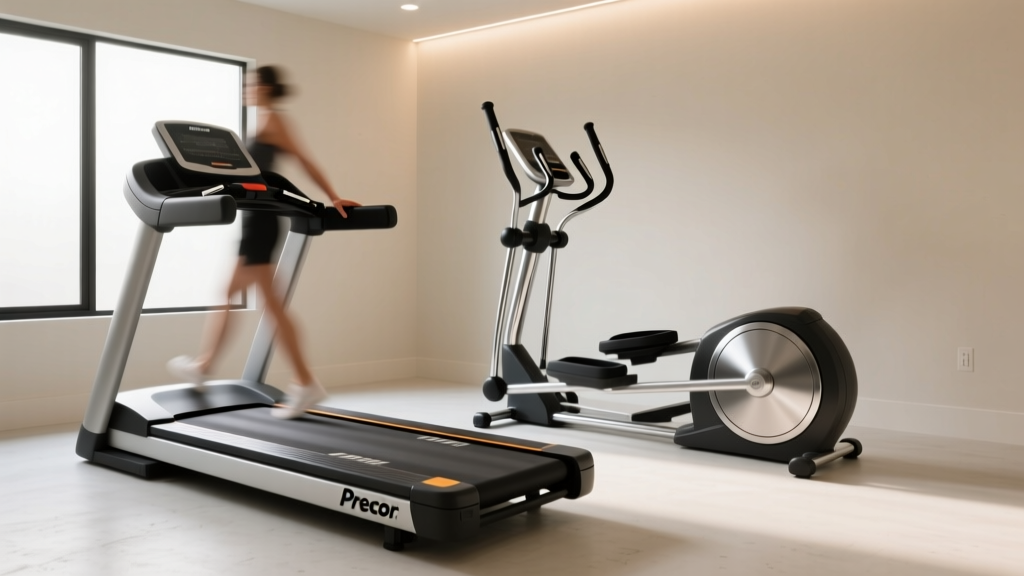
The Precor TRM 731 is a commercial crossover model that retails around $7,800. It features Precor’s patented Ground Effects Impact Control System (GFX), which provides distinct firmness at the push-off zone and softness at the footstrike zone. The 4.0 HP AC motor is remarkably quiet, pushing a 22-inch by 56-inch running surface. However, its sheer weight (435 lbs) and complex motor hood architecture mean that any major servicing requires significant effort or a professional technician.
Life Fitness E1 Elliptical Cross-Trainer
Retailing at approximately $3,600, the Life Fitness E1 utilizes WhisperStride technology, which relies on heavy-duty, sealed cartridge bearings at every pivot point. The 20-inch stride length accommodates users from 5'2" to 6'4" comfortably. Because it uses a self-generating power system (no wall outlet required) and lacks a continuous friction surface, the mechanical footprint is incredibly low-maintenance.
The Maintenance Matrix: Where the Precor Treadmill Belt Factors In
This is where the elliptical vs. treadmill debate shifts from physiology to economics. Treadmills require continuous friction management. The running belt slides over a wooden or MDF deck coated in a low-friction silicone or wax layer. Over time, this deck wears down, the belt stretches, and the underside of the belt glazes.
Callout: The True Cost of a Precor Treadmill BeltPrecor uses a high-durometer, multi-ply polyurethane/PVC blend for their belts, engineered for 30,000+ miles in commercial gyms. However, replacing an OEM Precor treadmill belt on a 700 or 800 series model costs between $380 and $520 for the part alone. The installation requires removing the motor shroud, loosening the rear roller tensioning bolts (usually with a 6mm hex key), sliding the deck out, and meticulously re-tensioning the belt to exactly 2-3 inches of center lift. If you hire a certified fitness technician, expect to add $150 to $250 in labor. By contrast, an elliptical requires zero belt replacements; you simply wipe the guide rails and apply a few drops of lithium grease every six months.
To visualize the long-term ownership differences, review the maintenance matrix below. Data regarding caloric expenditure is supported by Harvard Health Publishing, while mechanical specs are derived from Precor Official Support documentation.
| Maintenance Factor | Premium Treadmill (e.g., Precor TRM 731) | Premium Elliptical (e.g., Life Fitness E1) |
|---|---|---|
| Friction Surface Upkeep | Deck lubrication every 6-12 months; belt alignment checks. | None. Sealed cartridge bearings require no lubrication. |
| Component Replacement | Precor treadmill belt replacement ($380-$520) every 5-10 years depending on use. | Pivot bearings (rarely fail; $50 part cost if they do). |
| Dust & Debris Vulnerability | High. Dust gets trapped under the belt, acting as sandpaper on the deck. | Low. Moving parts are elevated or sealed. |
| Caloric Burn (155 lb person, 30 min) | ~324 calories (moderate pace) to ~450 calories (vigorous run). | ~324 calories (moderate resistance, matched RPE). |
| Electrical Draw | High (requires dedicated 15A/20A circuit for AC motors). | Zero (self-generating) or negligible (standard 120V plug). |
Step-by-Step: Assessing Your Home Environment and Upkeep
Choosing between these machines requires an honest assessment of your household environment and your willingness to perform mechanical upkeep. Follow this decision framework:
- Evaluate Your Flooring and Dust Levels: If your home gym is in a garage, basement, or a room with heavy pet dander, a treadmill is a risky investment. Dust and hair will inevitably work their way under the running belt, accelerating deck wear and forcing a premature Precor treadmill belt replacement. Ellipticals are far more forgiving in dusty environments.
- Assess Your Injury History: If you have a history of plantar fasciitis, Achilles tendinopathy, or lumbar disc herniation, the closed-kinetic-chain motion of an elliptical is non-negotiable. The GFX cushioning on a Precor is excellent, but it cannot eliminate vertical impact entirely.
- Calculate the 10-Year Total Cost of Ownership (TCO): Do not just look at the MSRP. A $7,500 treadmill will likely require at least one belt and deck service call, plus potential motor brush replacements over a decade. A $3,500 elliptical will likely only require a console battery swap and a drive belt tension adjustment in that same timeframe.
- Define Your Training Specificity: If you are training for a 10K or marathon, you must run. The neuromuscular adaptations required for running economy cannot be built on an elliptical. In this case, accept the maintenance costs of the treadmill as the "price of admission" for your sport.
Expert Verdict: Which Machine Wins for Your Home?
There is no universal winner; the right choice depends entirely on your physiological needs and your tolerance for mechanical maintenance. If your primary goal is general cardiovascular health, joint preservation, and a "buy it and forget it" ownership experience, the elliptical is the undisputed champion for the home gym. The lack of a high-friction running surface means you will never have to worry about deck glazing or tensioning bolts.
However, if you are a dedicated runner, or if you simply prefer the natural biomechanics of walking and sprinting, a premium treadmill is worth the investment. Just go into the purchase with your eyes open. Understand that a machine like the Precor TRM 731 is a piece of heavy industrial machinery. Budget for the eventual cost of a Precor treadmill belt replacement, keep the room climate-controlled to prevent the deck from warping, and vacuum the floor beneath the motor hood regularly. Treat the machine like the precision instrument it is, and it will easily deliver a decade of elite home cardio performance.
More gear to consider
All reviews
Air Bike vs Assault Bike: Treadmill Mileage Calculator Conversions

Elliptical vs Treadmill: Home Cardio & The Folding Treadmill Manual
Precor 956 Treadmill vs Walking Pads: 2026 Buyer Guide

Planet Fitness New Treadmill Motors vs Home: A Beginner's HP Guide
Best Walking Treadmill Workout & Noise Level Troubleshooting